Showing posts with label History. Show all posts

Monday, 7 April 2014

Female power in Vikings Season 2


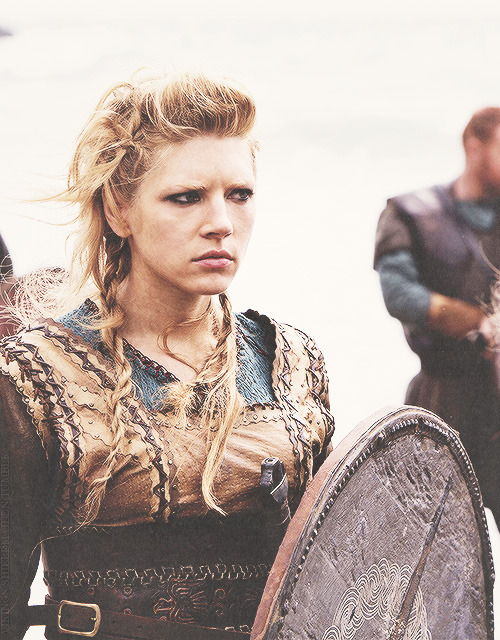
#vikings-shieldmaiden:  #Lagertha's career as a warrior began when Frø, king of Sweden, invaded #Norway and killed the Norwegian king Siward. F...


It is now half way through the second season of Vikings (for those who live in Canada or the US and for those who have few qualms regarding downloading). Obviously there will be spoilers, especially for those of you who are resigned to watching it in RTE 2! Suckers.

As she was in the first season, Lagertha is still my favourite character. This season also has a few more female characters of a bit more importance, most notably Aslaug, and it appears that the girl who Bjorn has his eye on may have a bigger role soon (But I can't help but be reminded of that absolute disaster The Legend of Hercules whenever I see her. Horrid flashbacks!). There are a few noteworthy moments involving the women of Vikings so far in the season:

Firstly, is Lagertha's decision to leave Ragnar, as Aslaug arrives on their doorstep with a bellyful of children. She has the dignity to walk away from Ragnar and start a new life with no drama involved, which is a nice change to the usual catfighting women screaming at one another over a man (even if he is as wonderful as Ragnar). In the actual mythology, Ragnar divorces Lagertha and there is a different woman, Þóra borgarhjörtr, in between her and Aslaug, but to be honest, that would make him look a bit too bad!



Four years later we see Lagertha with a new husband, Earl Sigvard, who is frankly, a bit of a dick. She stands up to his advances and his attempt to rape her and shows him where to shove it. As always, she does as she pleases, and returns to help Ragnar to reclaim Kattegat from Jarl Borg (as also happens in the myth - she comes to his aid with 120 ships, and saves his ass). 

In the last episode so far (episode 6), Lagertha returns to her second husband, despite still being in love with Ragnar (who is unwilling to choose just one wife). After getting his men to brutally beat her during the night, he attempts to publicly shame her by trying to show everyone at the table what lovely breasts she has. Unfortunately for him, she grabs a knife and turns around to stick it in his eye. Hell yeah! He is then beheaded by one of his own men (who I don't trust either...). In the myth, she is also responsible for her second husband's death; "the presumptious and self-indulgent woman would rather rule without her husband than share the glory with him" (Saxo Grammaticus). As you can see, the television series views her somewhat more sympathetically! Of course, this is as far as the mythology surrounding Lagertha appears to go, from what I can find, so its up to the series now! 


Another important scene takes place in Wessex in England (where attempts at speaking Old English are made...I understood cyning . . . so proud!) with Athelstan, the hot monk taken as a slave (and later made a free-man by Ragnar, and later captured by the people of Wessex), in episode 5. When a woman who is beaten because her husband thinks she has been unfaithful to him comes to King Ecgbert for counsel, the King asks him what the craic is with the pagans in such situations - Athelstan says that "if she was a free-woman, they would believe her word, and make judgement on her behalf". Ecgbert replies thinking that "surely her husband has every right over her, surely she belongs to him, to do with as he sees fit." Well, not according to the pagans! The open-minded Ecgbert (Athelstan has heard he is like Ragnar...and unlike the misogynistic Anglo-Saxons it would seem!) follows this pagan law and goes in the woman's favour. 

In general it would seem that the vast majority of main characters are somewhat "feminist" characters...to an extent. The Norse peoples, or as Ecgbert would say, the "pagans" have a more equal society than the Anglo-Saxons, allowing women to partake in raids and battle, and seemingly allowing them equal judgement in the eyes of the law. Of course, this didn't stop the vikings raping all around when they were on their raids, but this may also be seen as a "weapon of war" against the men, as much as it is seen as an act of violence against the women.
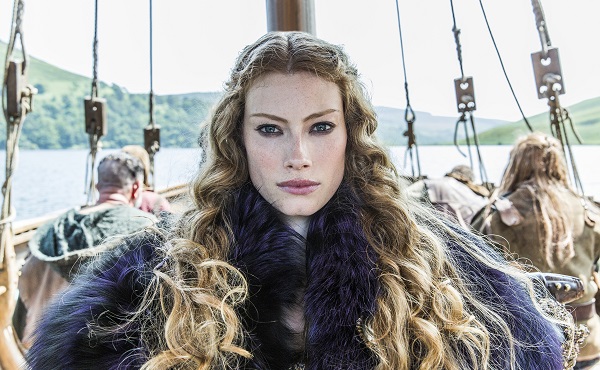


With regards to Aslaug, I am happy that this season is making a bit more of an attempt to flesh out her character, althoug it is not enough. Aslaug's character in mythology is pretty interesting - she is the daughter of Sigurd (who killed the dragon Fafnir) and Brynhildr, the shield-maiden, who I wrote a post on a few months back. As a child she was taken care of by a foster father, Heimer, and hid in a giant harp. Her next foster parents Ake and Grima, who killed Heimer as they thought there were valuables in the harp, found her hiding inside and raised her as their own, covering her in tar to hide her beauty (and therefore her noble birth). It is at this point that she meets Ragnar Lodbrok.
    Interestingly, Ragnar proposes to her, but she refuses him until he accomplished his mission in Norway. It is also, only after giving him three sons, that she reveals her true noble blood to him (after she hears that he has planned to marry Ingeborg), and promises to give birth to a child that bore a snake's eye, Sigurd Snake-In-The-Eye!

In the series, although she is not so much the "Other Woman" as she was at the end of season one, she is still portrayed as a bit of a princess, complaining about dirt and playing the jealous wife when Ragnar speaks to other girls. Hopefully we will get a more rounded character as we go along.


Also, GAME OF THRONES IS BACK, BYE

Tuesday, 31 December 2013

Tis the season to....drink as much as possible before you pass out on the couch


We're all going to heaven, lads, waheeey. Source


Happy Christmas (or should I say Happy Yule?) to all and to all a Happy Christmas. Tis the eve of the New Year, hopefully one that will be filled with a lot more motivation (I got my PhD!), a lot more exercise, a lot more painting, a lot more reading, and a lot less drinking!

Since I have basically spent my Christmas forcing as much drink into myself as possible (and equally telling myself that I am never ever touching drink again, whilst simultaneously pouring myself another glass (sure one won't hurt!)), I think it is a good time to write a post on alcohol and its history in Anglo-Saxon England, and other areas of interest!

So, back in the good old days, there were a few main types of alcoholic beverages drank by the Anglo-Saxons - mead, ale, beer and wine (fortunately for them they never had to experience Tesco Value Vodka) - medu, ealu, beor and win. It is unknown still whether these drinks were pretty much the same as the equivalents of today, and some believe that what the Anglo-Saxons referred to as beor, was in fact cider.

Anglo-Saxon drinking horn

Like us today, the Anglo-Saxons were obviously fond of the few scoops, as evidence from words like gebeorscipe, meaning "drinking party", and the fact that they had what we call "mead-halls". Furthermore, vessels like drinking-horns are mentioned in Beowulf (the Danes drink mead) and fittings for drinking-horns were discovered at Sutton Hoo.

It seems that wine wasn't much of a drink for the masses (or well...it was, but not those masses). Before the ninth-or-so century (this differs with sources), it seems that the climate wasn't suitable for cultivating wine, and so, before this, wine was imported from warmer climates, and so, was only really used for religious purposes and by the few who could afford to pay for it. Even so, after the climate improved, wine was really only left for the upper classes of society, while the rest of the dregs got pissed on ale and beor.

What we mostly seem to think of when we think of alcohol in these times is mead. In Norse Mythology, it's the drink that seems to be what you will be drinking for the rest of your life once you reach Valhalla, and os the source of Odin's strength as he suckled it froma goat as an infant. This however, is actually a foreign drink, the term medu coming from Proto-Indo-European médu, and similar drinks from the same (or earlier) period can be found all over the world, from the Slavic (med or miod), Baltic (midus) Sanskrit (madhu), and appears with different names all over the world, including Africa and Northern China (where the first possible traces of the making of mead are found). So, it's not an exclusively Anglo-Saxon or even Norse or Germanic, or even Western European, drink! 


I enjoy some mead in the coolest pub in Stockholm


That is all for now. Hope you have a great New Year!

Monday, 12 August 2013

Freaky Freydís


It is generally assumed that all Viking raiders and warriors were men (lazy archaeology?), but that's not actually the case - quite a large percentage (up to half in some cases) were actually women, Freydís Eiríksdóttir being one of the more notable (and absolutely mental) ones, as the following picture accurately conveys:


Here is a lovely wax figure of the woman herself in Reykjavik. Smashing stuff.


Daughter of Erik the Red, who was a (most likely) Norwegian fella who founded the first Norse settlement in Greenland (who the hell would want to live there is what I ask), Freydís is generally known to have been involved in the Norse exploration of North America around 1,000AD or so (quite a bit before 1492 I may add) along with her brother Leifr. 

Freydís appears in two sagas; the Saga of Erik the Red, and the Grœnlendinga Saga, both believed to be composed in the 13th century. Events from an expedition to Vinland (in North America) are described in the first of these sagas - during this visit to America, the Vikings traded with what they called the Skrælingjar, the peoples from around North America and Greenland. 


Vinland on the left. This map is reputedly pre-Colombian, although possibly a forge


    As the story goes, trading all went well until the Vikings ran out of everything except cow's milk. The Skrælingjar turned out to be lactose intolerant, of course, and thought they were being poisoned. This, along with a rather uneasy encounter with a bull ("what in god's name is that devil-beast?"), made, as one can imagine, things a bit tense, and the shit hit the fan.
    Freydís, who was heavily pregnant at this time, and therefore less agile than a hippo on stilts, found herself abandoned by her spineless crew, who were starting to set sail. Seeing them flee she shouted after them: "Why run you away from such worthless creatures, stout men that ye are [...] Let me but have a weapon, I think I could fight better than any of you." And so, she proceeded to find the sword of one of her dead companions, and when the Skrælingjar came upon her, she bared her breasts and beat the sword against them, letting out a battle-cry. Needless to say, they fled in terror, and so would you, had you encountered that wax figure above or this orangutan below:


So, she sounds cool, right?! I'm sorry, but your dreams of a new idol are about to be smashed into tiny pieces. Read on.

Obviously thrilled by this exhilarating experience (who doesn't like to act out King Kong?), Freydís decided to make a deal with some poor Icelandic feckers, Helgi and Finnbogi, and returned to Vinland, after agreeing to split the goods half and half with the brothers. Being the snake in the grass that she was, Freydís snuck a few extra men onto her ship (she also convinced the two brothers to let her take the bigger of the ships). Due to differences of opinion, by the time they arrived in Vinland, two camps were set up. Later on, Freydís told her husband that the two lads had assaulted her, and ordered them and their crew killed. The orders were followed, but her men refused to kill the unarmed women - Freydís saw to them herself, chopping off the five of their heads, no bother at all to her. 

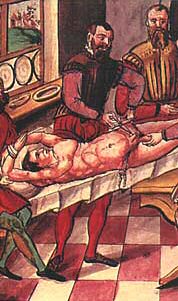
Not wanting to be seen as batshit crazy back home, she ordered silence on the matter for their return to Greenland. Her brother Leifr, obviously being a bit suspicious that the crew has magically shrunk by bloody half, resorted to torturing the truth out of some of the men. Being the just man that he was, he did....absolutely nothing, and Freydís got away with it all. I suffer more repercussions if I forget to hang the godanm washing out!


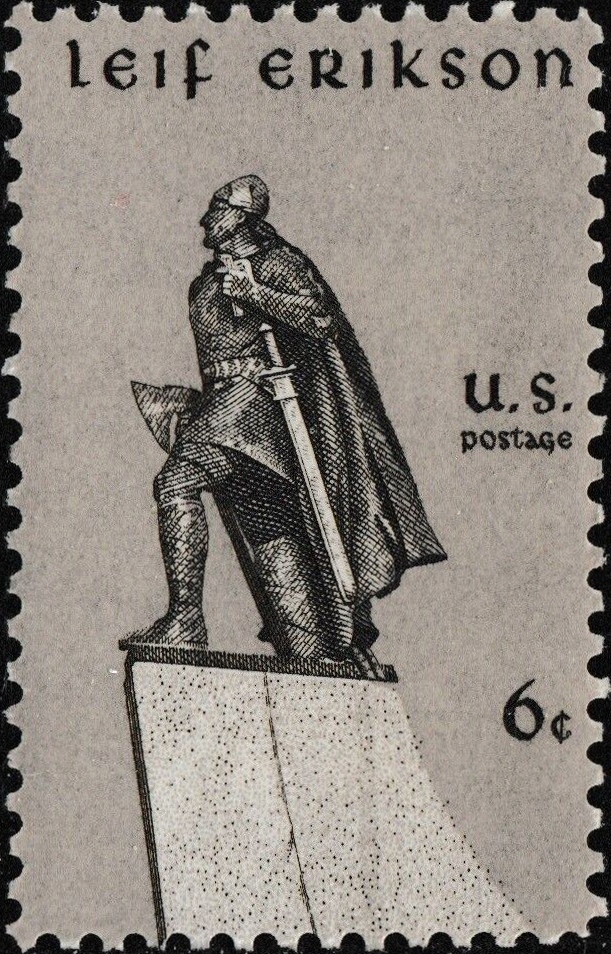
Leif Erikson, an all too forgiving brother


So, unfortunately, Freydis turned out to be a pretty horrible, greedy, merciless, thundering bitch, but either way, she is an interesting figure - a strong willed, courageous woman, but certainly not one to look up to or follow after - unless you fancy being secured in a psychiatric ward of a prison.

Sunday, 28 July 2013

Rape and abduction in Anglo-Saxon England


Source: progressivepatriots.com


I'm sure most people will remember that pretty controversial and outrageous statement that Republican (aren't they always!) Todd Akin said about rape victims being able to avoid pregnancy -
"If it's a legitimate rape, the female body has ways to try to shut that whole thing down". 
Yes, Todd, I'm sure you got an A in Biology. Funnily enough, with the pro-life folk always talking about abortion being something from the Dark Ages, this view that raped women can somehow prevent pregnancy is in fact from the Dark Ages! Maybe that's why many are considered to be White Anglo-Saxon Protestants.

According to Julia Coleman, in her chapter "Rape in Anglo-Saxon England", the earliest definition of rape in the Anglo-Saxon period can be found in the ninth century laws of King Alfred (remember, the guy who let the cakes burn). Here are some facts:
  • The rape of a non-virgin wasn't treated to be as serious as the rape of a virgin
  • Because marital sex was seen as a dutiful act to a spouse, it is likely that non-consnsual sex in a marriage wasn't seen as rape - unfortuantely many people still think this way
  • Abduction, elopement and adultery are also lumped in with rape
And what was the punishment for what was then considered rape? Well, mostly just a fine to the victim or her husband or father, but it could be as serious as castration in the case of a rape by a slave.


From another source, there is the likelihood that compensation was offered to the victims (or their "owners"), "ranging from 5s for seizing her by the breast to 60s for rape [...] The fine for removing a nun from a nunnery is also 120s, divided between the king and the ecclesiastical authorities [...] Compensation for rape is reduced by half if the victim was not a virgin " (Early English Laws). All this is presumably in shillings (20 shillings to a pound). Some other sources give different amounts for compensation. 


A screen shot from Corine Saunders' Rape and Ravishment in the Literature of Medieval England


In post-conquest England, after the Norman invasion, it is notable that there appears to be no mention of the victim's or the rapist's social class - whether you were a slave or a Lord, your genitals were getting the chop!


"Sausies for din-dins!"
    

As Coleman states, it wasn't only the woman's dignity that was affected - it also affected the men in her life's pride, as they feel lessened by the fact that they were unable to protect her. This can also be seen on a larger scale, with reports from Ancient Greece up until present day - rape is a pretty common consequence of warfare. "War rape" is more than just about the physical act, and goes beyond the terrorising of the woman (or man) who is being victimised. As Susan Brownmiller says:

(R)ape by a conqueror is compelling evidence of the conquered's status of masculine impotence. Defense of women has long been a hallmark of masculine pride, as possession of women has been a hallmark of masculine success. Rape by a conquering soldier destroys all remaining illusions of power and property for men of the defeated side.

Anglo-Saxon England, being a realm which was involved in regular conflict with the Danes and later the Normans, is no exception to this, and unfortunately women were often used as a tool to demonstrate the taking of the country to the men.


Sources:
http://www.law-lib.utoronto.ca/Diana/fulltext/tomp.htm
Rape in Anglo-Saxon England
Rape and Ravishment in the Literature of Medieval England
The Semiotics of Rape in Renaissance English Literature

Thursday, 4 July 2013

Womyn and Archery


It would seem that archery has become quite popular in the last few years, resulting in (or because of?) tons of archery related films and tv series, especially with women for some reason - Merrida in Brave, Katniss in The Hunger Games, Arya Stark and Ygritte ("Raight foot, leff foot") from Game of Thrones, Natalie Portman (can't remember the character name) in that shite film that also starred Zooey Deschanel, Mulan in Mulan, Andromeda in Wrath of the Titans,  and probably more. And that's only mentioning the female archers, phew! I'm not quite sure what exactly my point was in listing them all out, but anyway...

Looking back on ancient history, it is tough to find any real proof that women were skilled in archery, except for one group that keeps popping up - the Amazons. The Amazons were a nation of all-female warriors in Greek and Classical antiquity. Amazons were first depicted in art around the 8th century, and in writing around the same time (or later) in Homer's Iliad, in scenes concerning the Trojan War. 


In the 5th Century BC, the poet Pindar describes the Amazons as horse-riding female archers. Strabo (a 1st Century Greek historian and philosopher) speaks of the Amazons having their right breast "cauterized at a tender age" (source) to more easily throw spears, and so that a bow could more easily be drawn (although this is questionable, unless they were left-handed) - Hippocrates also mentions the missing breast trend. 

Also included in Greek Mythology is the female archer Atalanta, and the goddess Artemis (Roman equivalent, Diana) - goddess of the hunt, wilderness, wild animals and virginity. One of her epithets was "of the golden shaft", another, "arrow-pouring" (and another, "mistress of the beasts" is pretty cool too) and the image of a golden (or silver?) bow and arrows is symbolic of her. According to Greek Mythology, Artemis' father, Zeus (you may have heard of him...), asked his daughter what she desired in the whole world, to which she responded that she would have a bow and arrows, a pack of hounds to hunt with, nymphs to accompany her, a tunic short enough for her to run in, mountains and wilderness as her own special places, and eternal chastity (isn't chastity one of the first things that pops into every three year old's mind when asked what they want?). And so, Zeus granted it, and she went beneath the sea to Cyclopes to forge her silver bow and arrows. And once she had collected her nymphs, and got her hounds from Pan (as you do), she couldn't wait to try out her bow, and so hunted by torchlight.


Dianna of Versailles - a first century marble statue of the goddess Diana (Greek: Artemis)


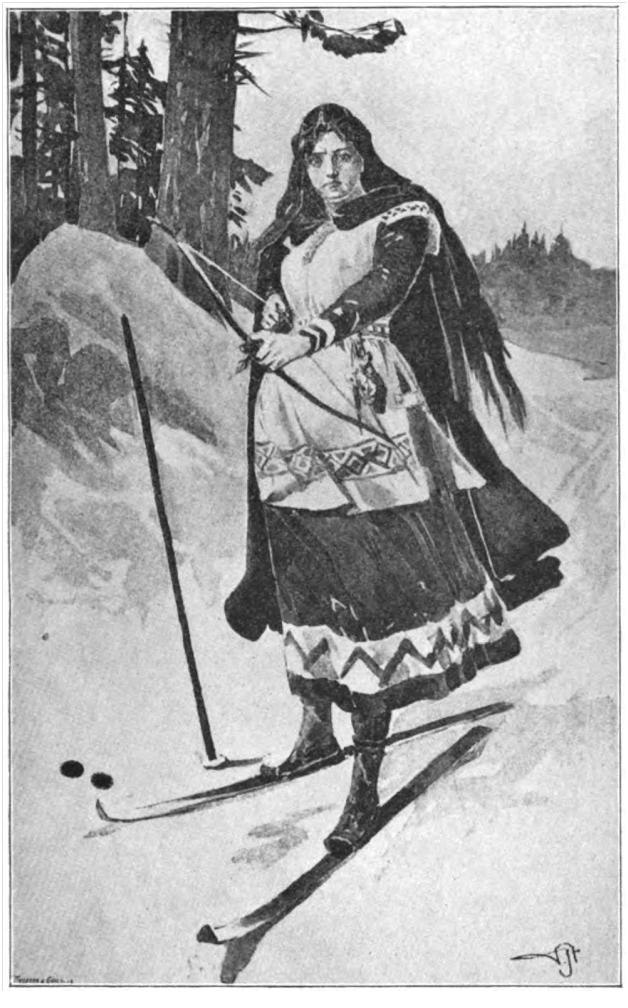
Returning somewhat closer to home, we have Skaði, a Norse goddess associated with winter, mountains, skiing (this brings pretty funny images to mind) and.... bowhunting! In all sources (Poetic Edda, Prose Edda, and more) Skaði, daughter of Þjazi, marries the god Njörðr as compensation provided by the gods for killing her father. In the Prose Edda, the figure of 'High' tells the story of how Skaði and Njörðr go their seperate ways due to him wanting to live by the sea, and her wanting to live in the mountains. High then mentions that Skaði returns to the mountains where she skis, wields a bow, and shoots wild animals, while Njörðr goes on to have two children, Freyr and Freyja.


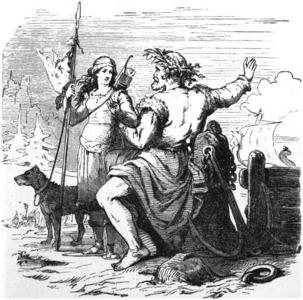
Njörðr and Skaði on the way to Nóatún (1882) by Friedrich Wilhelm Heine

Oh ya know, just skiing and throwin' spears, the usual

As you can see, Skaði can draw a bow with both tits intact


That is all for now. Happy arching!

Wednesday, 3 July 2013

Vikings!


So History Channel's new series Vikings showed in April and started an obsession. Its second season is currently being filmed in Wicklow, near the beautiful Glendalough (and I'm still holding out hope that I'll get cast as an extra), and will be out next year.

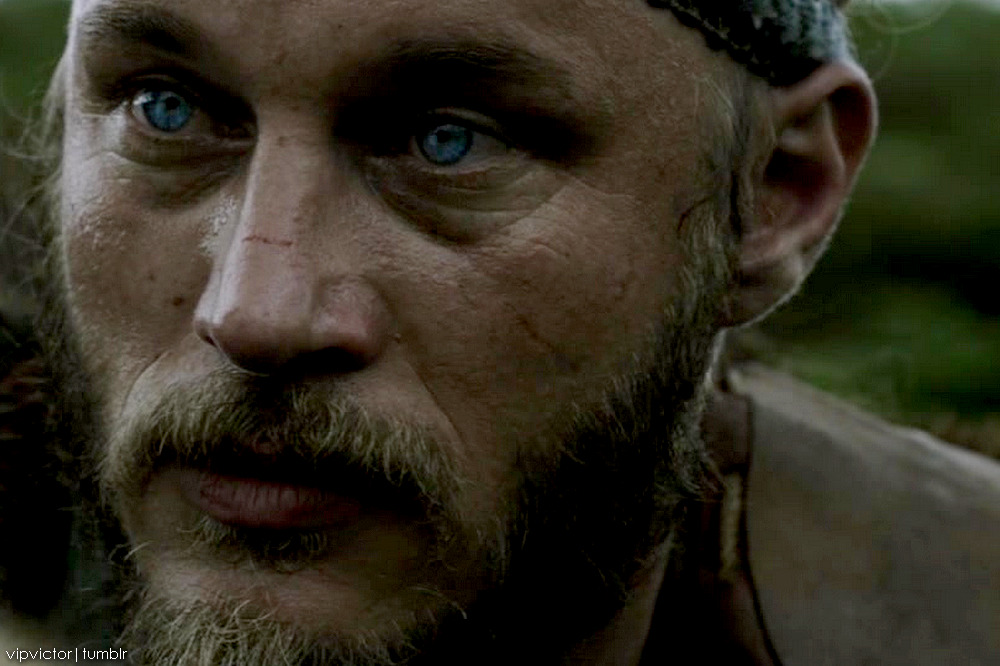
So, the fact that Vikings is attempting to be as close to history as possible is pretty cool, and there is a very authentic feel from it, and there is even a good attempt at the characters speaking a bit of Old Norse and Old English. Cooler still, is Lagertha Lothbrok, played by Canadian actress Kathryn Winnick. And Travis Fimmel's (who plays Ragnar) eyes deserve a mention too.


But anyway, back to Lagertha, who is my main interest, because she is one of those rare female characters who show that women are just as good as men when it comes to wits and battle (not me, personally, so don't take this as a challenge). And she's absolutely beautiful without being overly sexualised or turned into a mere ornament for viewers. And her hair, look at her hair! Basically, I want to be her. 

Anyway....I was interested to find that she was loosely based on a real life Danish shieldmaiden, and was also the real life wife of Ragnar Lodbrok (Lothbrok in the series). Lagertha's story was recorded in Saxo Grammaticus' History of the Danes, written in the 12th Century (and assumed to be mostly fictional by scholars such as Judith Jesch). Saxo describes her as so: 

"Ladgerda, a skilled Amazon, who, though a maiden, had the courage of a man, and fought in front among the bravest with her hair loose over her shoulders. All-marveled at her matchless deeds, for her locks flying down her back betrayed that she was a woman."

Cool, huh? Lagertha's story begins when Frø, king of Sweden, invaded Norway and killed Norwegian king Siward. He subsequently ordered all the women belonging to Siward's family to be put in a brothel for public humiliation. And so enters Ragnar, who, hearing of this madness, comes to avenge his dead grandfather, where he first spots Lagertha across the dancefloor...I mean, battlefield..., who along with many other women under king Siward's reign, had dressed as men to fight alongside Ragnar. Ragnar's victory over Frø is said to be much indebted to Lagertha, who acted as chief among these rebelling women. 

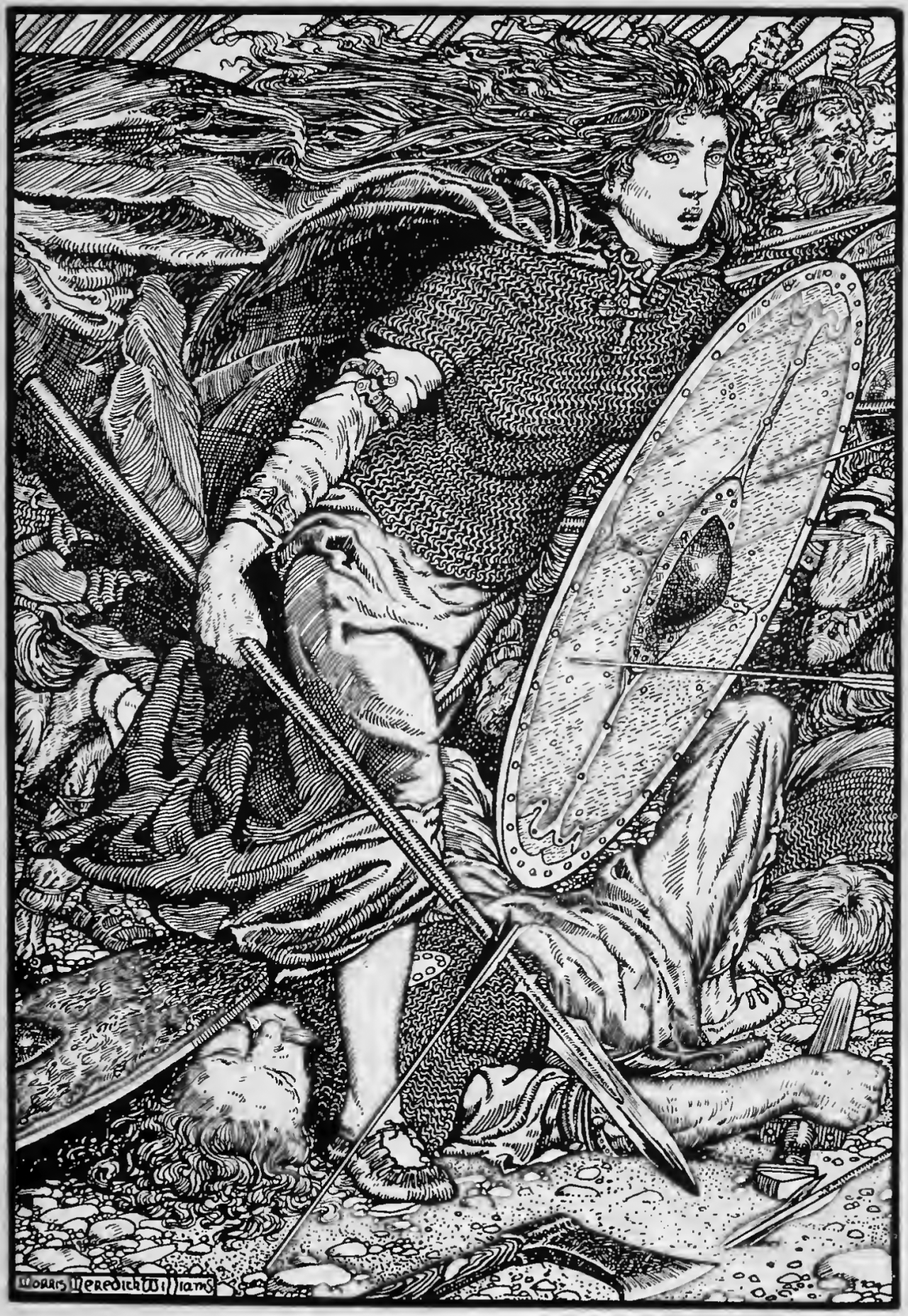
Morris Meredith William's Lagertha, from 1913


And who can blame Ragnar for falling for her? During his courtship of Lagertha, Ragnar sent messengers to her and though "she spurned his mission in her heart, she feigned compliance". He eventually killed both a bear and a great hound which were guarding Lagertha's home - and so, he won her hand in marriage, and children were had. But...Ragnar then divorces Lagertha (as he's still pissed about the bear and the hound, apparently), to marry Þóra borgarhjörtr (or Thora Town-Hart), daughter of the king of Sweden. Upon his return to Norway, he was faced with civil war, and the ever-admirable Lagertha, who still loves him (sob) comes to his aid with 120 ships and saves the day. After this victory, Lagertha kills her second husband, "the presumptious and self-indulgent woman would rather rule without her husband than share the glory with him". 

According to the Tale of Ragnar Lodbrok's sons (Ragnarssona þáttr), Thora Town-Hart later dies of an illness, and Ragnar then marries Aslaug (aka Aslög, Kraka, Kraba or Randalin), daughter of Brynhildr (you may know her from Xena), who we were just introduced to in the final episode of season one (and who has nothin' on Lagertha!). 

I do plan on finding out more about Lagertha, but there doesn't appear to be many sources, and I have no access to the library :(