Seen as it's almost Halloween, I'm gonna write a post on the figure I'm dressing up as (and putting an embarrassing amount of effort into)! So everybody knows about Medusa...well...you should know anyway. The snake-headed hag who can turn you to stone with one glance (maybe this is where my aversion to looking people in the eye originates). As a Grendel's Mother fan, it's probably unsurprising that I have quite an interest and soft-spot for Medusa too. It wasn't until recently though, that I started looking into her myth a bit further, and I realised it's a lot more complex than I had originally thought. Which means this post is not going to show every version. Partly because that would make this even more boring than it already is, and partly because I'm lazy.
So, despite general conceptions, Medusa did not actually originate in Greece, but rather was imported from other cultures, most likely from the Amazons in Libya and other North African countries, where she was the destroyer aspect, Anath (Athene) of the Great Triple Goddess
The Greek take on Medusa is sometimes associated with the vanquishing of the goddess religions for those associated with male Gods (namely Zeus and Jupiter), sometimes associated with Apollo's killing of Python, the son of Gaia the Earth Goddess. Consequently, former peaceful goddesses were turned into monstrous figures, and replaced by the warrior type gods of Olympus.This is just a theory of course!
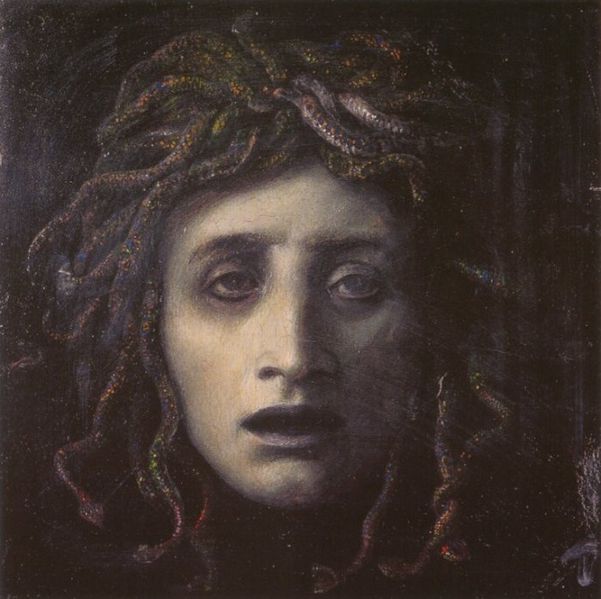
Braaaaains
And so, Medusa was turned into a monster! However, even the Ancient Greek myth is not known by many people, and in fact there seems to be a few variations of the myth.
The most popular myth of Medusa tells of a girl who was renowned for her beauty, wanted by every man around, and the subject of many bitching sessions by those who were jealous of her. Medusa, however, being a priestess of Athena/Minerva, could not get married, and was expected to stay chaste for her life. Unfortunately, this did not stop Poseidon, God of the Sea, who raped Medusa in the temple of Athena. If this wasn't bad enough, the fact that Medusa was taken advantage of in a place of worship, made Athena a very unhappy bunny. Athena was so angry that she turned Medusa's hair to serpents, and made her face so hideous that anybody unlucky enough to look at it would be turned into their very own Greek statue. Which, in my opinion, kind of makes Athena (and of course Poseidon) out to be the bad guy? No?
Thomas More's translation from Ovid's Metamorphoses:
Beyond all others she
was famed for beauty, and the envious hope
of many suitors. Words would fail to tell
the glory of her hair, most wonderful
of all her charms--A friend declared to me
he saw its lovely splendour. Fame declares
the Sovereign of the Sea attained her love
in chaste Minerva's temple. While enraged
she turned her head away and held her shield
before her eyes. To punish that great crime
Minerva changed the Gorgon's splendid hair
to serpents horrible. And now to strike
her foes with fear, she wears upon her breast
those awful vipers--creatures of her rage.
Other versions of the Medusa myth do exist - some say Medusa was born a gorgon, some say she wasn't raped, but took Poseidon willingly, others say Athena was just jealous of Medusa's beauty.
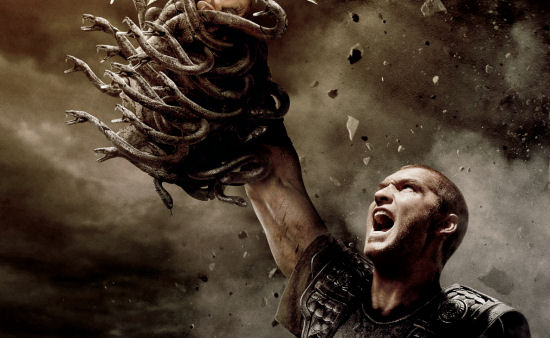
In the vast majority of retellings, Medusa is beheaded by Perseus, because her eyes still have the power to turn people (or krakens, as Sam Worthington and Harry Hamlin kindly show us in both versions of Clash of the Titans) to stone. As the story goes, Perseus used a mirrored shield to see Medusa without looking her in the eyes, clever fella that he was, and managed to chop her head off. As well as having a headful of snakes, it turned out that Medusa had a wombful of pretty unique children too - Pegasus, the winged horse, and Chrysaor, a sword-wielding giant. As ya do. And these children supposedly sprung from her blood-spurting neck. I'm not sure how exactly that would look, but according to Edward Burne Jones, it looked something like this:
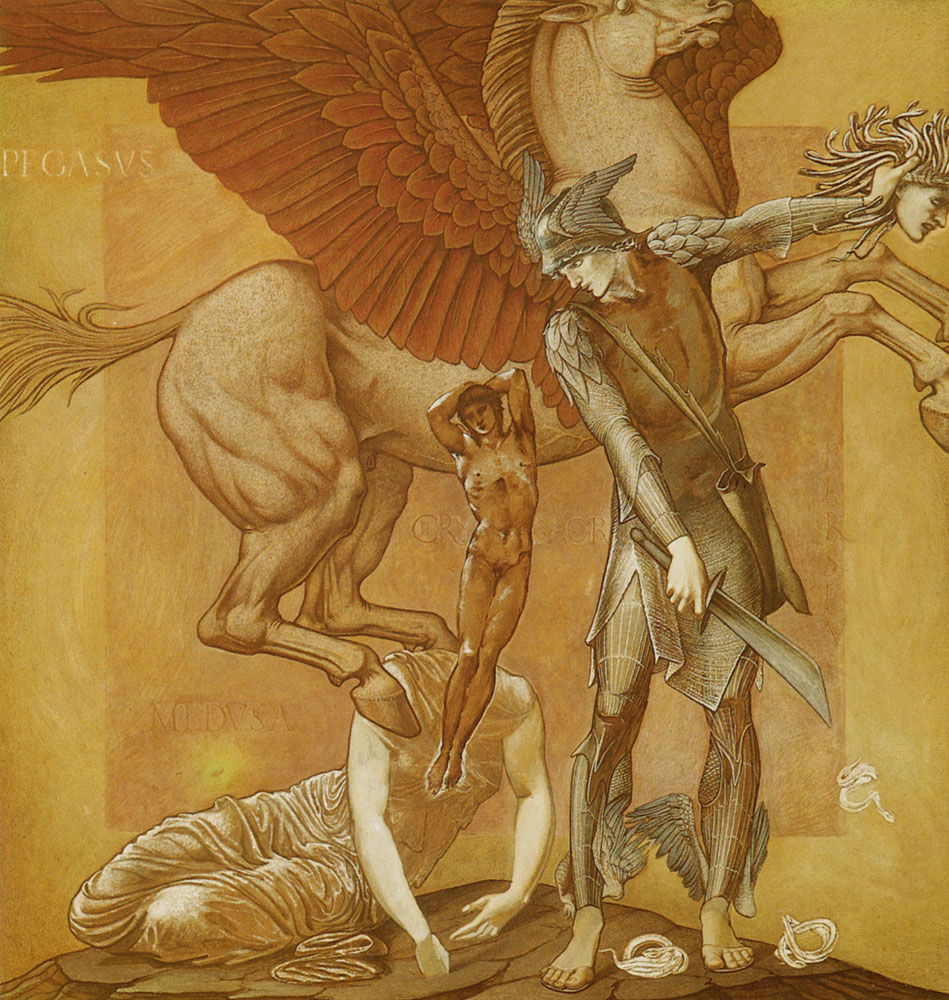
According to Ovid, Persues then flew around a bit with his handy new sandals from Hermes, where he turned quite a number of individuals to stone, including the Titan Atlas, Cetus (who was about to Andromeda alive), and Phineus, whom Andromeda was promised to before Perseus flew in on his golden winged sandals (or on Pegasus in more western takes on the myth) and impressed the hell out of her. Last, but not least, Perseus flew to Seriphos where he rescued his mother from her forced marriage to King Polydectes (sounds like some sort of pterodactyl), who had sent Perseus for Medusa's head in the first place.
Also, while Medusa was dead, she still managed to spawn some more offspring, namely Amphisbaena, a serpent with a head on both ends, as her blood dripped onto the Libyan desert (where her myth originated, and in a way ended)! How nice.

An Amphisbaena in the Aberdeen Bestiary

Perseus by Aubrey Beardsley