Showing posts with label norse. Show all posts

Monday, 28 April 2014

Ancient Equines


File:Odin rides to Hel.jpg
Odin Rides to Hel - W.G Collingwood (1908)


I've loved horses my whole life, and from a young age I was writing pretty class poems about them ("Big horse, little pony, fast trot, slow walk" - literary genius) and they are pretty much the inspiration for 99% of things I draw/paint, so why has it taken me so long to write a post about them?! They are wonderful, beautiful animals, they are extremely powerful, and most of them are extremely willing, they have fluffy ears and the softest loveliest noses, and they are afraid of silly things (gutters, leaves, things that weren't there yesterday), and they can mess you up if they want, and they can be complete assholes sometimes, and they make your life so much better. Respect, yo.

So, did the Ancient Everybodies love and respect horses as much as many people do today (I stress many, because there's too many who don't)? Today, there are still stories of horses from the ancient world and ancient mythologies, which seem to show that back in the day, horses mattered. Well, of course they did - they were handy for transport and war and keeping the lawn trimmed. But besides that, I want to look at some more famous horses.


Let's start with Bucephalus, who was the horse of Alexander the Great. Plutarch tells the story of how Philonicus the Thessalian brought the horse to Alexander's father Philip, but when they went to catch him, they found that he was batshit crazy and decided he was useless. Alexander, 13 at the time, noticed that he was a fine horse and said he would tame Bucephalus, to which everyone sniggered and muttered "lolz, ya rite", and if he failed, he would pay the full price for the horse: 
Alexander ran to the horse, and laying hold on the bridle, turned him to the sun; for he had observed, it seems, that the shadow which fell before the horse, and continually moved as he moved, greatly disturbed him. While his fierceness and fury abated, he kept speaking to him softly and stroking him; after which he gently let fall his mantle, leaped lightly upon his back, and got his seat very safe. Then, without pulling the reins too hard, or using either whip or spur, he set him a-going (Lanhornes' translation)
Alexander comes to us as some sort of Ancient horse whisperer of sorts. Seeing his son's taming of Bucephalus, Philip exclaims that Macedonia is too little for his son. And he was right, wasn't he - by the time he was 30 he had one of the biggest empires in the world.

Bucephalus is said to have been a huge, jet black horse, with a white star on his forhead, no doubt an inspiration to Anna Sewell when she wrote Black Beauty, and an obvious influence on Walter Farley's The Black Stallion, which tells of a boy, Alec, taming a black stallion (durr) on an island.
Bucephalus apparently died at the age of 30, which is a ripe old age even for horses these days, perhaps at battle. After the death of his beloved horse, Alexander founded the city Bucephala, in modern day Pakistan, to keep his memory alive. Unfortunately, it didn't remain as Bucephala, so so much for that.


One of my favourite people in history to read about is the Roman emperor Caligula, because he was pretty crazy (a bad crazy), but he was also crazy about his horse, Incitatus.... also perhaps a bad crazy. Caligula was so enamoured by his grey horse that he apparently had a stable made out of marble, a manger made of ivory, and a headcollar made from precious stones. Dio Cassius claimed that the horse had its own servants and was fed oats mixed with gold flakes. That's why I feel like Incitatus every time I drink goldshlager. It is also rumoured that Caligula planned to make Incitatus consul. However, it is disputed whether this was down to Caligula's insanity or his way of making a satire of the men in government. There is all sort of stories concerning Incitatus, some saying he was a racehorse from Spain, some saying he had his own house and gardens and that he held dinners for dignitaries. It is debated whether his treatment of his horse is accurate, or whether those who wrote about his life were exaggerating his folly in order with Clau-Clau-Claudius' (who succeeded him, also his uncle) regime. To which I would recommend reading I, Claudius by Robert Graves - a great book full of debauchery and so many characters that its hard to keep up.


Prince on horseback, possibly Caligula, Rome, 1 - 50 AD


I'll finish off with two mythological horses, the first of which is Pegasus - we couldn't leave him out! Pegasus's birth is a bit of a strange one, firstly because he is the son of Medusa (out of her union (possibly rape) with Poseidon), and was born at the same time as his brother Chrysaor. Even stranger again is that the two brothers were born when Perseus beheaded Medusa, and they somehow sprung out of her neck. Here is a depiction of it on an ancient Greek thing (although it leaves out Chrysaor):


Birth of Pegasus from the neck of Medusa | Greek vase, Athenian black figure white-ground lekythos


Pegasus is usually depicted as a pure white stallion (the horse world is still debating whether white horses actually exist, but well give him this, seen as he's mythological to begin with), his most important feature being his wings and his ability to fly. He was captured by Bellerophon with the help of Athena and Poseidon, and flew the hero to defeat the Chimera. Bellerophon is said to have fallen off Pegasus when Zeus sent a fly to sting him (the horse) - it hurts bad enough falling off a horse that can't fly, so I can only imagine. Pegasus then flew to Olympus where he was used as a pack horse to carry Zeus' thunderbolts. Noble ending, eh? Because of his loyalty, he was honoured with the legacy of becoming a constellation. 


Last, but not least, is the surprisingly not so famous Sleipnir, horse of Odin. Sleipnir has an even weirder birth and lineage than Pegasus, leading to many humorous Mother's Day Cards. Anyway, how did Sleipnir come about - a builder offered the gods to build a fortification to keep out invaders in exchange for Freyja, the sun, and the moon. The Gods agree, but only if the builder can build it within three seasons, with the help of no other men. He requests help from his horse Svaðilfari, and this is allowed, under the persuasion of Loki. The stallion turns out to be extremely strong and the Gods begin to panic, as the builder made fast progress. Three days before he is to finish the work, the gods gather around and point the finger at Loki and threaten him with death if he cannot find a way out of this. Basically the Gods are awful unfair cheaters. 

So...this is where it gets weird - Loki decides to turn into a mare, and seductively neighs to Svaðilfari, who being a stallion, cannot control himself and runs off with the mare and they frolic about for the night, causing the builder to fail in his challenge. A few months later, Loki gives birth to a lovely grey foal with eight legs (the kind of incident that would result in talks about genetic mutation and pollution and weird worship in modern times), described as the best horse among the gods and men.


File:Loki and Svadilfari by Hardy.jpg


Sleipnir is described numerous times as visiting Hel, with Odin and with Hermóðr. In the Prose Edda, Odin rides Sleipnir to Jötunheimr, land of the giants, where he encounters Hrungnir, who despite admitting that Sleipnir looks like a fine horse, that his own horse Gullfaxi (meaning "golden mane", no doubt an influence on Tolkiens Shadowfax), is much faster. Intending to attack Odin, he gallops after the two, only to find that he has chased the faster Sleipnir into the gates of Asgard.


File:Odin and Sleipnir - John Bauer.jpg
Odin and Sleipnir by John Bauer


Unfortunately, there doesn't seem to be any famous horses from the Anglo-Saxon era. There were numerous different words for "horse", basically describing their different roles. It's unfortunate that there is no records of any famous horses, but a horse burial was found by Sutton Hoo, where a man was buried with his harnessed horse, who had a bucket of food by its head. Which is somewhat heart-warming. 


Monday, 7 April 2014

Female power in Vikings Season 2


#vikings-shieldmaiden:  #Lagertha's career as a warrior began when Frø, king of Sweden, invaded #Norway and killed the Norwegian king Siward. F...


It is now half way through the second season of Vikings (for those who live in Canada or the US and for those who have few qualms regarding downloading). Obviously there will be spoilers, especially for those of you who are resigned to watching it in RTE 2! Suckers.

As she was in the first season, Lagertha is still my favourite character. This season also has a few more female characters of a bit more importance, most notably Aslaug, and it appears that the girl who Bjorn has his eye on may have a bigger role soon (But I can't help but be reminded of that absolute disaster The Legend of Hercules whenever I see her. Horrid flashbacks!). There are a few noteworthy moments involving the women of Vikings so far in the season:

Firstly, is Lagertha's decision to leave Ragnar, as Aslaug arrives on their doorstep with a bellyful of children. She has the dignity to walk away from Ragnar and start a new life with no drama involved, which is a nice change to the usual catfighting women screaming at one another over a man (even if he is as wonderful as Ragnar). In the actual mythology, Ragnar divorces Lagertha and there is a different woman, Þóra borgarhjörtr, in between her and Aslaug, but to be honest, that would make him look a bit too bad!


Four years later we see Lagertha with a new husband, Earl Sigvard, who is frankly, a bit of a dick. She stands up to his advances and his attempt to rape her and shows him where to shove it. As always, she does as she pleases, and returns to help Ragnar to reclaim Kattegat from Jarl Borg (as also happens in the myth - she comes to his aid with 120 ships, and saves his ass). 

In the last episode so far (episode 6), Lagertha returns to her second husband, despite still being in love with Ragnar (who is unwilling to choose just one wife). After getting his men to brutally beat her during the night, he attempts to publicly shame her by trying to show everyone at the table what lovely breasts she has. Unfortunately for him, she grabs a knife and turns around to stick it in his eye. Hell yeah! He is then beheaded by one of his own men (who I don't trust either...). In the myth, she is also responsible for her second husband's death; "the presumptious and self-indulgent woman would rather rule without her husband than share the glory with him" (Saxo Grammaticus). As you can see, the television series views her somewhat more sympathetically! Of course, this is as far as the mythology surrounding Lagertha appears to go, from what I can find, so its up to the series now! 


Another important scene takes place in Wessex in England (where attempts at speaking Old English are made...I understood cyning . . . so proud!) with Athelstan, the hot monk taken as a slave (and later made a free-man by Ragnar, and later captured by the people of Wessex), in episode 5. When a woman who is beaten because her husband thinks she has been unfaithful to him comes to King Ecgbert for counsel, the King asks him what the craic is with the pagans in such situations - Athelstan says that "if she was a free-woman, they would believe her word, and make judgement on her behalf". Ecgbert replies thinking that "surely her husband has every right over her, surely she belongs to him, to do with as he sees fit." Well, not according to the pagans! The open-minded Ecgbert (Athelstan has heard he is like Ragnar...and unlike the misogynistic Anglo-Saxons it would seem!) follows this pagan law and goes in the woman's favour. 

In general it would seem that the vast majority of main characters are somewhat "feminist" characters...to an extent. The Norse peoples, or as Ecgbert would say, the "pagans" have a more equal society than the Anglo-Saxons, allowing women to partake in raids and battle, and seemingly allowing them equal judgement in the eyes of the law. Of course, this didn't stop the vikings raping all around when they were on their raids, but this may also be seen as a "weapon of war" against the men, as much as it is seen as an act of violence against the women.


With regards to Aslaug, I am happy that this season is making a bit more of an attempt to flesh out her character, althoug it is not enough. Aslaug's character in mythology is pretty interesting - she is the daughter of Sigurd (who killed the dragon Fafnir) and Brynhildr, the shield-maiden, who I wrote a post on a few months back. As a child she was taken care of by a foster father, Heimer, and hid in a giant harp. Her next foster parents Ake and Grima, who killed Heimer as they thought there were valuables in the harp, found her hiding inside and raised her as their own, covering her in tar to hide her beauty (and therefore her noble birth). It is at this point that she meets Ragnar Lodbrok.
    Interestingly, Ragnar proposes to her, but she refuses him until he accomplished his mission in Norway. It is also, only after giving him three sons, that she reveals her true noble blood to him (after she hears that he has planned to marry Ingeborg), and promises to give birth to a child that bore a snake's eye, Sigurd Snake-In-The-Eye!

In the series, although she is not so much the "Other Woman" as she was at the end of season one, she is still portrayed as a bit of a princess, complaining about dirt and playing the jealous wife when Ragnar speaks to other girls. Hopefully we will get a more rounded character as we go along.


Also, GAME OF THRONES IS BACK, BYE

Tuesday, 11 March 2014

Grendel's Mother: Warrior Princess!


Unlike most of my friends, I wasn't very much a television child, and so I missed out on Xena: Warrior Princess (along with Saved by the Bell, The Fresh Prince of Bel Air, and Friends - which apparently makes me a freak of nature, causing people to gasp when I admit to these facts). But, little did I know that when I was doing my MA I would be faced with the program which I associated so much with strange costumes and even stranger shouting.


I am in China now? Whut? I share your confusion, Xena.


Anyway, strangely enough, Xena appears to be one of the very few out of the many adaptations that presents Grendel's Mother to us in an explicitly positive light. Even when she looks like the giant cockroach from Men in Black, we still think she's pretty okay. 

So, Grendel's Mother appears in three episodes of Xena from 2000 - "The Rheingold", "The Ring" and "Return of the Valkyries". She appears as Grinhilda, chief of the valkyries and lover of Odin. Beowulf and Grendel (who appears as Grindl) also appear in these three episodes but don't really have much importance...cause...well, it's Xena. 

At the start of "The Rheingold" we see Grinhilda through a flashback, where she appears as the extremely powerful giant turd/cockroach fighting Xena for possession of the Rheingold (a magical ring from Richard Wagner's 19th century opera, Das Rheingold, itself influenced by Norse and Germanic mythology - the Rhine gold can be made into a ring which will let its bearer rule the world, so long as he or she has renounced love). 


Grinhilda


Xena and Grinhilda have a bit of a tussle before Xena manages to lock Grinhilda in a cave. We are then taken to the present day, where the story of Grinhilda is recited by the character Brunhilda (prepare yourselves for a long-winded and probably confusing retelling of these episodes): 
Back in what is known as Xena's "dark days" (try not to laugh), Xena is chosen by Odin as a valkyrie. Unlike the peaceful Grinhilda, Xena is absolutely gagging for some fightin' and blood spill. In her attempt to gain more power, Xena visits the three Rhein maidens and steals the Rheingold from them, and smelts it into a ring (as the dwarf Alberich does in Wagner's Ring Cycle). Grinhilda, being a good girl, tries to stop Xena from using the ring, and so, places it on her own finger, where we see her transformed into the monster she has become, for she has not forsaken love. The ring destroys that which is most loved by the wearer - in this case, it is Grinhilda's own beauty and humanity. 


Grindl - and what a handsome boy he is


We are then brought back to the present day, where Xena and Beowulf (who has called on her help) are seen fighting a monster who is revealed to be Grindl (Grendel - and presumably Odin's son). They manage to kill him and we are shown Grinhilda mourning his death, and presumably intent on revenge (who would Grendel's Mother be without revenge?), and she then shows up, along with Odin, to fight Xena. Xena then places the ring of power on her finger, but, surprise surprise, it turns out the Xena has not forsaken love either, and loses her memory. 

The next episode presents to us the amnesiac Xena who is now known as 'Wealthea' (an obvious reference to Wealhtheow) and is marrying Hrothgar. Thankfully, Beowulf shows up and reminds her who she really is, and she can go back to fighting Grinhilda. Rather than fighting with her however, she convinces Grinhilda of her former humanity, and she is transformed back into her good old self. Funnily enough, with this, all is forgiven (even Xena's killing of her son...) and Grinhilda returns to her former valkyrie job. 


So! That's that. A rather confusing retelling, interlaced with a lot of Norse and Germanic Mythology and obviously influenced very much by Wagner's opera. But... it must be said, it's original, if a bit silly at times - but then again, it is Xena. It is very much like Parke Godwin's Tower of Beowulf, with its strong threads of Norse mythology as well as a very complex Grendel's Mother,, but that is for another day.

I'm going to focus more on Grendel's Mother as she is depicted here. I know I said she was explicitly positive in this, and then went on to talk about how she was a giant turd-monster, BUT, this is a positive retelling of her character, because it's not her fault that she turns into a monster (it's actually Xena's fault), and her extreme humanity and noble background are very much pushed in this. She is physically cursed and turned into a monster, very much like critics and translators have turned the Grendel's Mother of Beowulf into a monster (I'm getting deep here). Also important, is the fact that unlike Zemickis's or Baker's adaptations, her human form is not capitalised upon, and she is not overly sexualised.


And what about Grendel's Mother as a valkyrie, one of the "choosers of the slain"? Although it seems like a bit of an unorthodox view, and simply another norsification of the story, it's not an unfounded view, as Helen Damico (in "The Valkyrie Reflex in Old English Literature") argues that the valkyries were "half-mortal, half-supernatural beings called idisi in Old High German, ides in Old English and dis in Old Norse". Damico believes that the Beowulf poet is characterising Grendel's Mother as one of these "deadly battle demon[s]". She is after all, called an ides aglæcwif and a wælgæst wæfre, which Damico translates as "roaming slaughter-spirit". Damico also suggests that Grendel's Mother's protective covering may relate to the helm and byrnie of the valkyries. 

Although I'm not necessarily agreeing with this view of Grendel's Mother as a valkyrie, I am pointing it out as a possible influence on Xena's depictions of her, as, I feel, many adaptations, especially film or television adaptations, are often not given credit for researching their sources or the scholarship surrounding them. Of course, the writers of Xena may not have even heard of Helen Damico, but I will give them the benefit of the doubt, and either way, such depictions, whether or not based on an already established theory, can offer new possibilities and new ways of viewing the original poem. 

Overall, for once, Grendel's Mother plays a pretty important role, one more important than both her son and Beowulf. In general, Xena (along with shows like Buffy) is one of those shows that differs from the rest, in that its centred on female figures, but as well as that, it's characters rely less on their sexuality (as so many unfortunately do) than on their physical strength and cunning - they are some of the few accessible feminist role models available in mainstream culture (Girl Culture). And there is nothing bad about that, no matter how cringey Xena may be.

Tuesday, 31 December 2013

Tis the season to....drink as much as possible before you pass out on the couch


We're all going to heaven, lads, waheeey. Source


Happy Christmas (or should I say Happy Yule?) to all and to all a Happy Christmas. Tis the eve of the New Year, hopefully one that will be filled with a lot more motivation (I got my PhD!), a lot more exercise, a lot more painting, a lot more reading, and a lot less drinking!

Since I have basically spent my Christmas forcing as much drink into myself as possible (and equally telling myself that I am never ever touching drink again, whilst simultaneously pouring myself another glass (sure one won't hurt!)), I think it is a good time to write a post on alcohol and its history in Anglo-Saxon England, and other areas of interest!

So, back in the good old days, there were a few main types of alcoholic beverages drank by the Anglo-Saxons - mead, ale, beer and wine (fortunately for them they never had to experience Tesco Value Vodka) - medu, ealu, beor and win. It is unknown still whether these drinks were pretty much the same as the equivalents of today, and some believe that what the Anglo-Saxons referred to as beor, was in fact cider.

Anglo-Saxon drinking horn

Like us today, the Anglo-Saxons were obviously fond of the few scoops, as evidence from words like gebeorscipe, meaning "drinking party", and the fact that they had what we call "mead-halls". Furthermore, vessels like drinking-horns are mentioned in Beowulf (the Danes drink mead) and fittings for drinking-horns were discovered at Sutton Hoo.

It seems that wine wasn't much of a drink for the masses (or well...it was, but not those masses). Before the ninth-or-so century (this differs with sources), it seems that the climate wasn't suitable for cultivating wine, and so, before this, wine was imported from warmer climates, and so, was only really used for religious purposes and by the few who could afford to pay for it. Even so, after the climate improved, wine was really only left for the upper classes of society, while the rest of the dregs got pissed on ale and beor.

What we mostly seem to think of when we think of alcohol in these times is mead. In Norse Mythology, it's the drink that seems to be what you will be drinking for the rest of your life once you reach Valhalla, and os the source of Odin's strength as he suckled it froma goat as an infant. This however, is actually a foreign drink, the term medu coming from Proto-Indo-European médu, and similar drinks from the same (or earlier) period can be found all over the world, from the Slavic (med or miod), Baltic (midus) Sanskrit (madhu), and appears with different names all over the world, including Africa and Northern China (where the first possible traces of the making of mead are found). So, it's not an exclusively Anglo-Saxon or even Norse or Germanic, or even Western European, drink! 


I enjoy some mead in the coolest pub in Stockholm


That is all for now. Hope you have a great New Year!

Monday, 22 July 2013

Brynhildr - a Norse rom-com (minus the comedy... and much of the romance)

Brynhildr, depicted by Robert Engels in 1919


We've already talked about one (official) shieldmaiden, Lagertha, so I think it's time we talk about some more kickass Norse wimmins.

Interestingly enough (maybe? Is it? I dunno), there is a connection between Lagertha and the more famous shieldmaiden we are going to talk about today - Brynhildr. You may recall that Ragnar Lodbrok took Brynhildr's daughter, Aslaug, as his third wife, after divorcing Lagertha (I'm still a bit butt hurt over this). Brynhildr also has a connection to another figure, Gudrun/Kriemhild, who I want to discuss more in the future (she does pop up here quite a bit). Shit, she even has a connection to Grendel's Mother in Xena: Warrior Princess (Grinhilda)! Basically, Brynhildr gets around!

DISCLAIMER: There will be a whole lot of name repetitions - you will never want to hear the name Brynhildr again! Brynhildr Brynhildr Brynhildr!

The character of Brynhildr may be famous from Wagner's Ring Cycle, Der Ring des Nibelungen, but she started out as a figure in Norse mythology (and possibly even before this as Brunhilda of Austrasia, a real life Visigothic princess). Although, to be completely honest, most people will have heard the name Brynhildr/Brunhilde/blablabla etc, from things like Xena, various video games, World of Warcraft, Django Unchained, and by the looks of it, some softcore manga...what the...

Eh, anyway. Brynhildr appears in the Völsunga saga, a 13th century Icelandic text and some Eddic poems. In the Völsunga saga, she is condemned by Odin to live life as a mortal woman and imprisoned in a ring of fire until a man rescues and marries her. The lucky man to come and rescue Brynhildr was Sigurðr Sigmundson, hero of the Volsung saga, and needless to say, the two of them fall madly in love, ending with Sigurðr's offer of the ring Andvaranaut (which is likely to be an influence for the one ring in LOTR) as a proposal. Sigurðr, who needs to run off on important business, promises to return to make Brynhildr his bride. In the meantime, Gudrun comes over for a cup of tea and to ask for some help in interpreting a dream, which coincidentally enough foretells Sigurðr's betrayal of Brynhildr and his marriage to Gudrun - forget Freud, these guys really knew their dreams!


The man himself . Killing Fafnir.


So, at this stage, Sigurðr is off with Gjuki, the King of Burgundy. Gjuki's wife, Grimhild, who happens to be Gudrun's mother dearest AND a sorceress (how unlucky), prepares a magic potion so that Sigurðr will forget about Brynhildr. And alas, the potion does its job, and he marries Gudrun instead. In some strange series of events, Gjuki's wife then decides to marry her son Gunnar to Brynhildr (what a terrible mother-in-law she would have been). However, Gunnar finds that he can't get through this ring of flames, and so, Sigurðr offers to exchange shapes with him, and enters to claim her hand. So Sigurðr, disguised as Gunnar, stays with Brynhildr for three nights, putting a sword in between them so she will retain her virginity (imagine if they couldn't find a sword - close one!) and then takes the One Ring to Rule Them All from her finger to later give to Gudrun (oh no he didn't!). Sigurðr and Gunnar return to their true forms and Gunnar is married to Brynhildr.

And this is where shit gets real. Gudrun and Brynhildr start arguing about who has the better husband, where Brynhildr starts bragging about how brave her Gunnar was to ride through the flames to get her, causing Gudrun to drop the bombshell that it was actually Sigurðr. As you can imagine, Brynhildr goes ape, and Sigurðr starts to remember the truth, but fails to console her. So, Brunhildr tries to urge Gunnar to kill him, telling him that Sigurðr slept with her - Gunnar, being too scared to kill Sigurðr himself, gives his little brother a potion that enrages him, causing him to kill Sigurðr. Brynhildr then kills Sigurðr's son, and during Sigurðr's funeral, throws herself on his funeral pyre, thus entering into Hel with him - a somewhat romantic ending...in a rather messed up way.


Brünnhilde throws herself on the flames. By Arthur Rackham for Wagner's Ring Cycle


Have you died of boredom yet? There are differences in other versions of the story found in a few Eddic poems (eg Aslaug is Brynhildr's and Sigurðr's daughter), but honestly, ain't nobody got time fo' that.


The story of Brynhildr can then be found in the Nibelungenlied, a Middle High German epic poem about Siegfried (Sigurðr). There are quite a few differences regarding her tale in this version - Brunhild is the queen of Iceland, and with Siegfried's help (who is hidden under an invisibility claok that he got off Albus Dumbledore), Gunther (Gunnar) wins Brunhild in a series of rather warlike games. There doesn't appear to be any suggestion that Siegfried had proposed (or even known) Brunhild before this.

Brunhild, who is suspicious of Siegfried (as Gunther introduced him as a vassal, although he was actually royalty), denies Gunther her virginity until he tells her the truth. Gunther tries to take her by force, but Brunhild merely pushes away his advances as if he were a tiny kitten and ties him to the ceiling. 


Gunther's Wedding Night by Johann Heinrich Füssli


The next day, Gunther, being a little bit put out at not getting the ride, tells Siegfried what happened, so Siegfried enters their bed chamber that night under cover of the invisibility cloak, and holds Brunhild down until she submits to Gunther's will - a bit rapey if you ask me. In this version of the story, this is when Siegfried takes "a ring" from her finger (along with a girdle), which is later shown to her  y Kriemhild (Gudrun) during their "my husband is better than yours" argument - thus giving away the game. Hagen, Brunhild's vassal, promising to take revenge on the wrongdoer then kills Siegfried. So, as you can see, this version has a lot less romance, and a lot less sympathy for Siegfried/Sigurðr. 


Some other time I will discuss Wagner's Der Ring des Nibelungen, because this post is about forty-two times longer than I'd intended it to be. It's time for me to go watch Wrath of the Titans and see if it's as class....I mean....crap.... as Clash of the Titans (whose tagline was "Titans will Clash" - I never tire of telling people this).


Thursday, 4 July 2013

Womyn and Archery


It would seem that archery has become quite popular in the last few years, resulting in (or because of?) tons of archery related films and tv series, especially with women for some reason - Merrida in Brave, Katniss in The Hunger Games, Arya Stark and Ygritte ("Raight foot, leff foot") from Game of Thrones, Natalie Portman (can't remember the character name) in that shite film that also starred Zooey Deschanel, Mulan in Mulan, Andromeda in Wrath of the Titans,  and probably more. And that's only mentioning the female archers, phew! I'm not quite sure what exactly my point was in listing them all out, but anyway...

Looking back on ancient history, it is tough to find any real proof that women were skilled in archery, except for one group that keeps popping up - the Amazons. The Amazons were a nation of all-female warriors in Greek and Classical antiquity. Amazons were first depicted in art around the 8th century, and in writing around the same time (or later) in Homer's Iliad, in scenes concerning the Trojan War. 


In the 5th Century BC, the poet Pindar describes the Amazons as horse-riding female archers. Strabo (a 1st Century Greek historian and philosopher) speaks of the Amazons having their right breast "cauterized at a tender age" (source) to more easily throw spears, and so that a bow could more easily be drawn (although this is questionable, unless they were left-handed) - Hippocrates also mentions the missing breast trend. 

Also included in Greek Mythology is the female archer Atalanta, and the goddess Artemis (Roman equivalent, Diana) - goddess of the hunt, wilderness, wild animals and virginity. One of her epithets was "of the golden shaft", another, "arrow-pouring" (and another, "mistress of the beasts" is pretty cool too) and the image of a golden (or silver?) bow and arrows is symbolic of her. According to Greek Mythology, Artemis' father, Zeus (you may have heard of him...), asked his daughter what she desired in the whole world, to which she responded that she would have a bow and arrows, a pack of hounds to hunt with, nymphs to accompany her, a tunic short enough for her to run in, mountains and wilderness as her own special places, and eternal chastity (isn't chastity one of the first things that pops into every three year old's mind when asked what they want?). And so, Zeus granted it, and she went beneath the sea to Cyclopes to forge her silver bow and arrows. And once she had collected her nymphs, and got her hounds from Pan (as you do), she couldn't wait to try out her bow, and so hunted by torchlight.


Dianna of Versailles - a first century marble statue of the goddess Diana (Greek: Artemis)


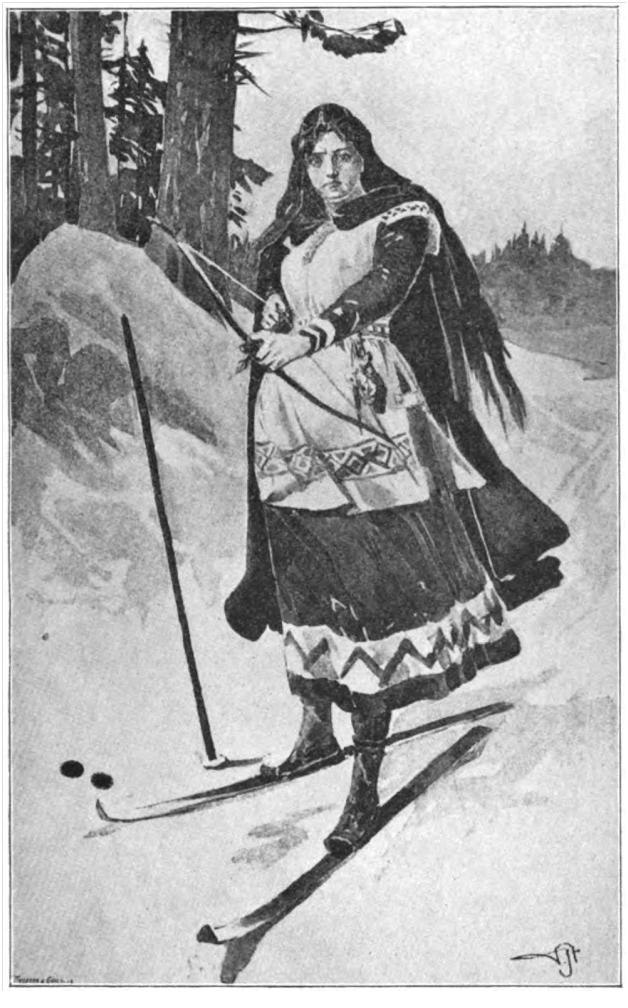
Returning somewhat closer to home, we have Skaði, a Norse goddess associated with winter, mountains, skiing (this brings pretty funny images to mind) and.... bowhunting! In all sources (Poetic Edda, Prose Edda, and more) Skaði, daughter of Þjazi, marries the god Njörðr as compensation provided by the gods for killing her father. In the Prose Edda, the figure of 'High' tells the story of how Skaði and Njörðr go their seperate ways due to him wanting to live by the sea, and her wanting to live in the mountains. High then mentions that Skaði returns to the mountains where she skis, wields a bow, and shoots wild animals, while Njörðr goes on to have two children, Freyr and Freyja.


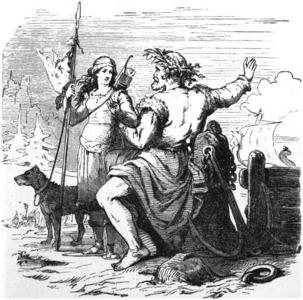
Njörðr and Skaði on the way to Nóatún (1882) by Friedrich Wilhelm Heine

Oh ya know, just skiing and throwin' spears, the usual

As you can see, Skaði can draw a bow with both tits intact


That is all for now. Happy arching!