Showing posts with label monster. Show all posts

Monday, 28 March 2016

Grendel the þyrs

The second part of my "Grendel's Gigantism" post is here already...despite concerns that it would take me a year to get my lazy ass to write it, Easter has proven so mind numbingly boring and awful that I may as well do it now.

I may as well also mention that, in my time spent holidaying (avoiding) from this blog, I have two published articles. And yes, I am totally just bragging here.

  1. The Grendel-kin: From Beowulf to the 21st Century - Boolean Journal, UCC, November 2015
  2. The Monster in the House: Grendel's Mother and the Victorian Ideal - Sibeal Feminist and Gender Studies Network, March 2016


Grendel by Charles Keeping


In my last post I spoke about Grendel's gigantism in relation to the term eoten, A second term used of Grendel is þyrs, once again, generally translated as "giant" or "ogre" or "demon" or bla bla bla. þyrs is generally agreed to be a pretty negative term, both in Old English, Old Norse, Old Saxon and Old High German sources. All these cognates appear to have descended from Proto-Germanic *þurisaz, which itself, according to the Etymological Dictionary of Proto-Germanic, was perhaps a God of war or sea-monster, as evidenced in the Iku-Turso or Turisas of Finnish folkore, a giant who appears to reside in the ocean. The Iku-Turso appears in The Kalevala, Finland's national saga.


Iku-Turso - Minna Sundberg


þyrs doesn't appear many times in the Old English corpus, which is pretty damn annoying when you want to develop some sort of in-depth understanding of its conception in Anglo-Saxon England. But saying that, the few examples that do exist are pretty clear-cut and damning. þyrs appears also in Maxims II to describe a creature which dwells alone in the fens - Ðyrs sceal on fenne gewunian ana innan lande, and again appears in Wright's Anglo-Saxon glossses to describe Cacus, Orcus and cyclopes . . . 

Hercules killing Cacus - Sebald Beham (1545)
Orcus Mouth 
Polyphemus, Johann Heinrich Wilhelm Tischbein, 1802


. . . all of which you can see, don't look like the most upstanding folks. Furtermore, if we look at Old Norse þurs, it only gets bloody worse. In two Rune Poems, the Icelandic and the Norwegian, the word þurs is associated with some very bad things indeed;
–Þurs vældr kvinna kvillu; kátr værðr fár af illu, “Giant causes anguish to women: misfortune makes few men cheerful” (Norwegian Rune poem, Dickens 25)
–þurs as kvenna kvöl ok kletta búi ok varðrúnar verr, “torture of women and cliff-dweller and husband of a giantess” (Icelandic Rune poem, Dickens 29) 

In general, it appears that they were associated with female anguish - perhaps rape? They are also associated with malevolent magic in the Poetic Edda's Skirnismal. As well as being a rune (þ) associated with hostile magic and woman-torture, the þursar also appear to be a race in mythology. Although often lumped together with the jotunn, it should be noted that the þursar had pretty much nothing going for them - they were a shower of bastards really, it seems. They were completely antagonistic towards the deities (especially Thor) and were also known for being a bit thick. Cleasby and Vigfusson, in their ON dictionary cite the phrase hár sem risi, sterkr sem jötunn, heimskr sem þurs, “tall as a risi, strong as a jötunn, stupid as a þurs” (498).


As with all mythological figures worth their while, they appear as a beer


While the OE þyrs isn't necessarily completely comparable to the ON þurs (we don't really know how much influence ON mythology and paganism had on Anglo-Saxon England, besides a few similarities like Woden and Odin), it still seems like a pretty shitty figure - even if we forget the ON sources, there is still its appearance in Maxims II - living alone in the fens is NEVER GOOD, and its connection to ancient Greek and Roman mythological baddies also does not help this term's case.

But...does this mean that Grendel is a giant? That he is a þyrs? Well, it is important to note that it is not the poet or the narrator who names Grendel as one of these creatures, but rather Beowulf, the lad himself. This may lead us to the possibility that maybe perhaps maybe not, it is not meant as a definitive term for Grendel - perhaps it is a means for Beowulf to belittle his foe. And as I noted in the last post, Robert E. Kaske believes eoten is used in this way of the Frisians in the Hildeburh passage. Similarly, Alexandra Hennessey Olsen believes that the use of þyrs changed to that of an insult for large, dim-witted men. Perhaps this really seems like grasping for straws, but it does seem to me to be a conceivable alternative (although this is coming from someone who thinks that doing a PhD in Old English will lead to job opportunities, harhar, kill me now please).


folio 139v, ðing wið þyrse


Tuesday, 23 June 2015

Gaiman and the Golden Grundwyrgenne

It has been too long, but alas, my brain cells had run dry and my spirit was broken from the cataclysm known as the IRC, most famously depicted in Albrecht Dürer's The Four Horseman of the Apocalypse. 

Saying that, it hasn't been all bad, as I got to speak at the EMICS Stories and Storytelling in the Medieval World in University College London last April, where I spoke about Zemeckis's -let's be honest - god-awful adaptation of Beowulf, which this post is going to be about.


Despite the film's absolute over-indulgence in CGI, cringe-worthy quotes, and frat-boy-inspired antics, it must be said, the 2007 adaptation is one of the most engaged with the actual poem, and with scholarship surrounding the poem. This can't be too surprising, seen as the film's script was actually written by Neil Gaiman and Roger Avary. Neil Gaiman is a pretty adored author who obviously goes to a shitload of effort when researching his work (as we can see with American Gods) and he also has written two short adaptations of Beowulf  (Bay Wolf and The Monarch of the Glen which can be found in Fragile Things and Smoke and Mirrors). Roger Avary then, co-wrote the screenplay of Pulp Fiction and Reservoir Dogs and the screenplay for that mad bastard, Bret Easton Ellis's The Rules of Attraction - an impressive enough CV.

So it's safe enough to say the film's storyline was in good hands. Minus the terrible dialogue which included Hrothgar naming Unferth as "violator of virgins" and the mind-numbing song that would appeal to teenage boys and (hopefully) nobody else.

The most obvious thing that stands out in this Beowulf when comparing it to the Anglo-Saxon poem, is the sex. Especially the Grendel's mother sex. And the fact that she's a naked, high-heel-footed, golden, reptile (but sexy reptile) thing. Pretty much along the same lines as Graham Baker's less well-known 1999 adaptation, which was so bad that it was sort of okay (let's not get ahead of ourselves).


Despite this being an extremely sexualised view of Grendel's mother, and one which can be described as a great example of what Anita Sarkeesian calls the "Evil Demon Seductress" (think Megan Fox in Jennifer's Body, or Scarlett Johannsson in Under the Skin, or that roboty wan in one of the Transformers films - a trope which generally allows audiences to sexualise and demonise women at the same time), there is the possibility of there being a deeper meaning to this portrayal (not that the young men this film was obviously targeting gave even one solitary crap!).

As with most adaptations, it says something about its own time, the 21st century - a time where the main concerns are not anything like those of the Anglo-Saxon's, but circulate more around the self, with anxieties about sexuality and masculinity. Zemeckis's film could have left out the sexual element included, but heroes always get the girl (even if she's not really a girl, as in this case), and if Beowulf wasn't seduced by naked-golden-Ridley-Scott-Alien-Angelina, then there would be no doubt people would think, "what a fag, like, I'd totally nail her". Anxieties about homosexuality still exist, and the film-makers do not want to put Beowulf's sexuality into question. And if there's anything we can learn from films, it's morals (the couple always die first in the horror film, guys, so ABSTAIN. And the black guy always dies too...so...don't be black?). And because we live in a society where people are still shit-scared of sexually- and otherwisely powerful women, those women must be demonised, while the chaste Wealhtheow's of the world are revered.


But, there is a faint glimmer of hope. There lies the possibility that Jane Chance's article "The Structural Unity of Beowulf: the Problem of Grendel's Mother" had somewhat of an influence - in this article, Chance argues that there exist sexual undertones in the scene of Beowulf and GM's battle, with each other fighting for a dominant position astride the other and the ripping of chain mail and trying to penetrate each other with daggers and rolling about and, god, I gotta open a window. Seriously though, it's possible.
Of more importance is the sword, which in the poem, melts when Beowulf decapitates Grendel's corpse, but in the film, melts ("into gory icicles") when Grendel's mother caresses it, in the most obvious sexual innuendo in film history. And the poem itself seems to treat the giant's sword in the same way - it is described as being "a blade that boded well . . . an ideal weapon, one that any warrior would envy, but so huge and heavy of itself on Beowulf could wield it in battle" (from Heaney's translation). Like, seriously.


Maybe a stronger argument for the depiction of GM as a golden sex beast, is because of its (possible) influence by the work of Frank Battaglia, which seeks to view Grendel's mother as an ancient earth goddess, Gefjon (related perhaps to Freyja and Nerthus). Grendel's mother does look a bit more like a goddess than a monster (or normal woman as I like to argue!), right? And besides, in Caitlin Kiernan's novelization of the film, she mentions Nerthus, and other Germanic and Norse gods, for whom GM has been presumed to be. Despite appearing to be a rather obscure source of inspiration for a film, it seems to fit pretty well. I think. Whatever.

So, although at first the portrayal of GM is kind of ridiculous, and kind of roll-eyes worthy at first, it appears that some thought did actually go into her appearance, besides whatever would make the most money (although I'm sure this was priority!). It goes to show that some of these films can't be presumed to be uneducated pieces of garbage (most anyway!), and they are interesting to study in relation to their engagement with the poem. Basically, every adaptation has something to offer, whether in how it uses the poem to express its own concerns, and how it chooses to engage with the poem and with scholarship.

Tuesday, 30 September 2014

The Victorians and the ides aglæcwif (and I delve into the murky mere of tutoring)


I have (just about) survived my first week of tutoring Old English to second years, and....well, let's just say, I had expected university students to be a bit more communicative. Instead, it appears to be a "who can hold off responding the longest" competition. Am I just paranoid?....am I just stoned? If only I could go back to the times when listening to a Green Day album was the most productive thing I did in a day.


Whilst trying to maintain my sanity, the rest of my life must go on (my life being thesis, sleep, painting, thesis, sleep, staring into space, thesis). And the other thing my life appears to revolve around...Grendel's mother. Again?! Yes, again.


grendles modor ides aglæcwif


Today, I ask 'why'. Why has Grendel's mother been turned into the "monstrous ogress" with the "talons" and the wolfish ways and the gold paint and the scales and the everything?

I have pretty much established that she was not demonised by the poet himself, not even her actions (see previous posts!). Not even Beowulf and Hrothgar think she's doing something terrible. The only people who do think that, are the translators and scholars who decided secg means "warrior" for Beowulf, but shit, look, it's also used for Grendel's mother... eh, it probably means "creature" in that instance. Just put down "creature"...or I know, I know, "monster". Yeah, that's as accurate as we're gonna get here.

So, I recently started delving into this a bit deeper, wondering who the hell is the bane of my existence (and at the same time the reason I'm doing a PhD in this subject...thank you), and, well, I guess there's a few possible reasons.

The most obvious of these is that, firstly, she is the mother of Grendel, and is therefore assumed to be monstrous. Whether or not Grendel is as monstrous as he is assumed to be, this is not enough proof for his mother to be monstrous. Secondly, she is an antagonist, therefore is bound to get the short end of the stick (is that the phrase?? Hard end of the stick? The ugly stick?) when it comes to translating her.

Berit Åström argues that the reason for her characterisation, and for other women's dismissal, lies in the fact that in the 1800's (when Beowulf was first given much attention), history was viewed in a linear fashion - meaning that, in their opinion, the centuries got progressively more civilised. The Anglo-Saxon era then, must have been all about power, glory, and manstuff, meaning that female figures in history got ignored because they were presumably unimportant to the Anglo-Saxons. 

I think Åström was on the right track here - after all, for a period that treated women so horrendously, of course women were treated even worse by the Anglo-Saxons. I can picture a Victorian scholar musing over how much they'd progressed in their treatment of women in that 800 year gap. "Sure at least we're not as bad as those old Anglo-Saxons! Edith, get me some tea, woman!"

But there's most likely more to it than that. After all, the Victorian era was pretty renowned for its sexism, its lack of women's rights, and its strict confines to what femaleness meant.
Being a time of staunch Christian belief and conservative morals (carried on from the Middle Ages), the bible was a pretty big reference book on how to behave. Unfortunately for women, the bible is also a pretty misogynistic text.

Which are you?


And basically, when it comes to the bible, really only two kinds of women are prevalent. You can choose to emulate the Virgin Mary, submissive, willing to carry God's child (even though they hadn't even gone on one date yet - sluuuut) or you could emulate Eve, the one who overstepped the boundary and went against God's will (the patriarchy, man!). You can only be one or the other. You're either all good, or you're a FUCKING WHORE.

For the Victorians, this Virgin-Whore, Madonna-Eve complex was present, especially for middle and higher class women (while the working class made shit in factories and spoke in strong cockney accents according to TV). But it was probably more present in an angel-demon dichotomy. For some strange reason, in the 1800's, the ideal woman started to be seen as an angel - whereas before this, angels were muscled, androgynous figures with spears (or freakishly muscular babies). The ideal woman's role revolved around marriage and childbirth and the homestead and shutting the fuck up. And somewhere along the line, the terms 'angel' and 'domesticity' seemed to become almost synonymous, as Auerbach argues (in Woman as Demon). This possibly started with Coventry Patmore's poem "The Angel in the House", which was basically “a convenient shorthand for the selfless paragon all women were exhorted to be, enveloped in family life and seeking no identity beyond the roles of daughter, wife, and mother” (Auerbach, 69).


And so, those women who were not the ideal, who were not submissive and domestic, were often to be seen as monstrous (not necessarily Alien or those terrifying things from The Descent (shiver) type monstrous) or often were described with imagery harking back to the Fall, categorising them as snake-like. Basically, unfeminine actions like physical exertion and having an opinion made you monstrous.

Furthermore, a 'discipline' that was very popular in the Victorian era was that of physiognomy - basically, the assessment of someone's character by their outward appearance. Fierce scientific stuff, really! Yet its impact appears throughout Victorian literature (and still somewhat today), in works of Dickens, Brontë, Wilde, Austen, and more, and was also influential on art. Even if you look at old illustrations of suffragettes, they are often characterised as ugly women (who probably couldn't get a man anyway - why does this sound familiar! Still!). Bad guys were, and still are, often made to look like bad guys. And women who did not fit the ideal of the angel in the house (prostitutes, spinsters, feminists, female authors, fallen women), were often illustrated as ugly


Physiognomy in 19th century illustration - maybe the guy on the left has a fiery temper, harhar.


So...what the hell did these moral crusaders do when it came to Grendel's mother and translating her for a modern audience? Well, they could not have that blasphemy going unchecked (A woman? Fighting? Killing? Never!), so the easiest way to deal with it is *BAM*, tell everyone she's a monster and make her reaaaallly ugly!
Who knows if she was actively changed or subconsciously believed to be representative of a monster anyway? Perhaps a bit of both? Don't ask me anyway.

This is something I hope to immerse myself more in, and at the end of the day, it's all a bit of guessing and a bit of speculation. Any other opinions (opposing or otherwise) are very welcome.


Thursday, 24 October 2013

Medusssaaa


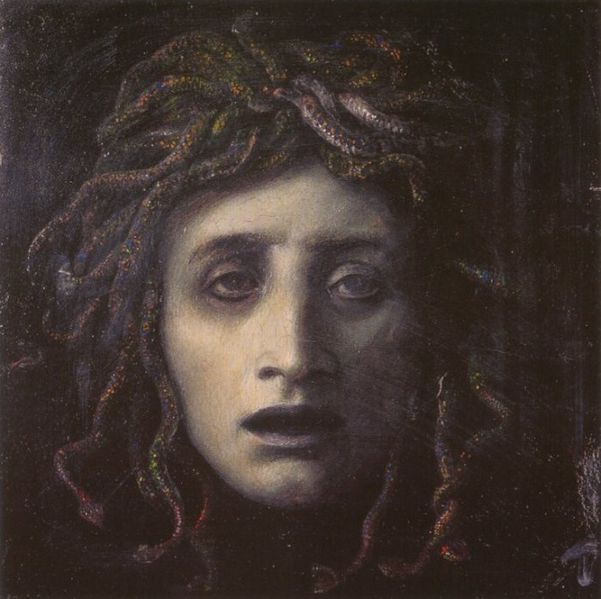
Seen as it's almost Halloween, I'm gonna write a post on the figure I'm dressing up as (and putting an embarrassing amount of effort into)! So everybody knows about Medusa...well...you should know anyway. The snake-headed hag who can turn you to stone with one glance (maybe this is where my aversion to looking people in the eye originates). As a Grendel's Mother fan, it's probably unsurprising that I have quite an interest and soft-spot for Medusa too. It wasn't until recently though, that I started looking into her myth a bit further, and I realised it's a lot more complex than I had originally thought. Which means this post is not going to show every version. Partly because that would make this even more boring than it already is, and partly because I'm lazy.

So, despite general conceptions, Medusa did not actually originate in Greece, but rather was imported from other cultures, most likely from the Amazons in Libya and other North African countries, where she was the destroyer aspect, Anath (Athene) of the Great Triple Goddess
The Greek take on Medusa is sometimes associated with the vanquishing of the goddess religions for those associated with male Gods (namely Zeus and Jupiter), sometimes associated with Apollo's killing of Python, the son of Gaia the Earth Goddess. Consequently, former peaceful goddesses were turned into monstrous figures, and replaced by the warrior type gods of Olympus.This is just a theory of course!


Braaaaains


And so, Medusa was turned into a monster! However, even the Ancient Greek myth is not known by many people, and in fact there seems to be a few variations of the myth.

The most popular myth of Medusa tells of a girl who was renowned for her beauty, wanted by every man around, and the subject of many bitching sessions by those who were jealous of her. Medusa, however, being a priestess of Athena/Minerva, could not get married, and was expected to stay chaste for her life. Unfortunately, this did not stop Poseidon, God of the Sea, who raped Medusa in the temple of Athena. If this wasn't bad enough, the fact that Medusa was taken advantage of in a place of worship, made Athena a very unhappy bunny. Athena was so angry that she turned Medusa's hair to serpents, and made her face so hideous that anybody unlucky enough to look at it would be turned into their very own Greek statue. Which, in my opinion, kind of makes Athena (and of course Poseidon) out to be the bad guy? No? 


Thomas More's translation from Ovid's Metamorphoses:

Beyond all others she  
was famed for beauty, and the envious hope  
of many suitors. Words would fail to tell  
the glory of her hair, most wonderful  
of all her charms--A friend declared to me  
he saw its lovely splendour. Fame declares  
the Sovereign of the Sea attained her love  
in chaste Minerva's temple. While enraged  
she turned her head away and held her shield  
before her eyes. To punish that great crime  
Minerva changed the Gorgon's splendid hair  
to serpents horrible. And now to strike  
her foes with fear, she wears upon her breast  
those awful vipers--creatures of her rage. 


Other versions of the Medusa myth do exist - some say Medusa was born a gorgon, some say she wasn't raped, but took Poseidon willingly, others say Athena was just jealous of Medusa's beauty.


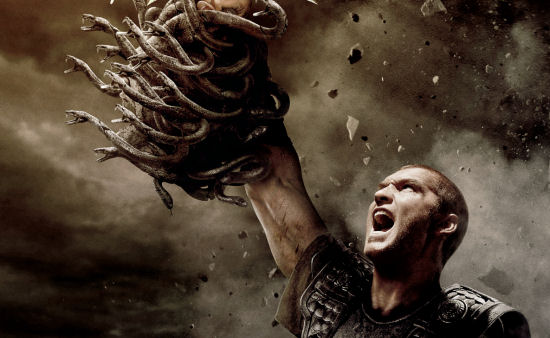
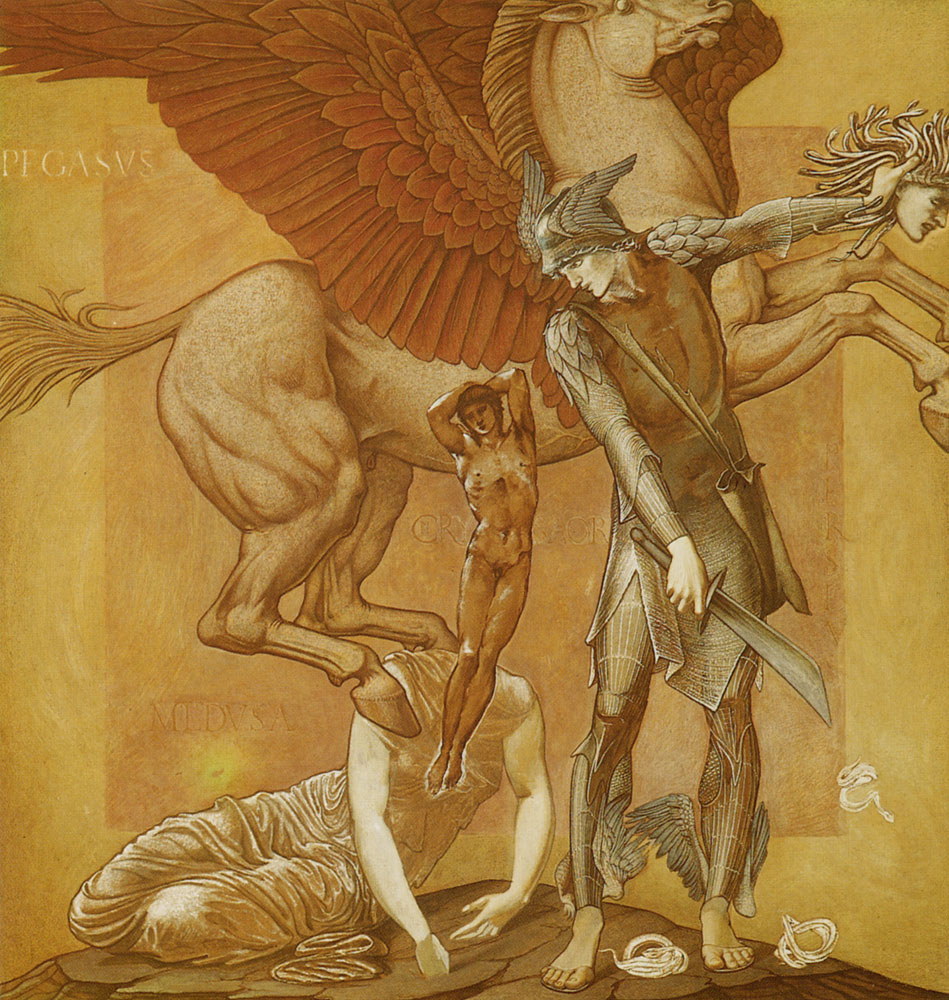
In the vast majority of retellings, Medusa is beheaded by Perseus, because her eyes still have the power to turn people (or krakens, as Sam Worthington and Harry Hamlin kindly show us in both versions of Clash of the Titans) to stone. As the story goes, Perseus used a mirrored shield to see Medusa without looking her in the eyes, clever fella that he was, and managed to chop her head off. As well as having a headful of snakes, it turned out that Medusa had a wombful of pretty unique children too - Pegasus, the winged horse, and Chrysaor, a sword-wielding giant. As ya do. And these children supposedly sprung from her blood-spurting neck. I'm not sure how exactly that would look, but according to Edward Burne Jones, it looked something like this:


According to Ovid, Persues then flew around a bit with his handy new sandals from Hermes, where he turned quite a number of individuals to stone, including the Titan Atlas, Cetus (who was about to Andromeda alive), and Phineus, whom Andromeda was promised to before Perseus flew in on his golden winged sandals (or on Pegasus in more western takes on the myth) and impressed the hell out of her. Last, but not least, Perseus flew to Seriphos where he rescued his mother from her forced marriage to King Polydectes (sounds like some sort of pterodactyl), who had sent Perseus for Medusa's head in the first place.

Also, while Medusa was dead, she still managed to spawn some more offspring, namely Amphisbaena, a serpent with a head on both ends, as her blood dripped onto the Libyan desert (where her myth originated, and in a way ended)! How nice.


An Amphisbaena in the Aberdeen Bestiary


Perseus by Aubrey Beardsley

Sunday, 15 September 2013

A Realistic Beowulf


On the whole, Beowulf isn't exactly a very realistic story....There's (apparent) sea monsters, a dragon, monsters (that depends on your stance on Grendel and his mommy), and various displays of superhuman strength and endurance. So, it's pretty interesting to find a retelling of Beowulf's adventures that are realistic (to an extent!).


Michael Crichton is known for his rational approach to fantastical stories, most notably in his 1990 novel that was made into the best film ever, Jurassic Park, where Richard Attenborough fills in the incomplete dinosaur DNA with amphibian DNA (unfortunately/fortunately this won't actually work).


Before Crichton was escalating the hopes of dinosaur fanatics, he was exploring Beowulf and coming up with ways in which it could really be explained...well...probably not really, as despite the ideas in his book being rational, they are still rather far-fetched. 

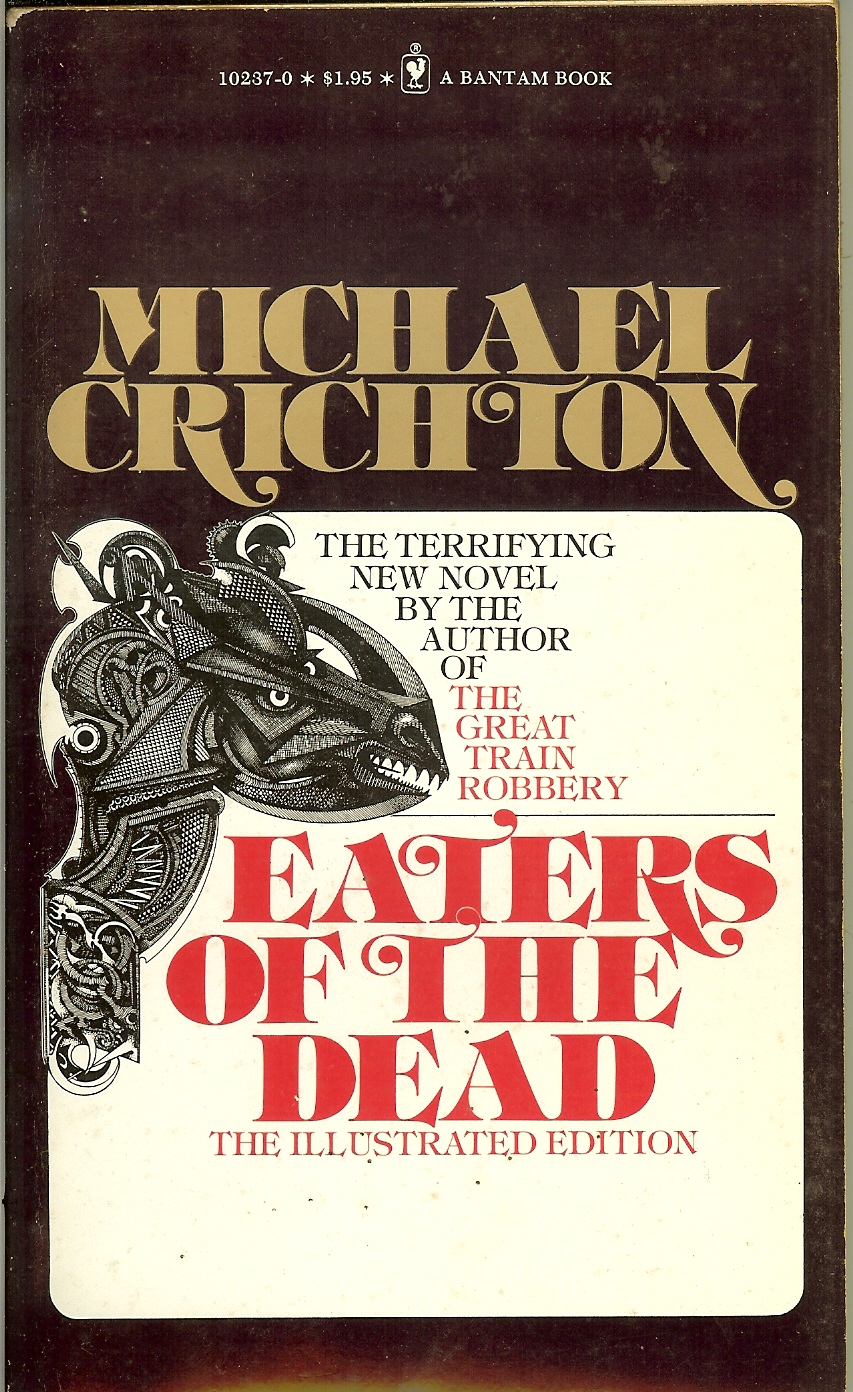
In 1976 Crichton released Eaters of the Dead: The Manuscript of Ibn Fadlan, Relating His Experiences with the Northmen in A.D. 922 (later made into The 13th Warrior, starring Puss in Boots). Crichton constructs the novel so that it imitates a real historical document, professing to be the chronicled expedition of Ibn Fadlan, who was an actual 10th Century Arabic explorer, known for his descriptions of the Volga Vikings. 

Parts of Ibn Fadlan's actual chronicles are present in the first few chapters of Eaters of the Dead, and in general it stays pretty close to his manuscript (or so I have read! I do not profess to know much about Ibn Fadlan's actual antics) up until chapter 4, where the story gradually turns into a retelling of Beowulf, and where Fadlan, who is originally sent to the king of the Volga Bulgars, is persuaded into joining a mad (aren't they always) group of Northmen, led by Buliwyf (an obvious play on Beowulf). Their quest is to destroy a "dread and nameless terror, which all the people are powerless to oppose". This terror, turns out to be a cannibalistic tribe known as the Wendol. 

Wendol, is surely both a reference to Grendel and to the Vandals, an early East Germanic tribe - nicely done, Michael, nicely done. The Wendol are described in Ibn as being "manlike in every respect, but not as any man upon the face of the earth". They are "short...broad and squat, and hairy on all parts of their bodies save their palms, the soles of their feet, and their faces" They had large prominent jaws, with large heads. Now, at the end of Cricthon's book, there is a fake appendix, fake footnotes, and fake sources, all to add to the idea of this being an actual real account (but a fictional real account...). So, at the end of the novel, these fake researchers are trying to explain Ibn Fadlan's accounts. So, we are given a realistic explanation for the Wendol. The Appendix describes them as being "suggestive of Neanderthal anatomy", which although should have vanished 30-40,000 years prior to Ibn Fadlan's accounts, were still in existence. In another one of these fake reports, "Goodrich", a "paleontologist" describes Ibn Fadlan's tendency to overstate facts and differences, suggesting that the Wendol may just have been uncivilized Homo Sapiens, whose cultural differences were interpreted as physical differences. Well...that was confusing!


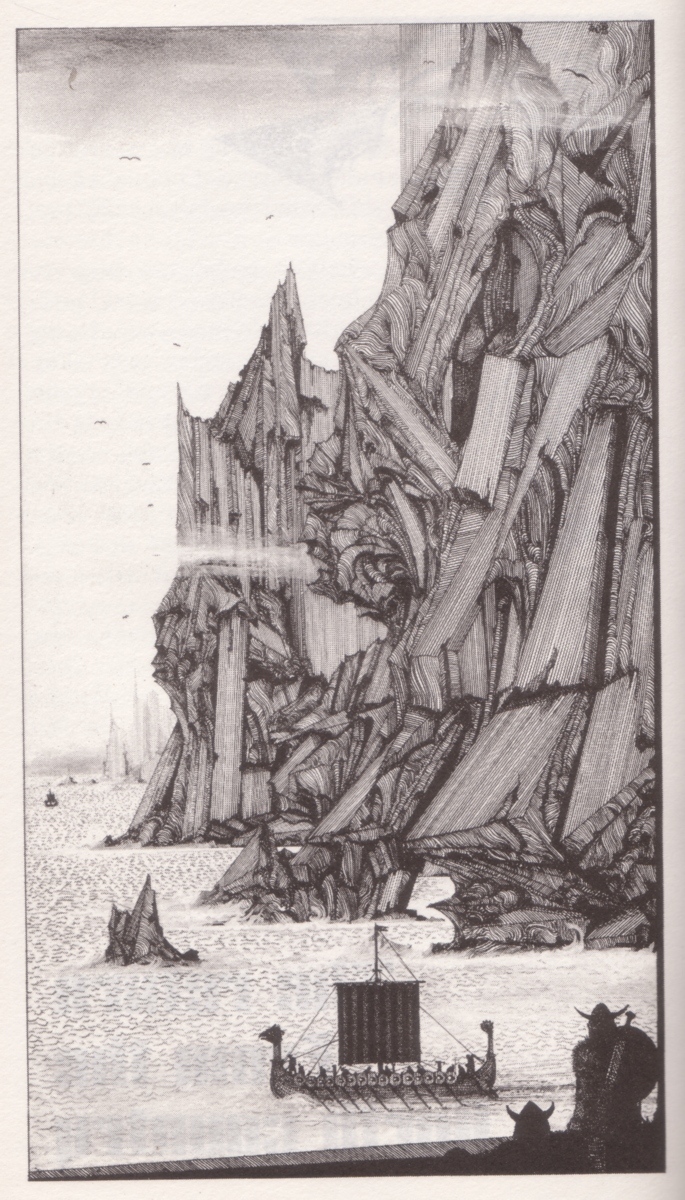
An image from the beautifully illustrated version of the novel


The next "monster" we come across is the "Korgon", or the dragon, later revealed to be Wendol carrying flames on horseback. Here, we are also told of a figure on horseback who had the head of a bear - perhaps a suggestion that the Wendol were berserkr (translated as "bearskin"), a type of Norse Warrior known for their war frenzy, their animal-skin attire and their general tomfoolery. Of course, it must be noted that our trust in Ibn Fadlan's accounts and descriptions is to be taken with a pinch of salt, as earlier in the novel, he describes "sea monsters" (a nice reference to those that Beowulf fights) that pass their boat, "spitting a fountain, and raising a giant tail split in two". Of course, we say "Duhhh, it's a whale, idiot!", but we must remember, this is an account of an Arab explorer, set in the 10th century, and although it's unlikely that they hadn't heard of whales, it is a nice touch to make us wary of Ibn's accounts. 


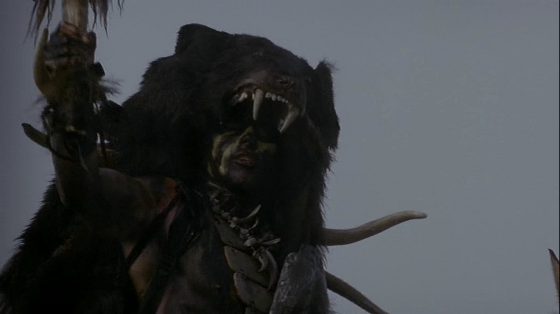
One of the Wendol, in The 13th Warrior


And now we come to my favourite bit....the bit where we talk about Grendel's Mother (AWWWW YEAAAH)! For the majority of the novel her existence is only hinted upon. One scene shows the discovery of a stone figure resembling a woman's torso - "there was no head, no arms, and no legs; only the torso with a great swollen belly and, above that, two pendulous swollen breasts", a "crude and ugly" figure which causes the Norsemen to physically puke violently (Breasts? Bleurggh!). Of course, this is an obvious reference to both the Venus of Hohle Fels and the Willendorf Venus, which are both associated with prehistoric times, and are therefore hinting at the humane although primitive nature of the Wendol. 


Venus of Hohle Fels and the Willendorf Venus


When we do get to finally meet the Mother of the Wendol Ibn Fadlan assumes she is female "but if she was female, [he] saw no sign, for she was old to the point of being sexless". She is described as being surrounded by snakes (perhaps a reference to Medusa, a figure often associated with Grendel's Mother and dangerous women in general). Unlike in the original poem she does not appear to have abnormal strength, and instead uses a poisoned pin on Buliwyf. 


Unlike many other adaptations, the Wendol here are not shown with any sympathy. The Wendol's Mother shows no anger over the death of her numerous kin, and it is implied that it is her who has been instigating these attacks on King Rothgar's people. The matriarchal society is seen as threatening and vomit-inducing, compared to the Scandinavians patriarchal society in which the women are seen as caretakers and consorts. Some Kristevan themes can be seen throughout the novel: Through the worship of the female mother, the Wendol are left barbaric and uncivilized, while the Northmen, who have pushed the maternal away have evolved into more refined civilians. Julia Kristeva suggests that in order to acquire language and align itself with the symbolic system, the subject must push the mother and the maternal body away. Similar themes can be seen in John Gadner's Grendel, where Grendel only finds language through pushing away from his mother and her primitive state.


Hopefully that wasn't so confusing! Goodbye, I am off to watch Channing Tatum.


Thursday, 8 August 2013

Grendel, Grendel, Grendel's Mother


This has to be one of the coolest book covers around


Another Grendel's Mother post, yaaaay! Today I'm going to write about John Gardner's novel Grendel, and the animated film adaptation, Grendel, Grendel, Grendel. That's a lot of 'Grendel's in one sentence.

Grendel was one of the first (and most popular) adaptations of Beowulf, being written in 1971, and is known for its sympathetic treatment of Grendel. The story is told from Grendel's point of view, with very little focus on Beowulf (he isn't ever named, and we only meet him at the very end). As Alexander Stitt's film narrates, "it is told "through twentieth century eyes, where one is more likely to see the humanity in a monster" - yeah, well, not for Grendel's Mother.


This retelling of the Beowulf story, features one of the most monstrous and animal-like Grendel's Mother around, and although the story is seen through Grendel's eyes, even less of his mother is seen than in the original poem. And although it is a different view of her, it's not necessarily anyway less monstrous than any translations of the poem. She is described as a "life-bloated, baffled, long-suffering hag", a "horrible, humpbacked, carp-toothed creature", with "strange eyes" and "bristly fur". Can you feel the love that he feels for his mum? She is obviously not human-like at all...well, I guess you could find some people who fit those descriptions, but anyway...


Even more notable than appearance, is Grendel and his Mother's intelligence - where Grendel is portrayed as intelligent, rational, and quite philosophical (along with the dragon), ad even has an upper class British accent in the film, while his mother has no voice at all - "she'd forgotten language long ago, or maybe had never known it" - she cannot even comprehend what Grendel says.

Despite all this, there is a small amount of sympathy for Grendel's Mother - perhaps she is not all that monstrous - "I was, in her eyes some meaning I could never know and might not care to know", "she would have given her life to end my suffering". And although we know how it pans out in the original poem, we can only presume that she avenges her son after the novel ends. This love for her son of course, isn't necessarily a human trait, but could rather be an animal's maternal instinct - I mean, shit, the Moorwen in Outlander was almost more human-like than this Grendel's Mother!


Brian Froud's depiction of Grendel


So, despite being a book that was great for Grendel, it's not exactly great for his mother. It is a good book however, and worth a read if you're into Beowulf. Sure fuckit, aren't we all. And this is where I realise I'm turning into one of those people...those people who write blogs on academic stuff. Goodbye childhood.


Grendel, Grendel, Grendel can be found here! It's worth watching especially for the part at the start.

And now I'm off to London. Goodbye, suckers!

Thursday, 18 July 2013

Space Grendels


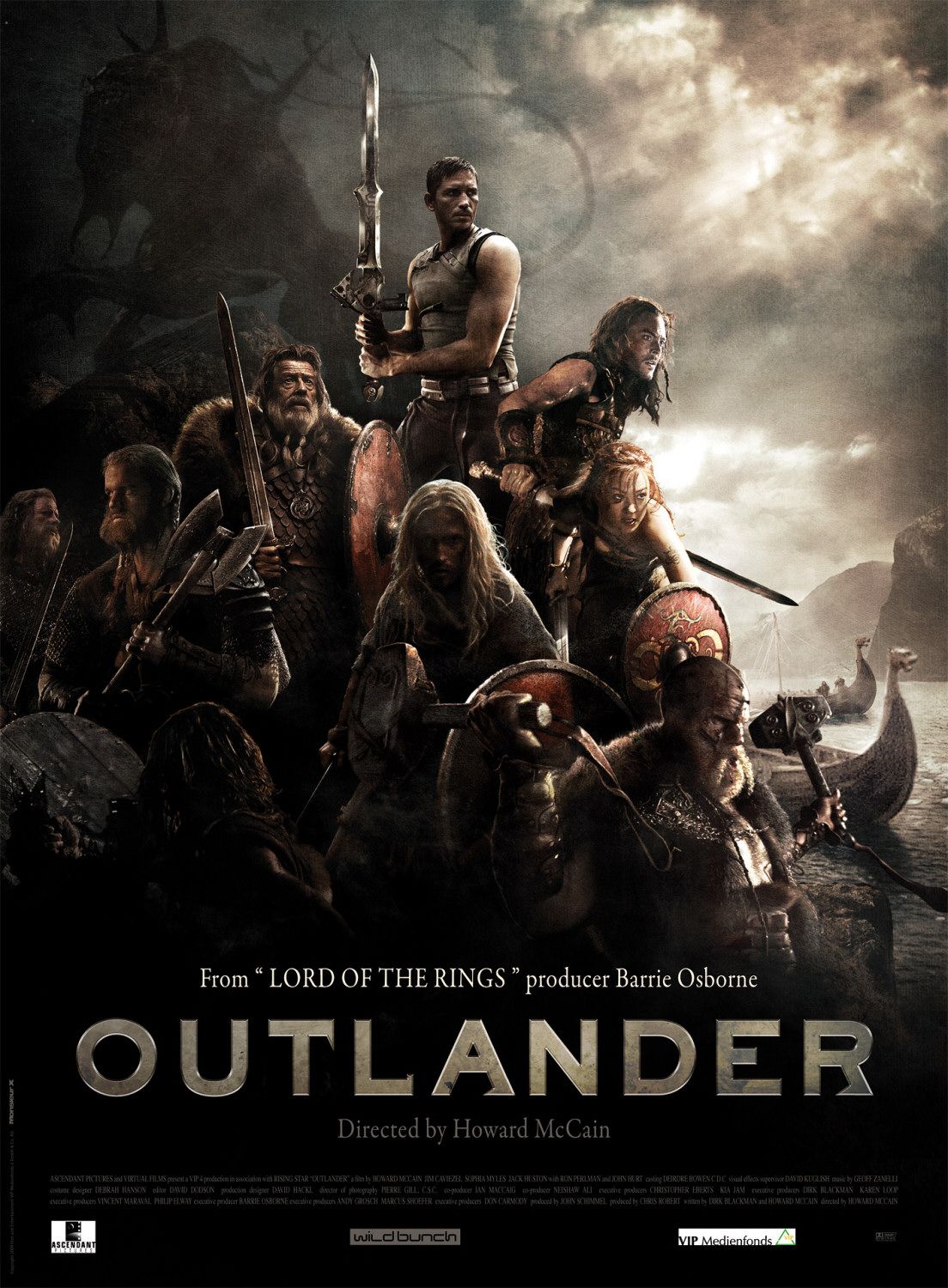
In the very few cases that people have asked me what my favourite Beowulf film is (most likely it's me telling them against their will when I'm shitfaced), I have to answer with Outlander. Funnily enough, it's only very vaguely got anything to do with Beowulf, and Grendel's Mother is the most monstrous that you'll probably ever see her. But all that aside, I think it's a pretty good film (but then again, I'm into all that kinda crap). And as well as its similarities to things like Clash of the Titans (I had to start calling this a guilty pleasure when I found out that it's not cool to like it) and 300, which I just can't get enough of, I think another reason I like this film is because of a certain viking....


So, I'm really gonna sell this movie to you now - basically, a man from another planet crashlands in 8th century Norway, unfortunately bringing along a 'Moorwen' which seems to have hitchhiked in his spaceship without consent. So, this fella, Kainan (played by Jim Caviezel, whoever the hell he is), then comes across King Hrothgar (John Hurt - a nod to Alien? minus chest-bursters) and his people, and the Moorwen starts attacking everybody, and the rest can be guessed from there. SOUNDS GREAT RIGHT? Yes, yes, I know, thank me later.

Outlander was made in 2008 by Howard McCain, and unsurprisingly nobody I know has ever heard of it, and it's one of those films that seems to get played on the Syfy channel sometimes (no way as good as such cinematic masterpieces like Mega Shark vs Giant Octopus and The Human Centipede of course). Anyway, as the story goes, McCain always wanted to make a Beowulf adaptation, but his agent told him that "everybody hates Beowulf" (how wrong could he be?!...actually, he was probably right...), so he decided to title it Outlander and made a few character changes....a few drastic ones. 

I'm going to concentrate on the Moorwen from here on in, because this monster beor appears to be some sort of re-imagining of Grendel's Mother. It's kind of hard to discern this Moorwen's gender, because as you'll see....


....yes, what the fuck is that?! It looks like some sort of warg-tyrannosaurus-komodo dragon-angler fish. So, according to Google Search, not many people seem to agree with my view that this is Grendel's Mother (in fact, only two results show up, neither of which actually says that the Moorwen is Grendel's Mother), but rather that the Moorwen is Grendel. But, if any of these people had paid attention, the Moorwen GIVES BIRTH to another one and then goes ape when her offspring is killed....sounds kind of like....yes, you got it, Grendel's Mother! 

Of course, like most films these days, Outlander makes us feel sympathy for the monster, and Kainan tells the Vikings about how his race of people thoughtlessly wiped out the Moorwen population in order to expand their own civilisation, and this last survivor of the species is just trying to exact revenge (and later on revenge for her dead offspring) - there seems to be a warning of urban expansion in there somewhere, but this is kind of undermined when they then proceed to "go kill this thing", seemingly losing their sympathy in a rush of adrenaline and human nature. At the very end, this vague sense of sympathy returns, just as the monster is about the die, but at the end of the day, she is just seen as a beast, and everybody can go back to drinking mead and running about on top of shields in peace, and Kainan gets the girl. Durrr.

But....saying all that, because I know it sounded very critical...I do like this film. It definitely beat watching a bleach-headed Beowulf do multiple back-flips to a soundtrack of techno, and it also beat watching Ray Winstone and Brendan Gleeson with their CGI'd abs looking like they're about to jump aboard the Polar Express. And I'll take an out-and-out monster over a porn star who turns into a praying mantis any day too! And it's worth watching it just for Wulfric. 


Sweet dreams


And, also, here is an amazing (and completely off topic) song that I feel I must spread to everyone and anyone who will listen.