Showing posts with label lord of the rings. Show all posts

Sunday, 15 December 2013

Beowulf: An Unexpected Journey


Having went to see The Hobbit: The Desolation of Smaug the other night, and only recently returning from the country of Tolkien's birth, I guess it's only natural that this post should concern him and The Hobbit's links with Beowulf. I have previously mentioned some things in a previous post, but let's make another one, sure why not lads.

Despite some dodgy CGI at times (I really can't understand how they can create such an amazing dragon, yet at times the horses look like they are taken out of Zemickis's Beowulf (see what I did there!)), and despite the fact that it will never be as great as Lord of the Rings, the film was really good. Surprisingly, I even liked the introduction of Tauriel to try and somewhat lessen the sausage-fest that The Hobbit is. And Kili, the obligatory exceedingly attractive dwarf (Ireland, I'm proud of you!). I enjoyed that part too.
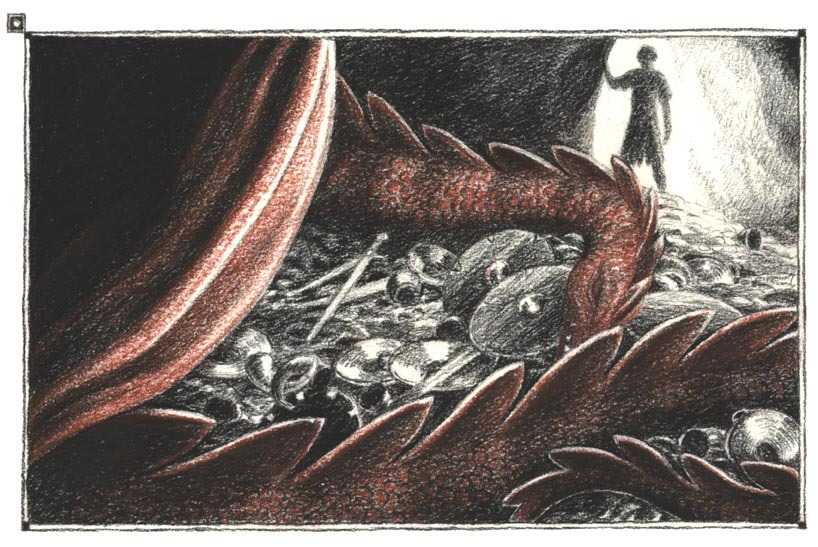


An illustration which would suit either Beowulf or The Hobbit.
It's actually from a Beowulf book by Anke Eissmann


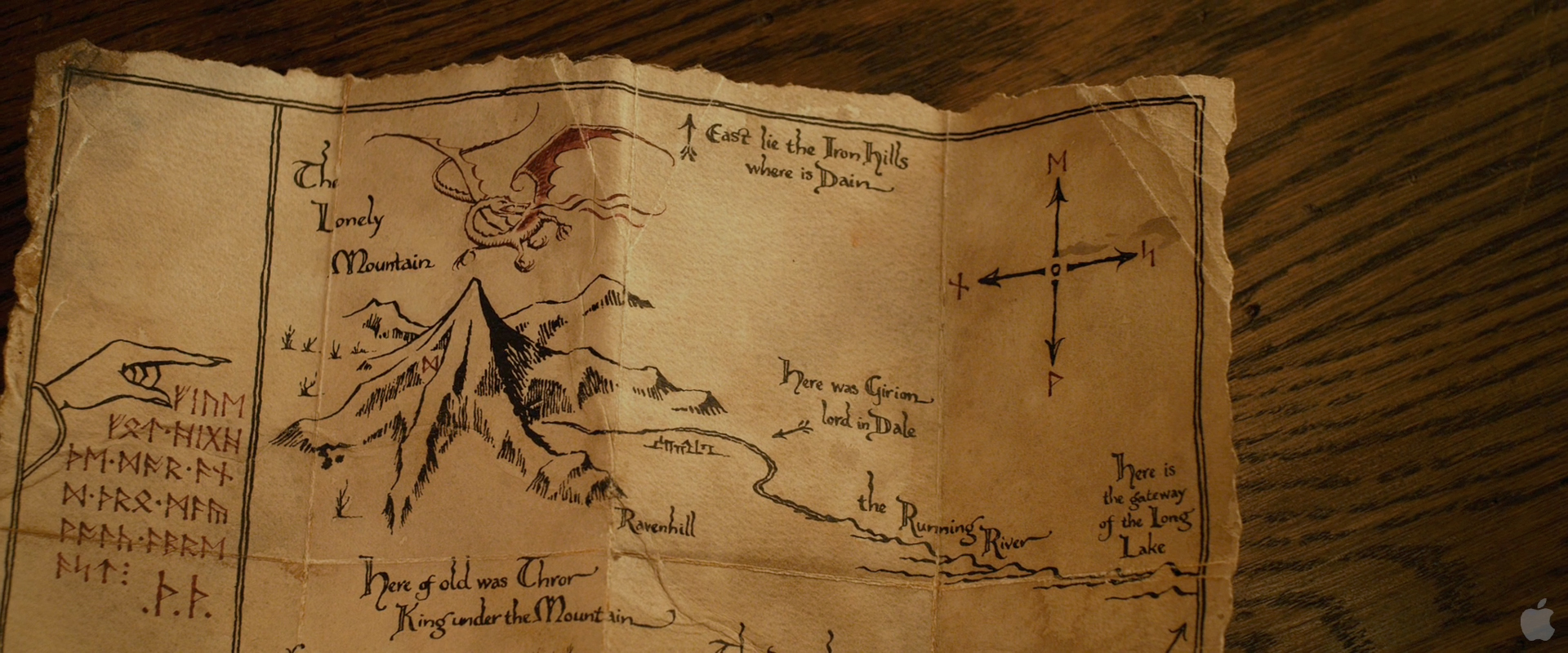
The most obvious link between The Hobbit and Beowulf is of course the dragon! In a way the dragon scenes are climaxes of both stories (although The Hobbit ends with a huge battle, it's fair to say that the dragon is the big thing in the story). Most notable, I think is the fact that the dragon is woken by the theft of a cup, by Bilbo in The Hobbit, and by some other eejit in Beowulf. As well as this, both dragons' lairs are entered by a secret passage: in Beowulf "there was a hidden passage, unknown to men" (Heaney's translation), whilst in The Hobbit, the dwarves (I guess you could extend this entrance as being "unknown to men" also, seen as dwarves technically aren't men) enter by the secret passage, revealed only at a certain time - the last light of Durin's Day. After the theft of treasure from both dragons' barrows, they both go absolutely ape and enact revenge on the surrounding land - from this, we can deduce that dragons have the emotional capacity of a 5 year old child. As in Beowulf, it is not the protagonist that kills the dragon in The Hobbit, but a relatively minor (but very honourable) character - Bard. Both dragons end up in a pretty similar grave also - "they pitched the dragon over the cliff-top, let tide's flow and backwash take the treasure-minder" (Beowulf), and for Smaug; "he would never again return to his golden bed, but was stretched cold as stone, twisted upon the floor of the shallows". Sleep with the fishies.  

Another thing, which I was thinking of, is The Hobbit's influence on Beowulf adaptations - it is possible that the dragon from John Gardner's Grendel was made with considerable influence from Smaug, who unlike the Beowulf dragon, actually speaks, and appears to be able to hold a pretty decent conversation!


Grendel, by John Howe


Although a bit sketchy, there has been some comparisons between Grendel and Gollum. Although Gollum has a shit ton more brains and charisma than Grendel does, it is interesting to note some similarities. In Beowulf it is said that Grendel is a "grim demon", dwelling "among the banished monsters", a descendent of Cain (from Cain also sprang ogres (orcs?), giants (perhaps our friend, the cave-troll, from the Mines of Moria?), and elves...although it's pretty clear that Tolkien's elves aren't seen as Cain's clan - nobody as pretty as Legolas could be!). It is clear from both stories that both Grendel and Gollum are outcasts, both live in caves and both are pretty ugly. The point about Cain is also very interesting, because, as we learn in Lord of the Rings, Gollum, back when he was still known as Sméagol, killed Déagol (his relative) in order to take the ring. And while we know Gollum was once, many many years beforehand, a hobbit of sorts, there is also perhaps a human link for Grendel in his connection with Cain. 

Numerous other links exists between both stories
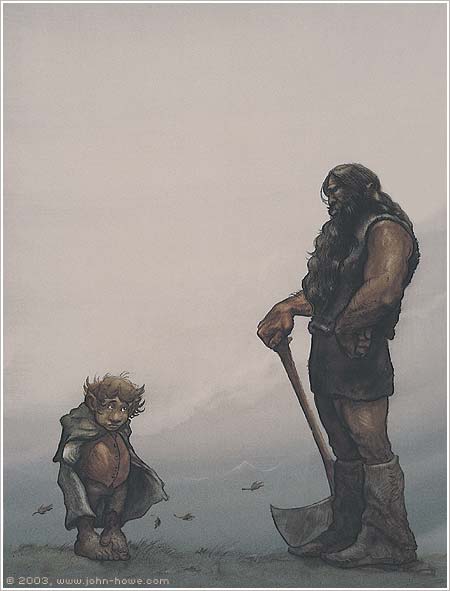


  • Beorn as a reworking of Beowulf himself. Perhaps? Perhaps. Both are proud and strong. And as seems to be happening all the time in Beowulf (isn't it a surprise he had time to do all his killing!), Beorn's home is full of feasting and story-telling. Futhermore, the name Beorn can have two different meanings - "man" or "warrior" from the Old English beorn, or "bear" from the Old Norse björn. On the other hand "Beowulf", means "bee-wolf", which is a kenning for "bear"! 


Beorn, by John Howe

  • As in Beowulf with Hrunting, the swords in The Hobbit are given names, like Sting, Glamdring, and Orcrist, depending on their history. 
  • As mentioned in this blog, a parallel can be seen when the dwarves are awaiting Bilbo's escape from the goblins' cave, and Beowulf's thanes awaiting his return from Grendel's Mother's mere.
  • Beowulf has 14 companions (so 15 in all). In The Hobbit, there are 13 dwarves, Bilbo Baggins making the 14th member. And Gandalf can be considered a 15th. 


Saturday, 6 July 2013

The real life Éowyn... kind of


As most people already know, J.R.R Tolkien was somewhat of an Anglo-Saxon, Middle Ages, and Norse Mythology enthusiast, having been involved in such works as Sir Gawain and the Green Knight (translator), Beowulf: The Monsters and the Critics (where he forgets about Grendel's Mother), and The Legend of Sigurd and Gudrún, as well as being professor of Anglo-Saxon studies in Oxford. Tolkien was also the founder of the Kolbitar club (members included C.S. Lewis), where a group would sit around and read Icelandic and Norse sagas over some pints of mead...well...maybe not the mead bit, but the rest is true.


WHERE CAN I GET THIS?!


So anyway, the influence of all these cultures and their literatures is pretty obvious to spot in The Hobbit and The Lord of the Rings trilogy. 

  • There were many 'rings of power' in Norse mythology - perhaps the one ring is based on "Andvaranaut", a magical ring forged by the dwarf Andvari. Norse god of mischief, Loki, tricked Andvari into giving him this ring, and so the dwarf, in revenge, curses the ring so that it brings destruction to whoever wore it. 
  • Many of the dwarves' names in The Hobbit are taken from Norse mythology, and can be seen in the Prose Edda, including Dvalin, Bifur, Bafur, Bombor, Dori, Nori, Ori, Oin, Fili, Kili, Gloin and Thorin!
  • There's clearly a link between Middle-Earth and Midgard, the Norse realm of humankind. 
  • There's a possibility that the inspiration for Smaug came from the dragon that appears in Beowulf 
  • Perhaps Arwen is an adaptation of Freyja, her necklace which she gives to Aragorn a version of the Brisings necklace, which Freyja wore to enhance her beauty. It is also notable that Freyja had a human lover, Óttar. 
  • And there are many more similarities...

And now that I've gone off the point somewhat, it's time to talk about what the post is actually about...Éowyn! But it's mostly about....Æthelflæd!


So, who the hell is Æthelflæd? Well, she just so happens to be a pretty kick-ass Anglo-Saxon woman. Born during the height of the Viking invasions, she was the daughter of Alfred the Great, King of the Anglo-Saxon kingdom of Wessex (the other three kingdoms being Northumbria, East Anglia and Mercia). During the 9th century, England was experiencing more frequent attacks from the Vikings, which culminated in "The Great Heathen Army" in 865. In 871,  Æthelflæd's uncle, King Æthelred died from wounds received in battle, and Alfred the Great came to power, winning a victory over the Danes. This led to a peace agreement, in  which the Vikings were given the eastern part of Mercia, to be incorporated into the Viking East Anglia. 

THIS IS ENGLAND

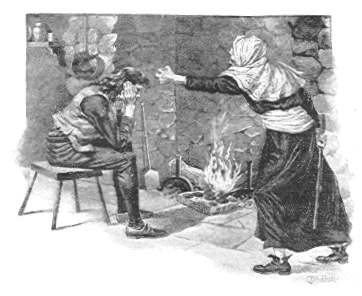
Unluckily for Alfred, the Vikings didn't keep their word (after all, they were plundering, raiding Vikings), and after a few years laid an attack on Wessex, and Alfred and the rest of the royal family were forced to flee to the Somerset marshes, while the lousy King of Mercia fled to Europe (what a dryballs). In Somerset, Alfred apparently took shelter in the home of a peasant woman who asked him to look after some cakes on the fire. Being too preoccupied with the kingdom and all that nonsense, he accidentally let the cakes burn. 

You let the cakes burn, you dope!

Anyway, while in Somerset, Alfred got together some followers and turned them into warriors (I'll Make a Man out of You from Mulan comes to mind), and defeating the Danes at the Battle of Edington. He eventually returned London to the Mercians, and Æthelred, ruler of the remaining Mercia recognised Alfred as his Overlord. And finally, Æthelflæd comes into the story, as she was offered by Alfred to Æthelred, to cement their alliance, much like a peace-weaver would have done in Ancient Scandinavia. Alfred defeated yet another wave of Vikings, and all across England, was recognised as king. After Alfred's death, his son Edward become king of Wessex. Meanwhile in Mercia, Æthelred falls ill, and Æthelflæd effectively became ruler. 

With her brother Edward, Æthelflæd raided Danish East Anglia and repulsed the last major Danish army sent to ravage England. Æthelflæd then won the support of the Danes, and formed an alliance with the Scots and the Welsh to stand against the Norwegian invaders. When her husband died in 911, she became the sole ruler of Mercia and builds fortifications throughout Mercia. She then went on to invade Wales in order to avenge the murder of a Mercian abbot Ecgberht, and succeeded in capturing the king's wife. Æthelflæd then led her armies against the Viking invaders, capturing their stronghold at Derby. In 918, the people of the region of York promised to pledge their loyalty to Æthelflæd in order to gain her support against Norse raiders. Unfortunately, before this could be realised, she died in the same year, leaving behind her daughter Ælfwynn as ruler of Mercia (although she is removed from power by Edward). 

Æthelflæd's and Éowyn's lives are by no means identical, I am not saying they are, but Æthelflæd was most likely an influence, especially noting that the Rohirrim in general seem to have been influenced by the Anglo-Saxons - their language is based on Old English, and the Hall "Meduseld" brings to mind images of the mead-hall, especially that of King Hrothgar's in Beowulf. In fact, comparisons can also be made between Éowyn and Wealhtheow, as both serve as cup-bearers in the Great Hall. Comparisons can also be made between the hymn sang by Eorl in Lord of the Rings and 'The Wayfarer', an Anglo-Saxon poem. And many more comparisons too. It makes sense that Éowyn should be based on Anglo-Saxon sources also (although there have also been comparisons made between her and the Valkyries of Norse Mythology), and is perhaps some sort of hybrid between the traditional cup-bearer Wealhtheow, and the more active and powerful Æthelflæd. 

Too often have I heard of duty,’she cried. ‘But am I not of the House of Eorl, a shieldmaiden and not a dry-nurse? I have waited on faltering feet long enough. Since they falter no longer, it seems, may I not now spend my life as I will? 
'What do you fear, lady?” he asked. 

'A cage,” she said. “To stay behind bars, until use and old age accept them, and all chance of doing great deeds is gone beyond recall or desire.'”

Éowyn's deeds also remind me of my reading of Lagertha. Also a shieldmaiden, she disguises herself as a man (much like the women in Lagertha's story do when their relam is attacked by the King of Sweden) and proves herself the be as capable as any man on the battlefield. Hell, she even kills the witch king!