Showing posts with label Vikings. Show all posts

Monday, 7 April 2014

Female power in Vikings Season 2


#vikings-shieldmaiden:  #Lagertha's career as a warrior began when Frø, king of Sweden, invaded #Norway and killed the Norwegian king Siward. F...


It is now half way through the second season of Vikings (for those who live in Canada or the US and for those who have few qualms regarding downloading). Obviously there will be spoilers, especially for those of you who are resigned to watching it in RTE 2! Suckers.

As she was in the first season, Lagertha is still my favourite character. This season also has a few more female characters of a bit more importance, most notably Aslaug, and it appears that the girl who Bjorn has his eye on may have a bigger role soon (But I can't help but be reminded of that absolute disaster The Legend of Hercules whenever I see her. Horrid flashbacks!). There are a few noteworthy moments involving the women of Vikings so far in the season:

Firstly, is Lagertha's decision to leave Ragnar, as Aslaug arrives on their doorstep with a bellyful of children. She has the dignity to walk away from Ragnar and start a new life with no drama involved, which is a nice change to the usual catfighting women screaming at one another over a man (even if he is as wonderful as Ragnar). In the actual mythology, Ragnar divorces Lagertha and there is a different woman, Þóra borgarhjörtr, in between her and Aslaug, but to be honest, that would make him look a bit too bad!


Four years later we see Lagertha with a new husband, Earl Sigvard, who is frankly, a bit of a dick. She stands up to his advances and his attempt to rape her and shows him where to shove it. As always, she does as she pleases, and returns to help Ragnar to reclaim Kattegat from Jarl Borg (as also happens in the myth - she comes to his aid with 120 ships, and saves his ass). 

In the last episode so far (episode 6), Lagertha returns to her second husband, despite still being in love with Ragnar (who is unwilling to choose just one wife). After getting his men to brutally beat her during the night, he attempts to publicly shame her by trying to show everyone at the table what lovely breasts she has. Unfortunately for him, she grabs a knife and turns around to stick it in his eye. Hell yeah! He is then beheaded by one of his own men (who I don't trust either...). In the myth, she is also responsible for her second husband's death; "the presumptious and self-indulgent woman would rather rule without her husband than share the glory with him" (Saxo Grammaticus). As you can see, the television series views her somewhat more sympathetically! Of course, this is as far as the mythology surrounding Lagertha appears to go, from what I can find, so its up to the series now! 


Another important scene takes place in Wessex in England (where attempts at speaking Old English are made...I understood cyning . . . so proud!) with Athelstan, the hot monk taken as a slave (and later made a free-man by Ragnar, and later captured by the people of Wessex), in episode 5. When a woman who is beaten because her husband thinks she has been unfaithful to him comes to King Ecgbert for counsel, the King asks him what the craic is with the pagans in such situations - Athelstan says that "if she was a free-woman, they would believe her word, and make judgement on her behalf". Ecgbert replies thinking that "surely her husband has every right over her, surely she belongs to him, to do with as he sees fit." Well, not according to the pagans! The open-minded Ecgbert (Athelstan has heard he is like Ragnar...and unlike the misogynistic Anglo-Saxons it would seem!) follows this pagan law and goes in the woman's favour. 

In general it would seem that the vast majority of main characters are somewhat "feminist" characters...to an extent. The Norse peoples, or as Ecgbert would say, the "pagans" have a more equal society than the Anglo-Saxons, allowing women to partake in raids and battle, and seemingly allowing them equal judgement in the eyes of the law. Of course, this didn't stop the vikings raping all around when they were on their raids, but this may also be seen as a "weapon of war" against the men, as much as it is seen as an act of violence against the women.


With regards to Aslaug, I am happy that this season is making a bit more of an attempt to flesh out her character, althoug it is not enough. Aslaug's character in mythology is pretty interesting - she is the daughter of Sigurd (who killed the dragon Fafnir) and Brynhildr, the shield-maiden, who I wrote a post on a few months back. As a child she was taken care of by a foster father, Heimer, and hid in a giant harp. Her next foster parents Ake and Grima, who killed Heimer as they thought there were valuables in the harp, found her hiding inside and raised her as their own, covering her in tar to hide her beauty (and therefore her noble birth). It is at this point that she meets Ragnar Lodbrok.
    Interestingly, Ragnar proposes to her, but she refuses him until he accomplished his mission in Norway. It is also, only after giving him three sons, that she reveals her true noble blood to him (after she hears that he has planned to marry Ingeborg), and promises to give birth to a child that bore a snake's eye, Sigurd Snake-In-The-Eye!

In the series, although she is not so much the "Other Woman" as she was at the end of season one, she is still portrayed as a bit of a princess, complaining about dirt and playing the jealous wife when Ragnar speaks to other girls. Hopefully we will get a more rounded character as we go along.


Also, GAME OF THRONES IS BACK, BYE

Sunday, 15 September 2013

A Realistic Beowulf


On the whole, Beowulf isn't exactly a very realistic story....There's (apparent) sea monsters, a dragon, monsters (that depends on your stance on Grendel and his mommy), and various displays of superhuman strength and endurance. So, it's pretty interesting to find a retelling of Beowulf's adventures that are realistic (to an extent!).


Michael Crichton is known for his rational approach to fantastical stories, most notably in his 1990 novel that was made into the best film ever, Jurassic Park, where Richard Attenborough fills in the incomplete dinosaur DNA with amphibian DNA (unfortunately/fortunately this won't actually work).


Before Crichton was escalating the hopes of dinosaur fanatics, he was exploring Beowulf and coming up with ways in which it could really be explained...well...probably not really, as despite the ideas in his book being rational, they are still rather far-fetched. 

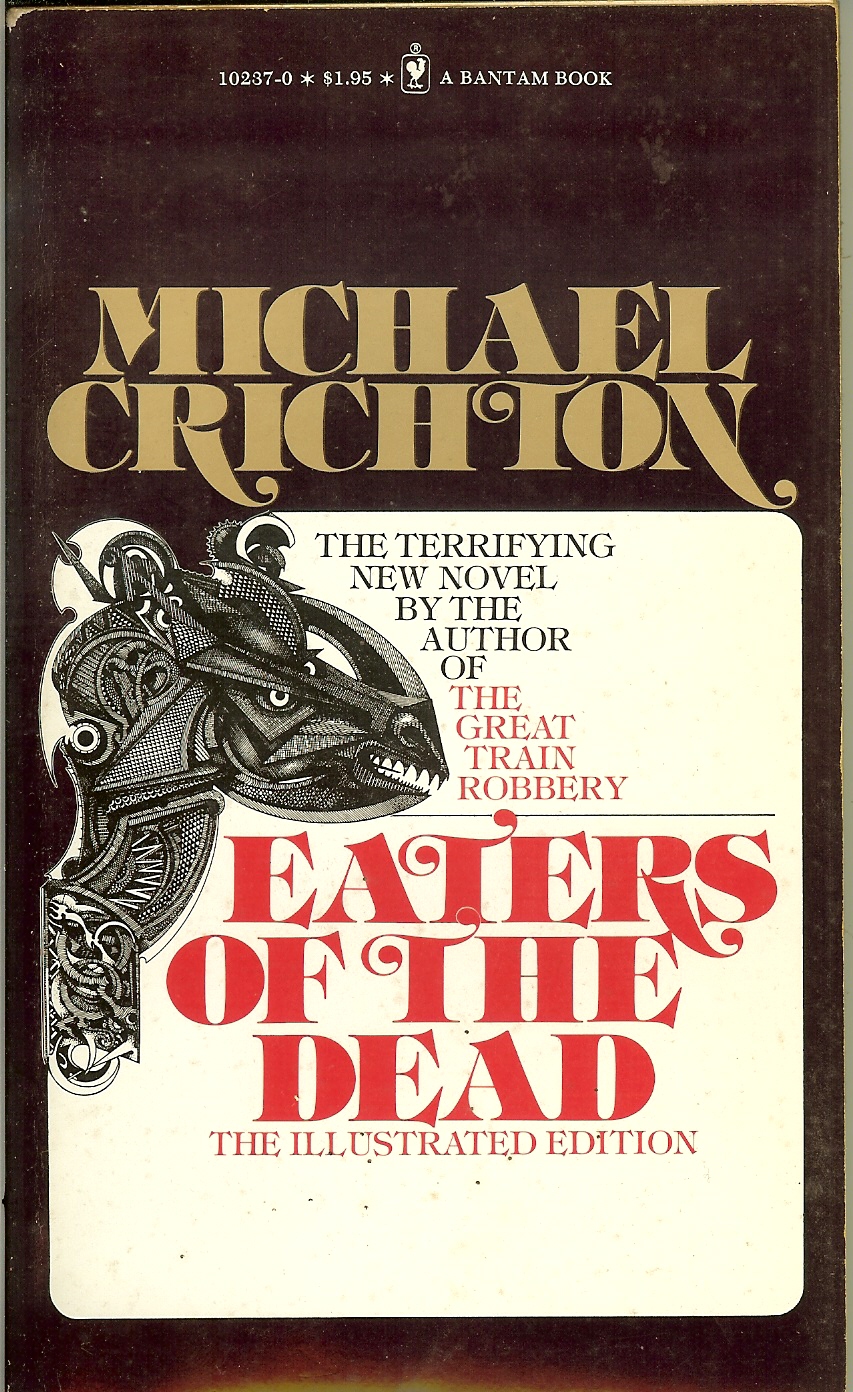
In 1976 Crichton released Eaters of the Dead: The Manuscript of Ibn Fadlan, Relating His Experiences with the Northmen in A.D. 922 (later made into The 13th Warrior, starring Puss in Boots). Crichton constructs the novel so that it imitates a real historical document, professing to be the chronicled expedition of Ibn Fadlan, who was an actual 10th Century Arabic explorer, known for his descriptions of the Volga Vikings. 

Parts of Ibn Fadlan's actual chronicles are present in the first few chapters of Eaters of the Dead, and in general it stays pretty close to his manuscript (or so I have read! I do not profess to know much about Ibn Fadlan's actual antics) up until chapter 4, where the story gradually turns into a retelling of Beowulf, and where Fadlan, who is originally sent to the king of the Volga Bulgars, is persuaded into joining a mad (aren't they always) group of Northmen, led by Buliwyf (an obvious play on Beowulf). Their quest is to destroy a "dread and nameless terror, which all the people are powerless to oppose". This terror, turns out to be a cannibalistic tribe known as the Wendol. 

Wendol, is surely both a reference to Grendel and to the Vandals, an early East Germanic tribe - nicely done, Michael, nicely done. The Wendol are described in Ibn as being "manlike in every respect, but not as any man upon the face of the earth". They are "short...broad and squat, and hairy on all parts of their bodies save their palms, the soles of their feet, and their faces" They had large prominent jaws, with large heads. Now, at the end of Cricthon's book, there is a fake appendix, fake footnotes, and fake sources, all to add to the idea of this being an actual real account (but a fictional real account...). So, at the end of the novel, these fake researchers are trying to explain Ibn Fadlan's accounts. So, we are given a realistic explanation for the Wendol. The Appendix describes them as being "suggestive of Neanderthal anatomy", which although should have vanished 30-40,000 years prior to Ibn Fadlan's accounts, were still in existence. In another one of these fake reports, "Goodrich", a "paleontologist" describes Ibn Fadlan's tendency to overstate facts and differences, suggesting that the Wendol may just have been uncivilized Homo Sapiens, whose cultural differences were interpreted as physical differences. Well...that was confusing!


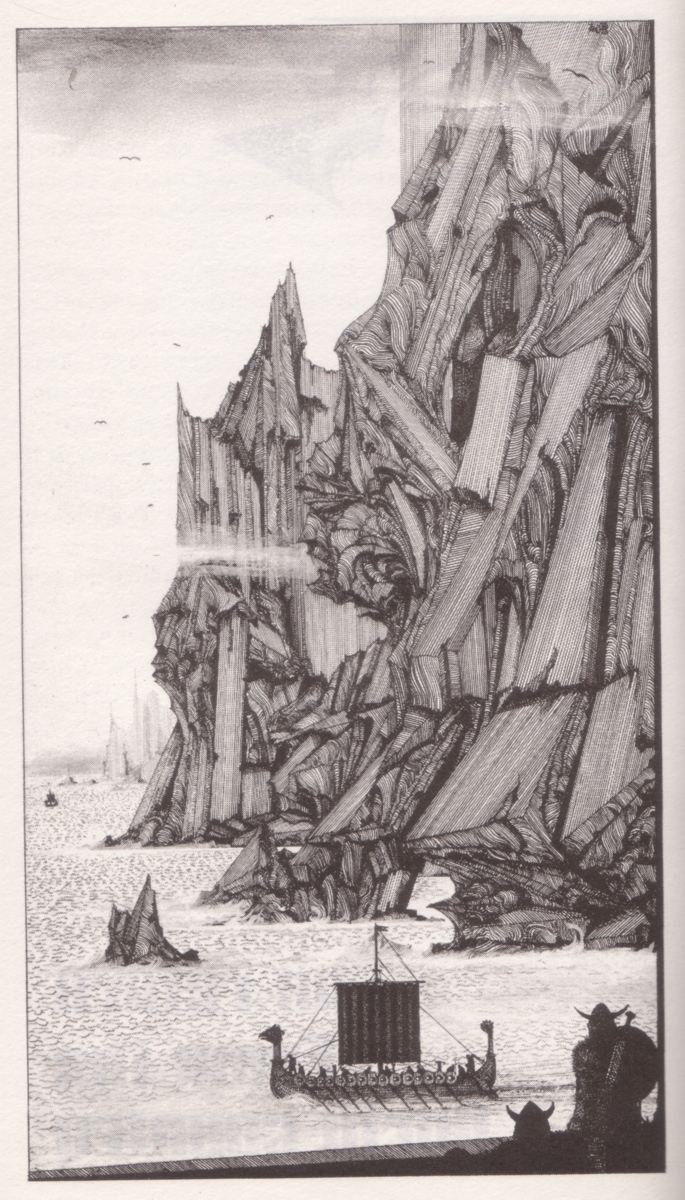
An image from the beautifully illustrated version of the novel


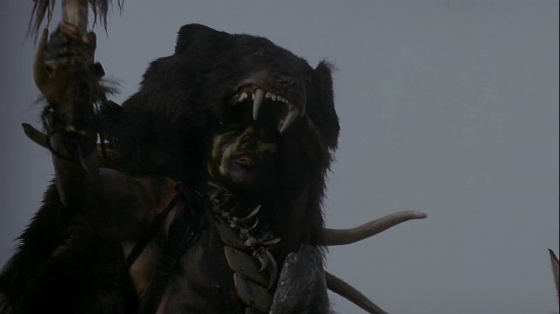
The next "monster" we come across is the "Korgon", or the dragon, later revealed to be Wendol carrying flames on horseback. Here, we are also told of a figure on horseback who had the head of a bear - perhaps a suggestion that the Wendol were berserkr (translated as "bearskin"), a type of Norse Warrior known for their war frenzy, their animal-skin attire and their general tomfoolery. Of course, it must be noted that our trust in Ibn Fadlan's accounts and descriptions is to be taken with a pinch of salt, as earlier in the novel, he describes "sea monsters" (a nice reference to those that Beowulf fights) that pass their boat, "spitting a fountain, and raising a giant tail split in two". Of course, we say "Duhhh, it's a whale, idiot!", but we must remember, this is an account of an Arab explorer, set in the 10th century, and although it's unlikely that they hadn't heard of whales, it is a nice touch to make us wary of Ibn's accounts. 


One of the Wendol, in The 13th Warrior


And now we come to my favourite bit....the bit where we talk about Grendel's Mother (AWWWW YEAAAH)! For the majority of the novel her existence is only hinted upon. One scene shows the discovery of a stone figure resembling a woman's torso - "there was no head, no arms, and no legs; only the torso with a great swollen belly and, above that, two pendulous swollen breasts", a "crude and ugly" figure which causes the Norsemen to physically puke violently (Breasts? Bleurggh!). Of course, this is an obvious reference to both the Venus of Hohle Fels and the Willendorf Venus, which are both associated with prehistoric times, and are therefore hinting at the humane although primitive nature of the Wendol. 


Venus of Hohle Fels and the Willendorf Venus


When we do get to finally meet the Mother of the Wendol Ibn Fadlan assumes she is female "but if she was female, [he] saw no sign, for she was old to the point of being sexless". She is described as being surrounded by snakes (perhaps a reference to Medusa, a figure often associated with Grendel's Mother and dangerous women in general). Unlike in the original poem she does not appear to have abnormal strength, and instead uses a poisoned pin on Buliwyf. 


Unlike many other adaptations, the Wendol here are not shown with any sympathy. The Wendol's Mother shows no anger over the death of her numerous kin, and it is implied that it is her who has been instigating these attacks on King Rothgar's people. The matriarchal society is seen as threatening and vomit-inducing, compared to the Scandinavians patriarchal society in which the women are seen as caretakers and consorts. Some Kristevan themes can be seen throughout the novel: Through the worship of the female mother, the Wendol are left barbaric and uncivilized, while the Northmen, who have pushed the maternal away have evolved into more refined civilians. Julia Kristeva suggests that in order to acquire language and align itself with the symbolic system, the subject must push the mother and the maternal body away. Similar themes can be seen in John Gadner's Grendel, where Grendel only finds language through pushing away from his mother and her primitive state.


Hopefully that wasn't so confusing! Goodbye, I am off to watch Channing Tatum.


Monday, 12 August 2013

Freaky Freydís


It is generally assumed that all Viking raiders and warriors were men (lazy archaeology?), but that's not actually the case - quite a large percentage (up to half in some cases) were actually women, Freydís Eiríksdóttir being one of the more notable (and absolutely mental) ones, as the following picture accurately conveys:


Here is a lovely wax figure of the woman herself in Reykjavik. Smashing stuff.


Daughter of Erik the Red, who was a (most likely) Norwegian fella who founded the first Norse settlement in Greenland (who the hell would want to live there is what I ask), Freydís is generally known to have been involved in the Norse exploration of North America around 1,000AD or so (quite a bit before 1492 I may add) along with her brother Leifr. 

Freydís appears in two sagas; the Saga of Erik the Red, and the Grœnlendinga Saga, both believed to be composed in the 13th century. Events from an expedition to Vinland (in North America) are described in the first of these sagas - during this visit to America, the Vikings traded with what they called the Skrælingjar, the peoples from around North America and Greenland. 


Vinland on the left. This map is reputedly pre-Colombian, although possibly a forge


    As the story goes, trading all went well until the Vikings ran out of everything except cow's milk. The Skrælingjar turned out to be lactose intolerant, of course, and thought they were being poisoned. This, along with a rather uneasy encounter with a bull ("what in god's name is that devil-beast?"), made, as one can imagine, things a bit tense, and the shit hit the fan.
    Freydís, who was heavily pregnant at this time, and therefore less agile than a hippo on stilts, found herself abandoned by her spineless crew, who were starting to set sail. Seeing them flee she shouted after them: "Why run you away from such worthless creatures, stout men that ye are [...] Let me but have a weapon, I think I could fight better than any of you." And so, she proceeded to find the sword of one of her dead companions, and when the Skrælingjar came upon her, she bared her breasts and beat the sword against them, letting out a battle-cry. Needless to say, they fled in terror, and so would you, had you encountered that wax figure above or this orangutan below:


So, she sounds cool, right?! I'm sorry, but your dreams of a new idol are about to be smashed into tiny pieces. Read on.

Obviously thrilled by this exhilarating experience (who doesn't like to act out King Kong?), Freydís decided to make a deal with some poor Icelandic feckers, Helgi and Finnbogi, and returned to Vinland, after agreeing to split the goods half and half with the brothers. Being the snake in the grass that she was, Freydís snuck a few extra men onto her ship (she also convinced the two brothers to let her take the bigger of the ships). Due to differences of opinion, by the time they arrived in Vinland, two camps were set up. Later on, Freydís told her husband that the two lads had assaulted her, and ordered them and their crew killed. The orders were followed, but her men refused to kill the unarmed women - Freydís saw to them herself, chopping off the five of their heads, no bother at all to her. 

Not wanting to be seen as batshit crazy back home, she ordered silence on the matter for their return to Greenland. Her brother Leifr, obviously being a bit suspicious that the crew has magically shrunk by bloody half, resorted to torturing the truth out of some of the men. Being the just man that he was, he did....absolutely nothing, and Freydís got away with it all. I suffer more repercussions if I forget to hang the godanm washing out!


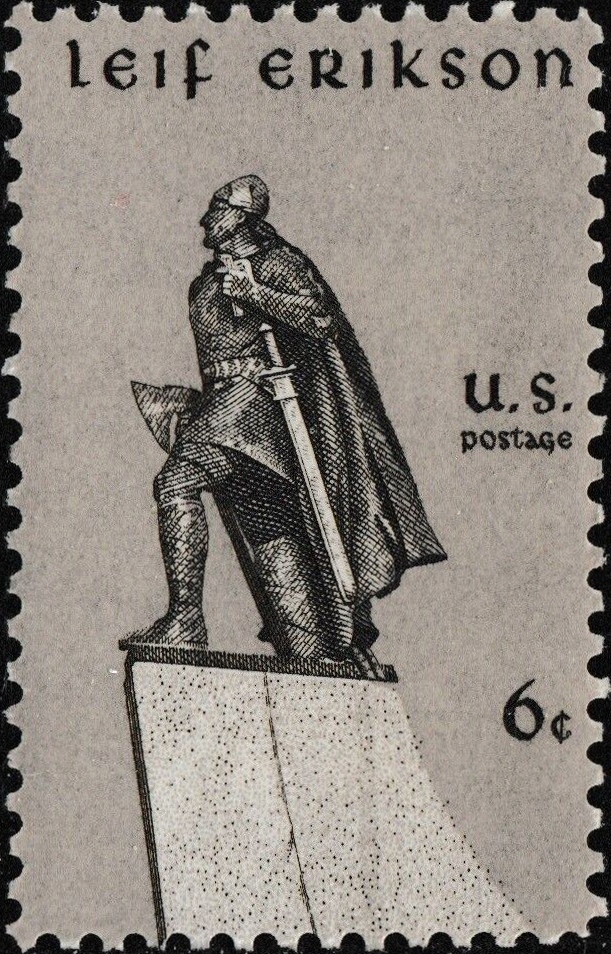
Leif Erikson, an all too forgiving brother


So, unfortunately, Freydis turned out to be a pretty horrible, greedy, merciless, thundering bitch, but either way, she is an interesting figure - a strong willed, courageous woman, but certainly not one to look up to or follow after - unless you fancy being secured in a psychiatric ward of a prison.

Monday, 22 July 2013

Brynhildr - a Norse rom-com (minus the comedy... and much of the romance)

Brynhildr, depicted by Robert Engels in 1919


We've already talked about one (official) shieldmaiden, Lagertha, so I think it's time we talk about some more kickass Norse wimmins.

Interestingly enough (maybe? Is it? I dunno), there is a connection between Lagertha and the more famous shieldmaiden we are going to talk about today - Brynhildr. You may recall that Ragnar Lodbrok took Brynhildr's daughter, Aslaug, as his third wife, after divorcing Lagertha (I'm still a bit butt hurt over this). Brynhildr also has a connection to another figure, Gudrun/Kriemhild, who I want to discuss more in the future (she does pop up here quite a bit). Shit, she even has a connection to Grendel's Mother in Xena: Warrior Princess (Grinhilda)! Basically, Brynhildr gets around!

DISCLAIMER: There will be a whole lot of name repetitions - you will never want to hear the name Brynhildr again! Brynhildr Brynhildr Brynhildr!

The character of Brynhildr may be famous from Wagner's Ring Cycle, Der Ring des Nibelungen, but she started out as a figure in Norse mythology (and possibly even before this as Brunhilda of Austrasia, a real life Visigothic princess). Although, to be completely honest, most people will have heard the name Brynhildr/Brunhilde/blablabla etc, from things like Xena, various video games, World of Warcraft, Django Unchained, and by the looks of it, some softcore manga...what the...

Eh, anyway. Brynhildr appears in the Völsunga saga, a 13th century Icelandic text and some Eddic poems. In the Völsunga saga, she is condemned by Odin to live life as a mortal woman and imprisoned in a ring of fire until a man rescues and marries her. The lucky man to come and rescue Brynhildr was Sigurðr Sigmundson, hero of the Volsung saga, and needless to say, the two of them fall madly in love, ending with Sigurðr's offer of the ring Andvaranaut (which is likely to be an influence for the one ring in LOTR) as a proposal. Sigurðr, who needs to run off on important business, promises to return to make Brynhildr his bride. In the meantime, Gudrun comes over for a cup of tea and to ask for some help in interpreting a dream, which coincidentally enough foretells Sigurðr's betrayal of Brynhildr and his marriage to Gudrun - forget Freud, these guys really knew their dreams!


The man himself . Killing Fafnir.


So, at this stage, Sigurðr is off with Gjuki, the King of Burgundy. Gjuki's wife, Grimhild, who happens to be Gudrun's mother dearest AND a sorceress (how unlucky), prepares a magic potion so that Sigurðr will forget about Brynhildr. And alas, the potion does its job, and he marries Gudrun instead. In some strange series of events, Gjuki's wife then decides to marry her son Gunnar to Brynhildr (what a terrible mother-in-law she would have been). However, Gunnar finds that he can't get through this ring of flames, and so, Sigurðr offers to exchange shapes with him, and enters to claim her hand. So Sigurðr, disguised as Gunnar, stays with Brynhildr for three nights, putting a sword in between them so she will retain her virginity (imagine if they couldn't find a sword - close one!) and then takes the One Ring to Rule Them All from her finger to later give to Gudrun (oh no he didn't!). Sigurðr and Gunnar return to their true forms and Gunnar is married to Brynhildr.

And this is where shit gets real. Gudrun and Brynhildr start arguing about who has the better husband, where Brynhildr starts bragging about how brave her Gunnar was to ride through the flames to get her, causing Gudrun to drop the bombshell that it was actually Sigurðr. As you can imagine, Brynhildr goes ape, and Sigurðr starts to remember the truth, but fails to console her. So, Brunhildr tries to urge Gunnar to kill him, telling him that Sigurðr slept with her - Gunnar, being too scared to kill Sigurðr himself, gives his little brother a potion that enrages him, causing him to kill Sigurðr. Brynhildr then kills Sigurðr's son, and during Sigurðr's funeral, throws herself on his funeral pyre, thus entering into Hel with him - a somewhat romantic ending...in a rather messed up way.


Brünnhilde throws herself on the flames. By Arthur Rackham for Wagner's Ring Cycle


Have you died of boredom yet? There are differences in other versions of the story found in a few Eddic poems (eg Aslaug is Brynhildr's and Sigurðr's daughter), but honestly, ain't nobody got time fo' that.


The story of Brynhildr can then be found in the Nibelungenlied, a Middle High German epic poem about Siegfried (Sigurðr). There are quite a few differences regarding her tale in this version - Brunhild is the queen of Iceland, and with Siegfried's help (who is hidden under an invisibility claok that he got off Albus Dumbledore), Gunther (Gunnar) wins Brunhild in a series of rather warlike games. There doesn't appear to be any suggestion that Siegfried had proposed (or even known) Brunhild before this.

Brunhild, who is suspicious of Siegfried (as Gunther introduced him as a vassal, although he was actually royalty), denies Gunther her virginity until he tells her the truth. Gunther tries to take her by force, but Brunhild merely pushes away his advances as if he were a tiny kitten and ties him to the ceiling. 


Gunther's Wedding Night by Johann Heinrich Füssli


The next day, Gunther, being a little bit put out at not getting the ride, tells Siegfried what happened, so Siegfried enters their bed chamber that night under cover of the invisibility cloak, and holds Brunhild down until she submits to Gunther's will - a bit rapey if you ask me. In this version of the story, this is when Siegfried takes "a ring" from her finger (along with a girdle), which is later shown to her  y Kriemhild (Gudrun) during their "my husband is better than yours" argument - thus giving away the game. Hagen, Brunhild's vassal, promising to take revenge on the wrongdoer then kills Siegfried. So, as you can see, this version has a lot less romance, and a lot less sympathy for Siegfried/Sigurðr. 


Some other time I will discuss Wagner's Der Ring des Nibelungen, because this post is about forty-two times longer than I'd intended it to be. It's time for me to go watch Wrath of the Titans and see if it's as class....I mean....crap.... as Clash of the Titans (whose tagline was "Titans will Clash" - I never tire of telling people this).


Wednesday, 3 July 2013

Vikings!


So History Channel's new series Vikings showed in April and started an obsession. Its second season is currently being filmed in Wicklow, near the beautiful Glendalough (and I'm still holding out hope that I'll get cast as an extra), and will be out next year.

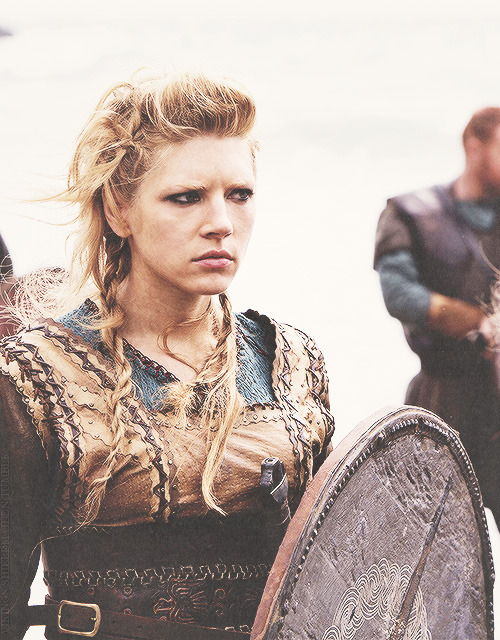
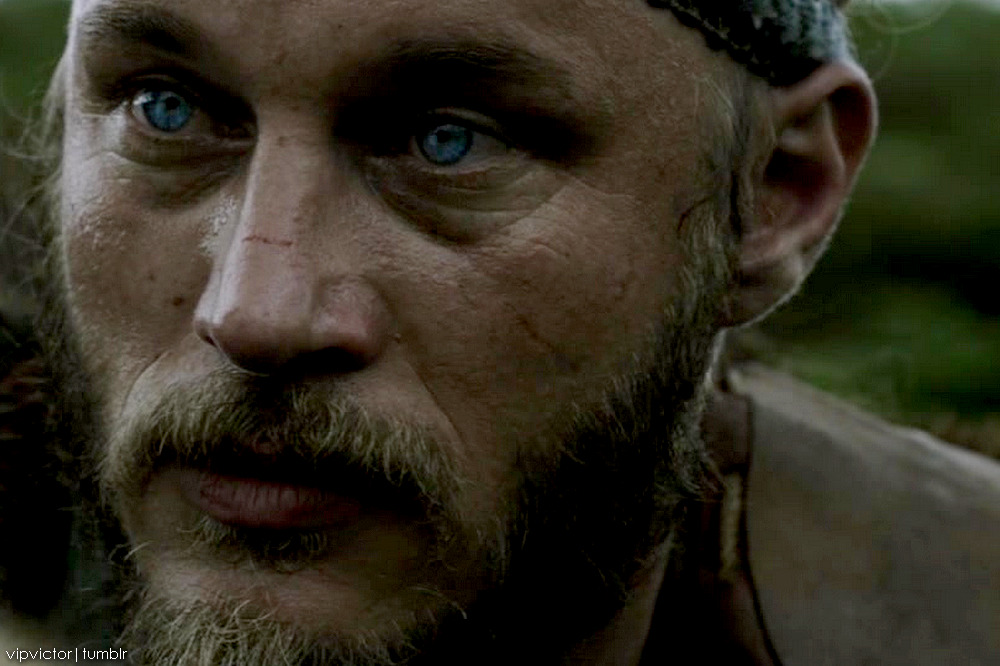
So, the fact that Vikings is attempting to be as close to history as possible is pretty cool, and there is a very authentic feel from it, and there is even a good attempt at the characters speaking a bit of Old Norse and Old English. Cooler still, is Lagertha Lothbrok, played by Canadian actress Kathryn Winnick. And Travis Fimmel's (who plays Ragnar) eyes deserve a mention too.


But anyway, back to Lagertha, who is my main interest, because she is one of those rare female characters who show that women are just as good as men when it comes to wits and battle (not me, personally, so don't take this as a challenge). And she's absolutely beautiful without being overly sexualised or turned into a mere ornament for viewers. And her hair, look at her hair! Basically, I want to be her. 

Anyway....I was interested to find that she was loosely based on a real life Danish shieldmaiden, and was also the real life wife of Ragnar Lodbrok (Lothbrok in the series). Lagertha's story was recorded in Saxo Grammaticus' History of the Danes, written in the 12th Century (and assumed to be mostly fictional by scholars such as Judith Jesch). Saxo describes her as so: 

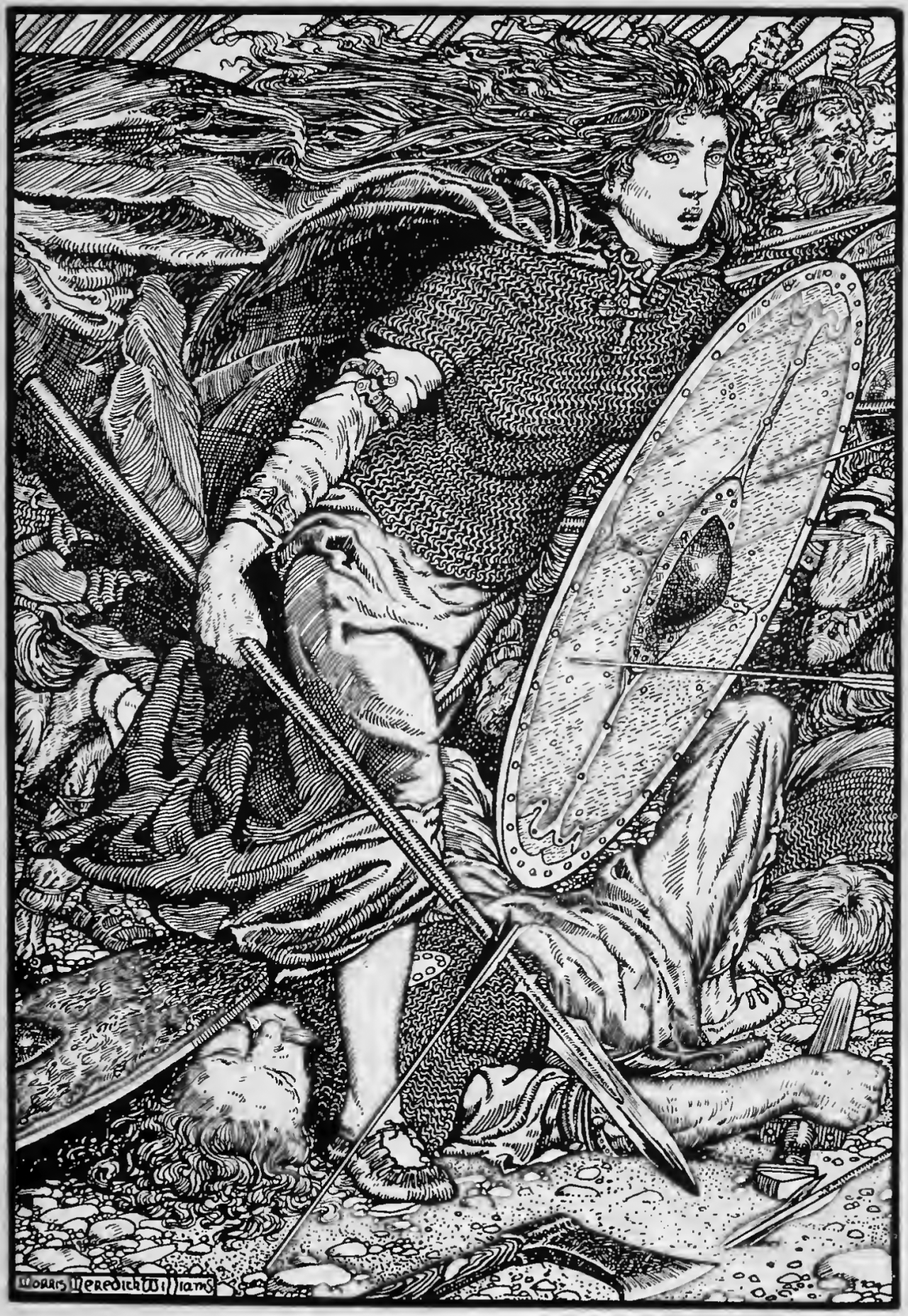
"Ladgerda, a skilled Amazon, who, though a maiden, had the courage of a man, and fought in front among the bravest with her hair loose over her shoulders. All-marveled at her matchless deeds, for her locks flying down her back betrayed that she was a woman."

Cool, huh? Lagertha's story begins when Frø, king of Sweden, invaded Norway and killed Norwegian king Siward. He subsequently ordered all the women belonging to Siward's family to be put in a brothel for public humiliation. And so enters Ragnar, who, hearing of this madness, comes to avenge his dead grandfather, where he first spots Lagertha across the dancefloor...I mean, battlefield..., who along with many other women under king Siward's reign, had dressed as men to fight alongside Ragnar. Ragnar's victory over Frø is said to be much indebted to Lagertha, who acted as chief among these rebelling women. 

Morris Meredith William's Lagertha, from 1913


And who can blame Ragnar for falling for her? During his courtship of Lagertha, Ragnar sent messengers to her and though "she spurned his mission in her heart, she feigned compliance". He eventually killed both a bear and a great hound which were guarding Lagertha's home - and so, he won her hand in marriage, and children were had. But...Ragnar then divorces Lagertha (as he's still pissed about the bear and the hound, apparently), to marry Þóra borgarhjörtr (or Thora Town-Hart), daughter of the king of Sweden. Upon his return to Norway, he was faced with civil war, and the ever-admirable Lagertha, who still loves him (sob) comes to his aid with 120 ships and saves the day. After this victory, Lagertha kills her second husband, "the presumptious and self-indulgent woman would rather rule without her husband than share the glory with him". 

According to the Tale of Ragnar Lodbrok's sons (Ragnarssona þáttr), Thora Town-Hart later dies of an illness, and Ragnar then marries Aslaug (aka AslögKrakaKraba or Randalin), daughter of Brynhildr (you may know her from Xena), who we were just introduced to in the final episode of season one (and who has nothin' on Lagertha!). 

I do plan on finding out more about Lagertha, but there doesn't appear to be many sources, and I have no access to the library :(