Tuesday, 11 March 2014

Grendel's Mother: Warrior Princess!


Unlike most of my friends, I wasn't very much a television child, and so I missed out on Xena: Warrior Princess (along with Saved by the Bell, The Fresh Prince of Bel Air, and Friends - which apparently makes me a freak of nature, causing people to gasp when I admit to these facts). But, little did I know that when I was doing my MA I would be faced with the program which I associated so much with strange costumes and even stranger shouting.


I am in China now? Whut? I share your confusion, Xena.


Anyway, strangely enough, Xena appears to be one of the very few out of the many adaptations that presents Grendel's Mother to us in an explicitly positive light. Even when she looks like the giant cockroach from Men in Black, we still think she's pretty okay. 

So, Grendel's Mother appears in three episodes of Xena from 2000 - "The Rheingold", "The Ring" and "Return of the Valkyries". She appears as Grinhilda, chief of the valkyries and lover of Odin. Beowulf and Grendel (who appears as Grindl) also appear in these three episodes but don't really have much importance...cause...well, it's Xena

At the start of "The Rheingold" we see Grinhilda through a flashback, where she appears as the extremely powerful giant turd/cockroach fighting Xena for possession of the Rheingold (a magical ring from Richard Wagner's 19th century opera, Das Rheingold, itself influenced by Norse and Germanic mythology - the Rhine gold can be made into a ring which will let its bearer rule the world, so long as he or she has renounced love). 


Grinhilda


Xena and Grinhilda have a bit of a tussle before Xena manages to lock Grinhilda in a cave. We are then taken to the present day, where the story of Grinhilda is recited by the character Brunhilda (prepare yourselves for a long-winded and probably confusing retelling of these episodes): 
Back in what is known as Xena's "dark days" (try not to laugh), Xena is chosen by Odin as a valkyrie. Unlike the peaceful Grinhilda, Xena is absolutely gagging for some fightin' and blood spill. In her attempt to gain more power, Xena visits the three Rhein maidens and steals the Rheingold from them, and smelts it into a ring (as the dwarf Alberich does in Wagner's Ring Cycle). Grinhilda, being a good girl, tries to stop Xena from using the ring, and so, places it on her own finger, where we see her transformed into the monster she has become, for she has not forsaken love. The ring destroys that which is most loved by the wearer - in this case, it is Grinhilda's own beauty and humanity. 


Grindl - and what a handsome boy he is


We are then brought back to the present day, where Xena and Beowulf (who has called on her help) are seen fighting a monster who is revealed to be Grindl (Grendel - and presumably Odin's son). They manage to kill him and we are shown Grinhilda mourning his death, and presumably intent on revenge (who would Grendel's Mother be without revenge?), and she then shows up, along with Odin, to fight Xena. Xena then places the ring of power on her finger, but, surprise surprise, it turns out the Xena has not forsaken love either, and loses her memory. 

The next episode presents to us the amnesiac Xena who is now known as 'Wealthea' (an obvious reference to Wealhtheow) and is marrying Hrothgar. Thankfully, Beowulf shows up and reminds her who she really is, and she can go back to fighting Grinhilda. Rather than fighting with her however, she convinces Grinhilda of her former humanity, and she is transformed back into her good old self. Funnily enough, with this, all is forgiven (even Xena's killing of her son...) and Grinhilda returns to her former valkyrie job. 


So! That's that. A rather confusing retelling, interlaced with a lot of Norse and Germanic Mythology and obviously influenced very much by Wagner's opera. But... it must be said, it's original, if a bit silly at times - but then again, it is Xena. It is very much like Parke Godwin's Tower of Beowulf, with its strong threads of Norse mythology as well as a very complex Grendel's Mother,, but that is for another day.

I'm going to focus more on Grendel's Mother as she is depicted here. I know I said she was explicitly positive in this, and then went on to talk about how she was a giant turd-monster, BUT, this is a positive retelling of her character, because it's not her fault that she turns into a monster (it's actually Xena's fault), and her extreme humanity and noble background are very much pushed in this. She is physically cursed and turned into a monster, very much like critics and translators have turned the Grendel's Mother of Beowulf into a monster (I'm getting deep here). Also important, is the fact that unlike Zemickis's or Baker's adaptations, her human form is not capitalised upon, and she is not overly sexualised.


And what about Grendel's Mother as a valkyrie, one of the "choosers of the slain"? Although it seems like a bit of an unorthodox view, and simply another norsification of the story, it's not an unfounded view, as Helen Damico (in "The Valkyrie Reflex in Old English Literature") argues that the valkyries were "half-mortal, half-supernatural beings called idisi in Old High German, ides in Old English and dis in Old Norse". Damico believes that the Beowulf poet is characterising Grendel's Mother as one of these "deadly battle demon[s]". She is after all, called an ides aglæcwif and a wælgæst wæfre, which Damico translates as "roaming slaughter-spirit". Damico also suggests that Grendel's Mother's protective covering may relate to the helm and byrnie of the valkyries. 

Although I'm not necessarily agreeing with this view of Grendel's Mother as a valkyrie, I am pointing it out as a possible influence on Xena's depictions of her, as, I feel, many adaptations, especially film or television adaptations, are often not given credit for researching their sources or the scholarship surrounding them. Of course, the writers of Xena may not have even heard of Helen Damico, but I will give them the benefit of the doubt, and either way, such depictions, whether or not based on an already established theory, can offer new possibilities and new ways of viewing the original poem. 

Overall, for once, Grendel's Mother plays a pretty important role, one more important than both her son and Beowulf. In general, Xena (along with shows like Buffy) is one of those shows that differs from the rest, in that its centred on female figures, but as well as that, it's characters rely less on their sexuality (as so many unfortunately do) than on their physical strength and cunning - they are some of the few accessible feminist role models available in mainstream culture (Girl Culture). And there is nothing bad about that, no matter how cringey Xena may be.

Tuesday, 18 February 2014

Raping the darkness, d-d-death by his side

So I have had the misfortune to hear Marillion's SEVENTEEN minute long song 'Grendel'. About one minute in I couldn't help but be reminded of Spinal Tap's 'Stonehenge' (except at least that's actually good). Apologies in advance to any Marillion fans. Let's agree to disagree.


Grendel: 


I. Heorot's plea and Grendel's awakening 

Midnight suns bid moors farewell, retreats from charging dusk 
Mountain echo, curfews bell, signal ending tasks 
They place their faith in oaken doors, cower in candlelight 
The panic seeps through bloodstained floors as Grendel stalks the night 

Earth rim walker seeks his meals 
Prepare the funeral pyres 
The shaper's songs no longer heal the fear 
Within their eyes, their eyes 


Wooden figures, pagan gods, stare blindly cross the sea 
Appeal for help from ocean fogs, for savior born of dreams 
They know their lives are forfeit now, priestly head they bow in shame 
They cannot face the trembling crowd that flinch in Grendel's name 

Earth rim walker seeks his meals 
Prepare the funeral pyres 
The shaper's songs no longer heal the fear 
Within their eyes, their eyes 

As Grendel leaves his mossy home beneath the stagnant mere 
Along the forest path he roams to Hrothgar's hall so clear 
He knows that victory is secured, his charm will testify 
His claws will drip with mortal blood as moonbeams haunt the sky 

Earth rim walker seeks his meals 
Prepare the funeral pyres 
The shaper's songs no longer heal the fear 
Within their eyes, their eyes 

II. Grendel's Journey 

Silken membranes span his path, fingerprints in dew 
Denizens of twilight lands humbly beg him through 
Mother nature's bastard child shunned by leaf and stream 
An alien in an alien land seeks solace within dreams 
The shaper's lies his poisoned tongue malign with mocking harp 
Beguiling queen her innocence offends his icy heart 

III. Lurker at the Threshold 


Hounds freeze in silence bewitched by the reptile spell 
Sulphurous essence pervades round the grassy dell 
Heorot awaits him like lamb to the butcher's knife 
Stellular heavens ignore even children's cries 

Screams are his music, lightning his guide 
Raping the darkness, death by his side 
Chants rise in terror, free round the oaken beams 
Flickering firelight portraying the grisly scene 

Warriors advance, prepare for the nightmare foe 
Futile their sacrifice as even their hearts must know 
Heroes delusion, with feet in the grave 
Lurker at the threshold, he cares not for the brave, he cares not for the brave 

So you thought that your bolts and your locks would keep me out 
You should have known better after all this time 
You're gonna pay in blood for all your vicious slander 
With your ugly pale skins and your putrid blue eyes 

Why should I feel pity when you kill your own and feel no shame 
God's on my side, sure as hell, I'm gonna take no blame 
I'm gonna take no blame, I'm gonna take no blame 
So you say you believe in all of Mother Nature's laws 

You lust for gold with your sharpened knives 
Oh when your hoards are gathered and your enemies left to rot 
You pray with your bloodstained hands at the feet of your pagan gods 
Then you try to place the killer's blade in my hand 

You call for justice and distort the truth 
Well I've had enough of all your pretty pretty speeches 
Receive your punishment, Expose your throats to my righteous claws 
And let the blood flow, and let the blood flow, flow, flow, flow


And there you have it. I'm not sure what makes me more embarrassed; the picture chosen for the video, the comments that say things like "Most unique, beautiful, fantasy, heroic song ever" or "Breath taking. gasping for air!" or the awful lyrics.
I feel bad for being so critical of this, but it really is awful. Apologies again to Marillion fans (as if any exist). On a good note however, the song is obviously influenced by Gardner's Grendel and some of the lyrics (despite their cheesiness) are....thought provoking? The last section of the song at least. 

Unfortunately for Grendel, his name hasn't had much look in the music industry, with the likes of this. It's also of little surprise that there's a Finnish power metal band also named Grendel. Those Finnish lads are crazy anyway. Whereas at least Grendel's Mother gets a good song, which I previously posted about. 


I think this explains everything


This is the kind of stuff you're driven to listen to (and write about) when you're supposed to be doing an assignment. But hey, at least I'm not doing something completely irrelevant. 

Wednesday, 12 February 2014

Grendel and Cain


Grendel was the name of this grim demon haunting the marches, marauding round the heath and the desolate fens; he had dwelt for a time in misery among the banished monsters, Cain's clan, whom the Creator had outlawed and condemned as outcasts (Beowulf, trans Seamus Heaney)

I'm finally going to talk about Grendel, who is probably more interesting to most people than Grendel's Mother (except when she's Angelina Jolie, of course). There's lots of different views on Grendel, mostly whether he's human or beast or human-beast or a bipedal dragon (seriously). I haven't quite made my mind up about Grendel - I do know I am sympathetic to his character, but I'm not certain how human he is. I don't think I can be quite so certain about Grendel as I am with Grendel's Mother, but I'm sure within the next year of studying my arse off I will have a better idea!

So...what we know about Grendel from his first introduction is that he is of Cain's clan, or at least lives with the feckers. From Cain also sprang the orcs and the elves and the giants (or as translated by Edwin Morgan (presumably while on an intense high), "kobolds and gogmagogs, lemurs and zombies"....eh, sure). So, for the purposes of this post, we'll say he is of Cain's descent, because let's face it, I wouldn't be writing this otherwise.


File:Peter Paul Rubens - Cain slaying Abel, 1608-1609.jpg


We all know Cain - he's the feen who killed Abel, his brother, for some reason or another, and thus became the first murderer and the first to fall under a curse. As a punishment, he was exiled and so were all who descended from him, and bore the "mark of Cain" (not necessarily a physical mark).

So, as one theory goes, the sons of God (conflicted ideas of whether these are men of Seth or the "Watchers") mated with the daughters of men (Cain) and produced the Nephilim, a race of giants who inhabit the earth in Genesis. However, there are conflicting ideas about this theory - it never says directly that the Nephilim were the offspring of the sons of God and daughters of men. Grendel being a giant, and being a descendent of Cain, means he is possibly connected to the Nephilim, but, the only problem here is that these giants were washed away in the Great Flood of Cork in 2014...or whatever time frame it was that Noah was around.

HOWEVER, fear not ( I know you were), another door lies somewhat ajar here. There are some roads leading from the statement in Genesis about the earth having to open her mouth and receive Abel's blood, quite the cannibalistic image. This is also repeated in the Old English Geneis A; "Feud occurred for the kin of men, since the earth first swallowed Abel's blood". In the Book of Enoch (aka I Enoch), a book which, judging what the good old Bede says, was somewhat popular with the Anglo-Saxons, it is said that the race of giants born from the daughters of men "devoured one another's flesh and drank the blood from it". It is possible that Beowulf was written in a time in Anglo-Saxon England when everyone from Ælfric to Bede and Wulfstan were freeaaking out about blood and laying down prohibitions about drinking it (this was mostly to do with animals in case you are wondering), along with major issues such as eating while taking a dump. Bede himself said that consuming blood was the greatest sin of the giants. And, finally getting to the point...Grendel also consumes blood - so in this way, he is linked to the Genesis giants and Cain.


File:Bonaventura Peeters - The Great Flood - WGA17128.jpg
The Great Flood, by Bonaventura Peeters


Yes, but still, the Great Flood. Well, apparently, Ham (or Cham), son of Noah, was the first person to be cursed after the Flood, as he inscribed secrets into stone and metal to preserve them from the Flood: "When the Flood was over he sought them out with the same curiosity for sacrilegious things with which he had hidden them, and transmitted the seeds of perpetual wickedness to later generations" (Book of Cassian). Similar episodes can also be seen in a number of Irish works, including the Middle Irish Sex aetates mundi, which states that Cham is the "heir of Cain after the Flood, and from him sprang leprechauns, and giants, and horseheads, and in general every unshapely form that men have", which is extremely, in a too-good-to-be-true way, really similar to the line in Beowulf about "ogres and elves and evil shades - as also the giants" (Alexander's trans). I really love that leprechauns and horseheads bit though. Kind of makes me wonder why I didn't study ancient Irish texts...too feckin' late now though.


File:Pieter Bruegel the Elder - The Fall of the Rebel Angels.JPG
The Fall of the Rebel Angels by Pieter Bruegel the Elder


According to Andy Orchard (who I owe much thanks to in this post: Thanks, man), there is another possible link in the sword that is found in Grendel's mere, the one Beowulf uses to finally kill Grendels Mother. In the Book of Enoch we are told about "The Watchers" or "Grigori", the fallen angels who are credited with teaching metalwork and weapon-making to men: "And Azâzêl taught men to make swords, and knives, and shields, and breastplates, and made known to them the metals of the earth and the art of working them . . . And there arose much godlessness, and they committed fornication, and they were led astray, and became corrupt in all their ways." (I Enoch, Chapter 8). Such an inscription on a metal sword depicting the Flood and the giants may also be linked to Cham's inscription on the metals and stone of the earth. Although, a bit of a weaker link, but I am clutching at straws here!

So, with texts like the Book of Enoch floating about (a latin translation from Britain dating from around the possible time of Beowulf) and these numerous Irish texts with similar features, it's not impossible that Beowulf, and in particular the story of Grendel was influenced by them. Either way, it makes for some interesting reading (in my warped mind at least)


Sunday, 5 January 2014

PhD, or Goodbye Outside World


This will definitely be me


So, next week I start my PhD, and so, the end of my life as a free-woman shall ensue. There will pretty much be no changes to my blog seen as I'm concentrating on Beowulf and modern media, but I will be expanding my interests to Beowulf and Grendel, and not just the love of my life, Grendel's Mother. I am kind of wondering what the hell I have gotten myself into and if I'll get out of this alive, but fingers crossed I will get through this and emerge as someone who will hopefully be able to get a job, hopefully in my area of interest - best case scenario.

I started this blog for myself, as a means of trying to throw around ideas for this PhD notion I'd got into this head of mine, and cringe at my attempts at humour, and it has really helped me, and has grown into an empire with TWO followers (they're not even people I know personally, wow!). I would like to thank my friends who read my posts for god-knows-why reason, and I especially want to say a big thank you to Angelina Jolie for generating most of my page views...oh, and Eowyn's boobs of course!:


A screen print of the search keywords in the last month


Odin-speed

Tuesday, 31 December 2013

Tis the season to....drink as much as possible before you pass out on the couch


We're all going to heaven, lads, waheeey. Source


Happy Christmas (or should I say Happy Yule?) to all and to all a Happy Christmas. Tis the eve of the New Year, hopefully one that will be filled with a lot more motivation (I got my PhD!), a lot more exercise, a lot more painting, a lot more reading, and a lot less drinking!

Since I have basically spent my Christmas forcing as much drink into myself as possible (and equally telling myself that I am never ever touching drink again, whilst simultaneously pouring myself another glass (sure one won't hurt!)), I think it is a good time to write a post on alcohol and its history in Anglo-Saxon England, and other areas of interest!

So, back in the good old days, there were a few main types of alcoholic beverages drank by the Anglo-Saxons - mead, ale, beer and wine (fortunately for them they never had to experience Tesco Value Vodka) - medu, ealu, beor and win. It is unknown still whether these drinks were pretty much the same as the equivalents of today, and some believe that what the Anglo-Saxons referred to as beor, was in fact cider.

Anglo-Saxon drinking horn

Like us today, the Anglo-Saxons were obviously fond of the few scoops, as evidence from words like gebeorscipe, meaning "drinking party", and the fact that they had what we call "mead-halls". Furthermore, vessels like drinking-horns are mentioned in Beowulf (the Danes drink mead) and fittings for drinking-horns were discovered at Sutton Hoo.

It seems that wine wasn't much of a drink for the masses (or well...it was, but not those masses). Before the ninth-or-so century (this differs with sources), it seems that the climate wasn't suitable for cultivating wine, and so, before this, wine was imported from warmer climates, and so, was only really used for religious purposes and by the few who could afford to pay for it. Even so, after the climate improved, wine was really only left for the upper classes of society, while the rest of the dregs got pissed on ale and beor.

What we mostly seem to think of when we think of alcohol in these times is mead. In Norse Mythology, it's the drink that seems to be what you will be drinking for the rest of your life once you reach Valhalla, and os the source of Odin's strength as he suckled it froma goat as an infant. This however, is actually a foreign drink, the term medu coming from Proto-Indo-European médu, and similar drinks from the same (or earlier) period can be found all over the world, from the Slavic (med or miod), Baltic (midus) Sanskrit (madhu), and appears with different names all over the world, including Africa and Northern China (where the first possible traces of the making of mead are found). So, it's not an exclusively Anglo-Saxon or even Norse or Germanic, or even Western European, drink! 


I enjoy some mead in the coolest pub in Stockholm


That is all for now. Hope you have a great New Year!

Sunday, 15 December 2013

Beowulf: An Unexpected Journey


Having went to see The Hobbit: The Desolation of Smaug the other night, and only recently returning from the country of Tolkien's birth, I guess it's only natural that this post should concern him and The Hobbit's links with Beowulf. I have previously mentioned some things in a previous post, but let's make another one, sure why not lads.

Despite some dodgy CGI at times (I really can't understand how they can create such an amazing dragon, yet at times the horses look like they are taken out of Zemickis's Beowulf (see what I did there!)), and despite the fact that it will never be as great as Lord of the Rings, the film was really good. Surprisingly, I even liked the introduction of Tauriel to try and somewhat lessen the sausage-fest that The Hobbit is. And Kili, the obligatory exceedingly attractive dwarf (Ireland, I'm proud of you!). I enjoyed that part too.


An illustration which would suit either Beowulf or The Hobbit.
It's actually from a Beowulf book by Anke Eissmann


The most obvious link between The Hobbit and Beowulf is of course the dragon! In a way the dragon scenes are climaxes of both stories (although The Hobbit ends with a huge battle, it's fair to say that the dragon is the big thing in the story). Most notable, I think is the fact that the dragon is woken by the theft of a cup, by Bilbo in The Hobbit, and by some other eejit in Beowulf. As well as this, both dragons' lairs are entered by a secret passage: in Beowulf "there was a hidden passage, unknown to men" (Heaney's translation), whilst in The Hobbit, the dwarves (I guess you could extend this entrance as being "unknown to men" also, seen as dwarves technically aren't men) enter by the secret passage, revealed only at a certain time - the last light of Durin's Day. After the theft of treasure from both dragons' barrows, they both go absolutely ape and enact revenge on the surrounding land - from this, we can deduce that dragons have the emotional capacity of a 5 year old child. As in Beowulf, it is not the protagonist that kills the dragon in The Hobbit, but a relatively minor (but very honourable) character - Bard. Both dragons end up in a pretty similar grave also - "they pitched the dragon over the cliff-top, let tide's flow and backwash take the treasure-minder" (Beowulf), and for Smaug; "he would never again return to his golden bed, but was stretched cold as stone, twisted upon the floor of the shallows". Sleep with the fishies.  

Another thing, which I was thinking of, is The Hobbit's influence on Beowulf adaptations - it is possible that the dragon from John Gardner's Grendel was made with considerable influence from Smaug, who unlike the Beowulf dragon, actually speaks, and appears to be able to hold a pretty decent conversation!


Grendel, by John Howe


Although a bit sketchy, there has been some comparisons between Grendel and Gollum. Although Gollum has a shit ton more brains and charisma than Grendel does, it is interesting to note some similarities. In Beowulf it is said that Grendel is a "grim demon", dwelling "among the banished monsters", a descendent of Cain (from Cain also sprang ogres (orcs?), giants (perhaps our friend, the cave-troll, from the Mines of Moria?), and elves...although it's pretty clear that Tolkien's elves aren't seen as Cain's clan - nobody as pretty as Legolas could be!). It is clear from both stories that both Grendel and Gollum are outcasts, both live in caves and both are pretty ugly. The point about Cain is also very interesting, because, as we learn in Lord of the Rings, Gollum, back when he was still known as Sméagol, killed Déagol (his relative) in order to take the ring. And while we know Gollum was once, many many years beforehand, a hobbit of sorts, there is also perhaps a human link for Grendel in his connection with Cain. 

Numerous other links exists between both stories


  • Beorn as a reworking of Beowulf himself. Perhaps? Perhaps. Both are proud and strong. And as seems to be happening all the time in Beowulf (isn't it a surprise he had time to do all his killing!), Beorn's home is full of feasting and story-telling. Futhermore, the name Beorn can have two different meanings - "man" or "warrior" from the Old English beorn, or "bear" from the Old Norse björn. On the other hand "Beowulf", means "bee-wolf", which is a kenning for "bear"! 


Beorn, by John Howe

  • As in Beowulf with Hrunting, the swords in The Hobbit are given names, like Sting, Glamdring, and Orcrist, depending on their history. 
  • As mentioned in this blog, a parallel can be seen when the dwarves are awaiting Bilbo's escape from the goblins' cave, and Beowulf's thanes awaiting his return from Grendel's Mother's mere.
  • Beowulf has 14 companions (so 15 in all). In The Hobbit, there are 13 dwarves, Bilbo Baggins making the 14th member. And Gandalf can be considered a 15th. 


Thursday, 24 October 2013

Medusssaaa


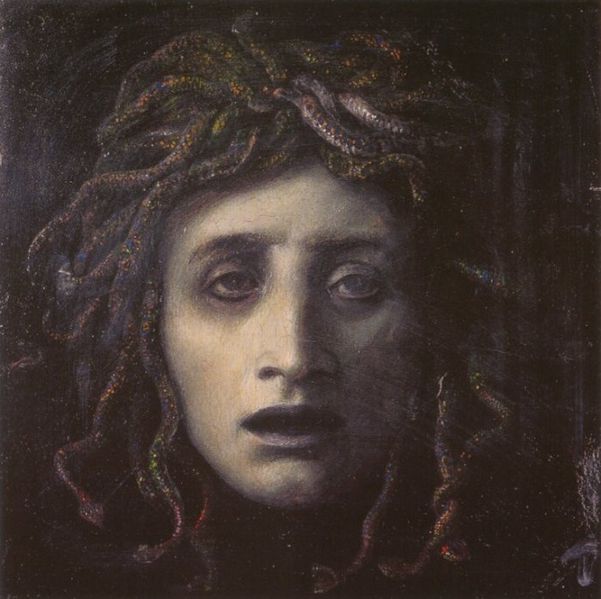
Seen as it's almost Halloween, I'm gonna write a post on the figure I'm dressing up as (and putting an embarrassing amount of effort into)! So everybody knows about Medusa...well...you should know anyway. The snake-headed hag who can turn you to stone with one glance (maybe this is where my aversion to looking people in the eye originates). As a Grendel's Mother fan, it's probably unsurprising that I have quite an interest and soft-spot for Medusa too. It wasn't until recently though, that I started looking into her myth a bit further, and I realised it's a lot more complex than I had originally thought. Which means this post is not going to show every version. Partly because that would make this even more boring than it already is, and partly because I'm lazy.

So, despite general conceptions, Medusa did not actually originate in Greece, but rather was imported from other cultures, most likely from the Amazons in Libya and other North African countries, where she was the destroyer aspect, Anath (Athene) of the Great Triple Goddess
The Greek take on Medusa is sometimes associated with the vanquishing of the goddess religions for those associated with male Gods (namely Zeus and Jupiter), sometimes associated with Apollo's killing of Python, the son of Gaia the Earth Goddess. Consequently, former peaceful goddesses were turned into monstrous figures, and replaced by the warrior type gods of Olympus.This is just a theory of course!


Braaaaains


And so, Medusa was turned into a monster! However, even the Ancient Greek myth is not known by many people, and in fact there seems to be a few variations of the myth.

The most popular myth of Medusa tells of a girl who was renowned for her beauty, wanted by every man around, and the subject of many bitching sessions by those who were jealous of her. Medusa, however, being a priestess of Athena/Minerva, could not get married, and was expected to stay chaste for her life. Unfortunately, this did not stop Poseidon, God of the Sea, who raped Medusa in the temple of Athena. If this wasn't bad enough, the fact that Medusa was taken advantage of in a place of worship, made Athena a very unhappy bunny. Athena was so angry that she turned Medusa's hair to serpents, and made her face so hideous that anybody unlucky enough to look at it would be turned into their very own Greek statue. Which, in my opinion, kind of makes Athena (and of course Poseidon) out to be the bad guy? No? 


Thomas More's translation from Ovid's Metamorphoses:

Beyond all others she  
was famed for beauty, and the envious hope  
of many suitors. Words would fail to tell  
the glory of her hair, most wonderful  
of all her charms--A friend declared to me  
he saw its lovely splendour. Fame declares  
the Sovereign of the Sea attained her love  
in chaste Minerva's temple. While enraged  
she turned her head away and held her shield  
before her eyes. To punish that great crime  
Minerva changed the Gorgon's splendid hair  
to serpents horrible. And now to strike  
her foes with fear, she wears upon her breast  
those awful vipers--creatures of her rage. 


Other versions of the Medusa myth do exist - some say Medusa was born a gorgon, some say she wasn't raped, but took Poseidon willingly, others say Athena was just jealous of Medusa's beauty.


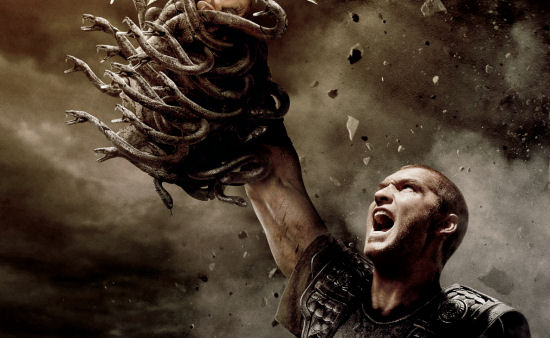
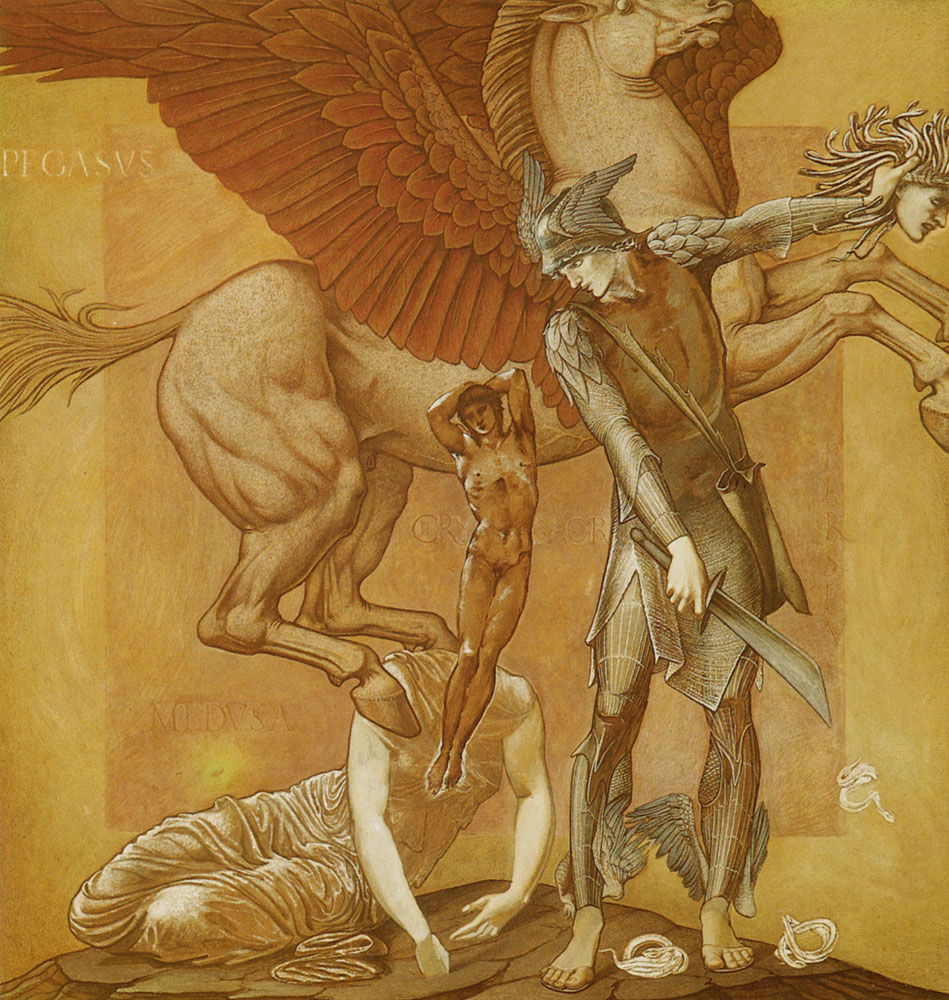
In the vast majority of retellings, Medusa is beheaded by Perseus, because her eyes still have the power to turn people (or krakens, as Sam Worthington and Harry Hamlin kindly show us in both versions of Clash of the Titans) to stone. As the story goes, Perseus used a mirrored shield to see Medusa without looking her in the eyes, clever fella that he was, and managed to chop her head off. As well as having a headful of snakes, it turned out that Medusa had a wombful of pretty unique children too - Pegasus, the winged horse, and Chrysaor, a sword-wielding giant. As ya do. And these children supposedly sprung from her blood-spurting neck. I'm not sure how exactly that would look, but according to Edward Burne Jones, it looked something like this:


According to Ovid, Persues then flew around a bit with his handy new sandals from Hermes, where he turned quite a number of individuals to stone, including the Titan Atlas, Cetus (who was about to Andromeda alive), and Phineus, whom Andromeda was promised to before Perseus flew in on his golden winged sandals (or on Pegasus in more western takes on the myth) and impressed the hell out of her. Last, but not least, Perseus flew to Seriphos where he rescued his mother from her forced marriage to King Polydectes (sounds like some sort of pterodactyl), who had sent Perseus for Medusa's head in the first place.

Also, while Medusa was dead, she still managed to spawn some more offspring, namely Amphisbaena, a serpent with a head on both ends, as her blood dripped onto the Libyan desert (where her myth originated, and in a way ended)! How nice.


An Amphisbaena in the Aberdeen Bestiary


Perseus by Aubrey Beardsley