Sunday, 15 September 2013

A Realistic Beowulf


On the whole, Beowulf isn't exactly a very realistic story....There's (apparent) sea monsters, a dragon, monsters (that depends on your stance on Grendel and his mommy), and various displays of superhuman strength and endurance. So, it's pretty interesting to find a retelling of Beowulf's adventures that are realistic (to an extent!).


Michael Crichton is known for his rational approach to fantastical stories, most notably in his 1990 novel that was made into the best film ever, Jurassic Park, where Richard Attenborough fills in the incomplete dinosaur DNA with amphibian DNA (unfortunately/fortunately this won't actually work).


Before Crichton was escalating the hopes of dinosaur fanatics, he was exploring Beowulf and coming up with ways in which it could really be explained...well...probably not really, as despite the ideas in his book being rational, they are still rather far-fetched. 

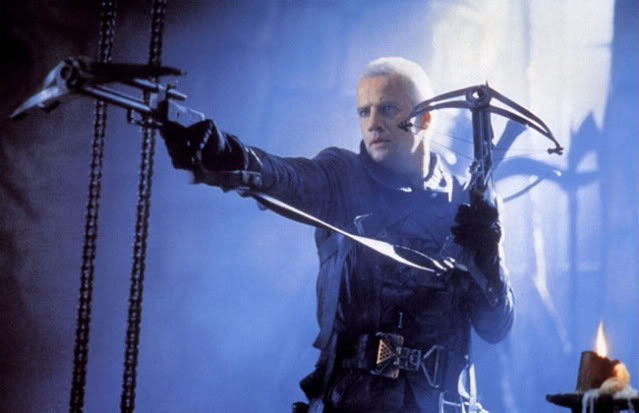
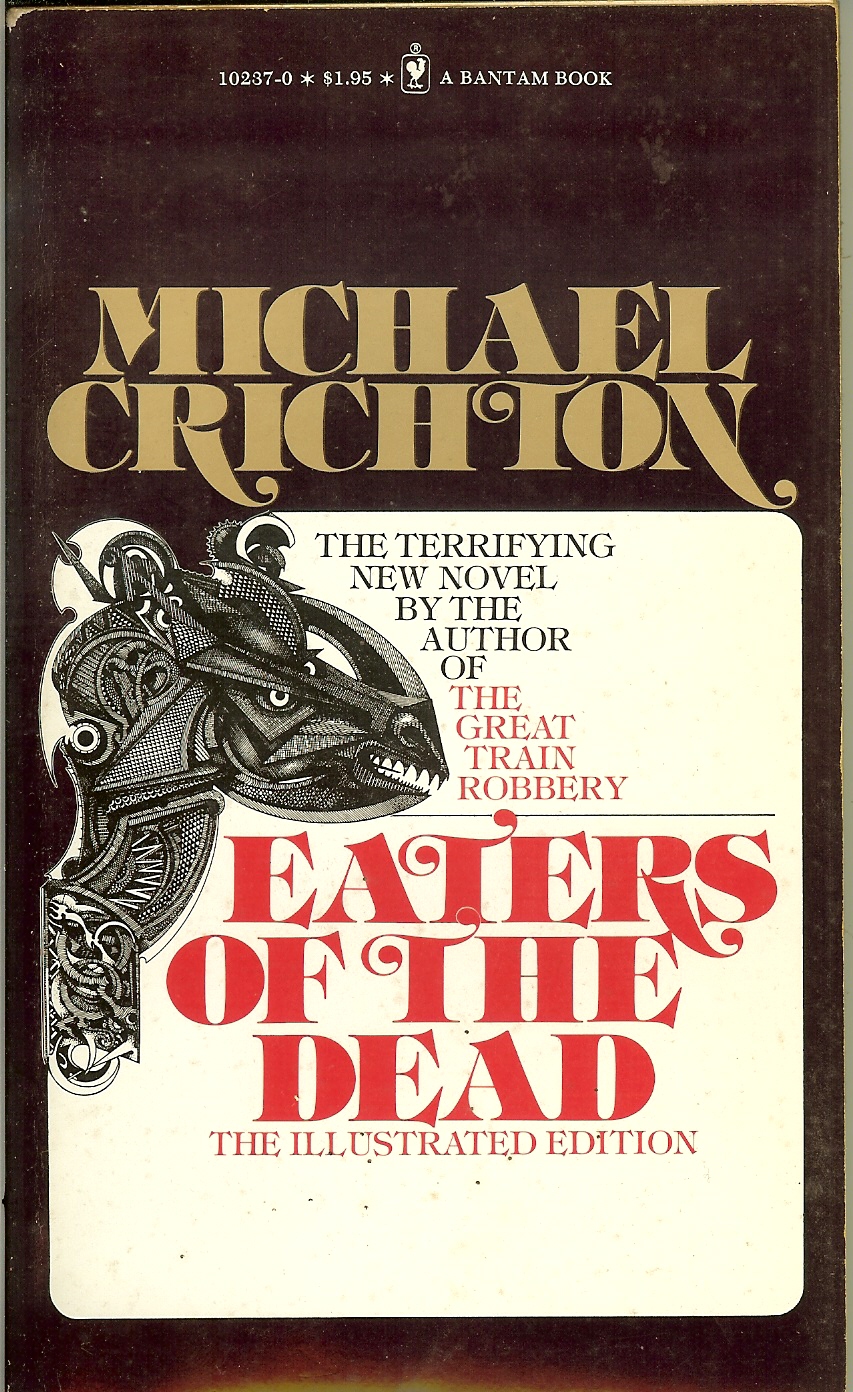
In 1976 Crichton released Eaters of the Dead: The Manuscript of Ibn Fadlan, Relating His Experiences with the Northmen in A.D. 922 (later made into The 13th Warrior, starring Puss in Boots). Crichton constructs the novel so that it imitates a real historical document, professing to be the chronicled expedition of Ibn Fadlan, who was an actual 10th Century Arabic explorer, known for his descriptions of the Volga Vikings. 

Parts of Ibn Fadlan's actual chronicles are present in the first few chapters of Eaters of the Dead, and in general it stays pretty close to his manuscript (or so I have read! I do not profess to know much about Ibn Fadlan's actual antics) up until chapter 4, where the story gradually turns into a retelling of Beowulf, and where Fadlan, who is originally sent to the king of the Volga Bulgars, is persuaded into joining a mad (aren't they always) group of Northmen, led by Buliwyf (an obvious play on Beowulf). Their quest is to destroy a "dread and nameless terror, which all the people are powerless to oppose". This terror, turns out to be a cannibalistic tribe known as the Wendol. 

Wendol, is surely both a reference to Grendel and to the Vandals, an early East Germanic tribe - nicely done, Michael, nicely done. The Wendol are described in Ibn as being "manlike in every respect, but not as any man upon the face of the earth". They are "short...broad and squat, and hairy on all parts of their bodies save their palms, the soles of their feet, and their faces" They had large prominent jaws, with large heads. Now, at the end of Cricthon's book, there is a fake appendix, fake footnotes, and fake sources, all to add to the idea of this being an actual real account (but a fictional real account...). So, at the end of the novel, these fake researchers are trying to explain Ibn Fadlan's accounts. So, we are given a realistic explanation for the Wendol. The Appendix describes them as being "suggestive of Neanderthal anatomy", which although should have vanished 30-40,000 years prior to Ibn Fadlan's accounts, were still in existence. In another one of these fake reports, "Goodrich", a "paleontologist" describes Ibn Fadlan's tendency to overstate facts and differences, suggesting that the Wendol may just have been uncivilized Homo Sapiens, whose cultural differences were interpreted as physical differences. Well...that was confusing!
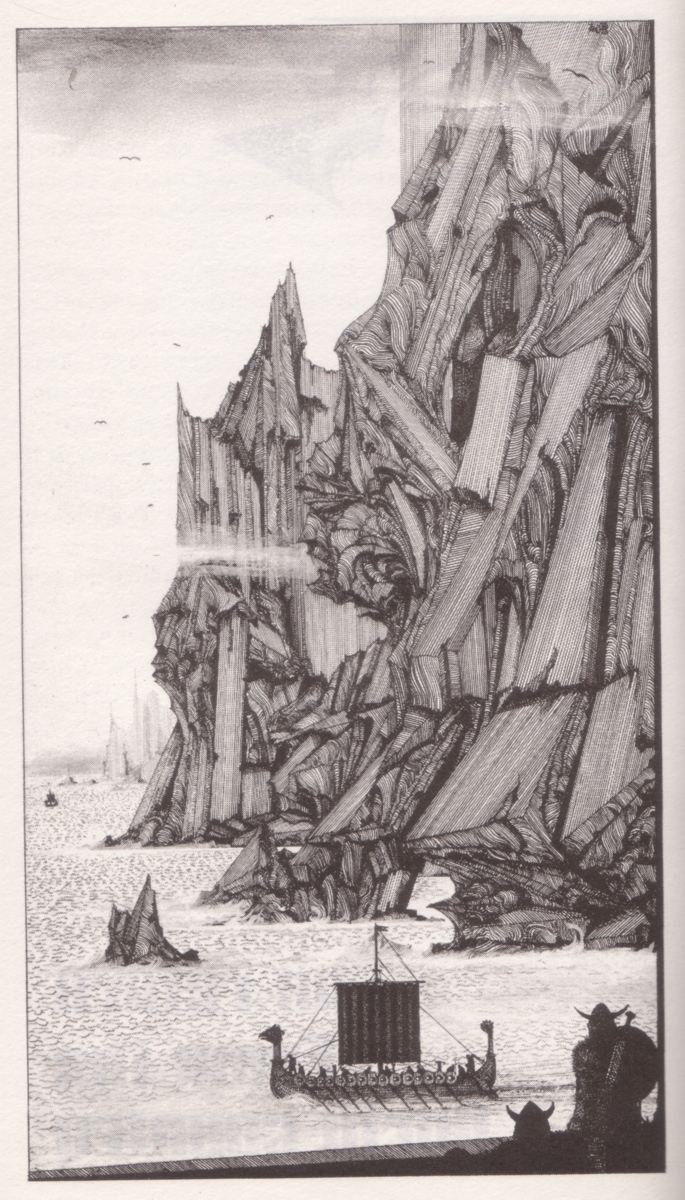

An image from the beautifully illustrated version of the novel


The next "monster" we come across is the "Korgon", or the dragon, later revealed to be Wendol carrying flames on horseback. Here, we are also told of a figure on horseback who had the head of a bear - perhaps a suggestion that the Wendol were berserkr (translated as "bearskin"), a type of Norse Warrior known for their war frenzy, their animal-skin attire and their general tomfoolery. Of course, it must be noted that our trust in Ibn Fadlan's accounts and descriptions is to be taken with a pinch of salt, as earlier in the novel, he describes "sea monsters" (a nice reference to those that Beowulf fights) that pass their boat, "spitting a fountain, and raising a giant tail split in two". Of course, we say "Duhhh, it's a whale, idiot!", but we must remember, this is an account of an Arab explorer, set in the 10th century, and although it's unlikely that they hadn't heard of whales, it is a nice touch to make us wary of Ibn's accounts. 
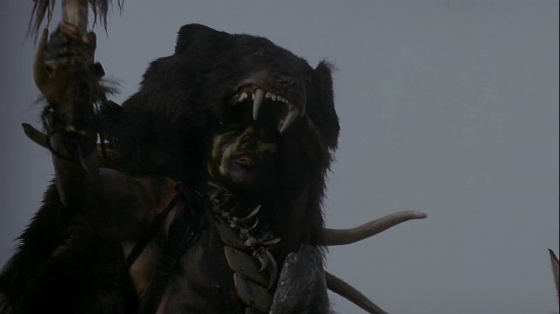

One of the Wendol, in The 13th Warrior


And now we come to my favourite bit....the bit where we talk about Grendel's Mother (AWWWW YEAAAH)! For the majority of the novel her existence is only hinted upon. One scene shows the discovery of a stone figure resembling a woman's torso - "there was no head, no arms, and no legs; only the torso with a great swollen belly and, above that, two pendulous swollen breasts", a "crude and ugly" figure which causes the Norsemen to physically puke violently (Breasts? Bleurggh!). Of course, this is an obvious reference to both the Venus of Hohle Fels and the Willendorf Venus, which are both associated with prehistoric times, and are therefore hinting at the humane although primitive nature of the Wendol. 


Venus of Hohle Fels and the Willendorf Venus


When we do get to finally meet the Mother of the Wendol Ibn Fadlan assumes she is female "but if she was female, [he] saw no sign, for she was old to the point of being sexless". She is described as being surrounded by snakes (perhaps a reference to Medusa, a figure often associated with Grendel's Mother and dangerous women in general). Unlike in the original poem she does not appear to have abnormal strength, and instead uses a poisoned pin on Buliwyf. 


Unlike many other adaptations, the Wendol here are not shown with any sympathy. The Wendol's Mother shows no anger over the death of her numerous kin, and it is implied that it is her who has been instigating these attacks on King Rothgar's people. The matriarchal society is seen as threatening and vomit-inducing, compared to the Scandinavians patriarchal society in which the women are seen as caretakers and consorts. Some Kristevan themes can be seen throughout the novel: Through the worship of the female mother, the Wendol are left barbaric and uncivilized, while the Northmen, who have pushed the maternal away have evolved into more refined civilians. Julia Kristeva suggests that in order to acquire language and align itself with the symbolic system, the subject must push the mother and the maternal body away. Similar themes can be seen in John Gadner's Grendel, where Grendel only finds language through pushing away from his mother and her primitive state.


Hopefully that wasn't so confusing! Goodbye, I am off to watch Channing Tatum.


Sunday, 25 August 2013

What do Praying Mantises and Angelina Jolie have in common?


I think it's about time we sit down and talk about the elephant in the room - the elephant in question being Angelina Jolie. Anyone who has read Beowulf (or those who sat in lectures pretending to have read it - I'll admit, I was one of them. And now look at me!), and who was expecting the sea-hag-witch-of-the-sea-demon (I was also once one of these people), was probably thinking "Really? Did these assholes even read the godamn poem?"...It would have been a lot more fitting if Angelina Jolie and Brendan Gleeson's roles were switched, right?

Well, as it turned out, I was wrong. Well...sort of anyway. Angelina Jolie is actually a lot more suited to play Grendel's Mother than any CGI monsters! However, it must be stated that this Grendel's Mother also raises other issues, which we will get to.

Before we continue with Angelina Jolie, I think it's good to look at one of the most cringy adaptations of Beowulf ever made. You may know it from the techno soundtrack, Beowulf's peroxide locks (it was the 90's, and Beowulf wasn't getting left behind with the fashion!), the extremely high rate of back flips, and its impressively low 3.8 IMDb rating.


I'm bringing up this embarrassment of a film because of its very own Grendel's Mother...Layla Roberts. Who knows what Graham Baker was thinking when he decided "Yes, a playboy bunny, that is exactly who I need to play Grendel's Mother! And you know, hey, seen as she is involved in that whole industry, we may as well add in some soft porn scenes!". They even crimped her hair, to make sure that in years to come we could look at this film and shout "the nineties!". And yet, this film seemed to be a huge influence on Zemickis's 2007 version - with regards to nudity and storyline. Danél Griffin thought that many scenes in the film seemed "so absurd and outlandish that we wonder if the writers, Mark Leahy and David Chappe, have even read the poem." I'm with you there, man.


Hrothgar, you dog!


Despite all the negativity directed at this film, this, along with Zemickis's version, gives Grendel's Mother a much larger role - she gets a god amount of screen time and she can speak! She doesn't appear to us as an irrational beast, like in Grendel, Grendel, Grendel or Outlander, or in Beowulf and Grendel (to a slightly lesser extent) - she appears as intellectually powerful, even if it is in a manipulative manner. A big thing for me was that she appeared to us in a human form (me being with the "Grendel's Mother is a Human too" campaign), but alas, this is too good to be true, and she is revealed to be a giant praying mantis (in Baker's) and that Alien-esque style creature in Zemickis's.

I don't think it's any mistake that Layla Roberts turns into a praying mantis - the praying mantis, along with the black widow spider and the Venus fly-trap plant, and poison ivy etc etc etc, are often associated with the 'seductress' woman, and sometimes with women more generally. Anita Sarkeesian argues that these insects and plants have become "the inspiration for a whole trope of sexy female characters", seemingly stemming from a misconception about female praying mantises biting their male counterparts heads off - as it turned out, this was indeed a misconception, yet unfortunately the myth lived on in the belief that sexually powerful women are dangerous. Sarkeesian calls this trope the:
evil demon seductress... a supernatural creature usually a demon, robot, alien, vampire most often disguised as a sexy human female. She uses her sexuality and sexual wiles to manipulate, seduce, and kill, and often eat, poor hapless men, by luring them into her evil web ("Tropes vs. Women #4)


Layla Roberts really pulling off a praying mantis


In both films, Grendel's Mother fits this description. She seduced Hrothgar, most likely for producing a son who will later attack Heorot and be the rightful king. In the 2007 version, this is taken a step further, and Angelina and Ray Winstone give birth to a beautiful baby dragon. So, despite the good news that Grendel's Mother gets more airtime, the films have the extra issue of demonising women. These films portray women as manipulative and controlling, using sex to fulfill ulterior motives. The use of Layla Roberts or Angelina Jolie only adds to the sexism - as Sarkeesian states, "when an evil demon seductress is on screen, men get ot objectify her while having these sexist preconceived notions that women are in fact manipulative and deceitful", and as Bill Schipper tells it, "nothing terrifies a male audience more than a physically and sexually powerful woman"

David Marshall states that Beowulf (2007) attempts to criticise the masculine power system and its inability to control desire. Both Hrothgar and Beowulf cannot resist Angelina Jolie's golden breasts. Furthermore, Heorot appears to us as some sort of Anglo-Saxon frat-boy party house, where Hrothgar (Anthony Hopkins) encourages "fornication" and praises Unferth (John Malkovich) as "violator of virgins". All the men appear to act on physical whims, whereas the women of the film, like Grendel's Mother and Wealhtheow act on reason. Unfortunately, the film kind of fails in this criticism when they decided to turn Grendel's Mother into a digitally enhanced, naked, golden Angelina Jolie, whose body "caters to the same hyper-sexualised function of masculine desire that drives Beowulf in Zemickis's film" (Marshall). In the end, the only character who gains our respect is Wealhtheow, who also preserves her chastity, whilst Grendel's Mother's powerful sexuality is made unnatural and monstrous. 


In the writing of this post I also found out that someone on Youtube has a pet praying mantis named Angelina Jolie. I wonder if they realise the depth of that choice.

Monday, 12 August 2013

Freaky Freydís


It is generally assumed that all Viking raiders and warriors were men (lazy archaeology?), but that's not actually the case - quite a large percentage (up to half in some cases) were actually women, Freydís Eiríksdóttir being one of the more notable (and absolutely mental) ones, as the following picture accurately conveys:


Here is a lovely wax figure of the woman herself in Reykjavik. Smashing stuff.


Daughter of Erik the Red, who was a (most likely) Norwegian fella who founded the first Norse settlement in Greenland (who the hell would want to live there is what I ask), Freydís is generally known to have been involved in the Norse exploration of North America around 1,000AD or so (quite a bit before 1492 I may add) along with her brother Leifr. 

Freydís appears in two sagas; the Saga of Erik the Red, and the Grœnlendinga Saga, both believed to be composed in the 13th century. Events from an expedition to Vinland (in North America) are described in the first of these sagas - during this visit to America, the Vikings traded with what they called the Skrælingjar, the peoples from around North America and Greenland. 


Vinland on the left. This map is reputedly pre-Colombian, although possibly a forge


    As the story goes, trading all went well until the Vikings ran out of everything except cow's milk. The Skrælingjar turned out to be lactose intolerant, of course, and thought they were being poisoned. This, along with a rather uneasy encounter with a bull ("what in god's name is that devil-beast?"), made, as one can imagine, things a bit tense, and the shit hit the fan.
    Freydís, who was heavily pregnant at this time, and therefore less agile than a hippo on stilts, found herself abandoned by her spineless crew, who were starting to set sail. Seeing them flee she shouted after them: "Why run you away from such worthless creatures, stout men that ye are [...] Let me but have a weapon, I think I could fight better than any of you." And so, she proceeded to find the sword of one of her dead companions, and when the Skrælingjar came upon her, she bared her breasts and beat the sword against them, letting out a battle-cry. Needless to say, they fled in terror, and so would you, had you encountered that wax figure above or this orangutan below:


So, she sounds cool, right?! I'm sorry, but your dreams of a new idol are about to be smashed into tiny pieces. Read on.

Obviously thrilled by this exhilarating experience (who doesn't like to act out King Kong?), Freydís decided to make a deal with some poor Icelandic feckers, Helgi and Finnbogi, and returned to Vinland, after agreeing to split the goods half and half with the brothers. Being the snake in the grass that she was, Freydís snuck a few extra men onto her ship (she also convinced the two brothers to let her take the bigger of the ships). Due to differences of opinion, by the time they arrived in Vinland, two camps were set up. Later on, Freydís told her husband that the two lads had assaulted her, and ordered them and their crew killed. The orders were followed, but her men refused to kill the unarmed women - Freydís saw to them herself, chopping off the five of their heads, no bother at all to her. 

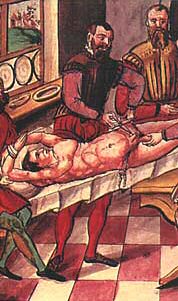
Not wanting to be seen as batshit crazy back home, she ordered silence on the matter for their return to Greenland. Her brother Leifr, obviously being a bit suspicious that the crew has magically shrunk by bloody half, resorted to torturing the truth out of some of the men. Being the just man that he was, he did....absolutely nothing, and Freydís got away with it all. I suffer more repercussions if I forget to hang the godanm washing out!


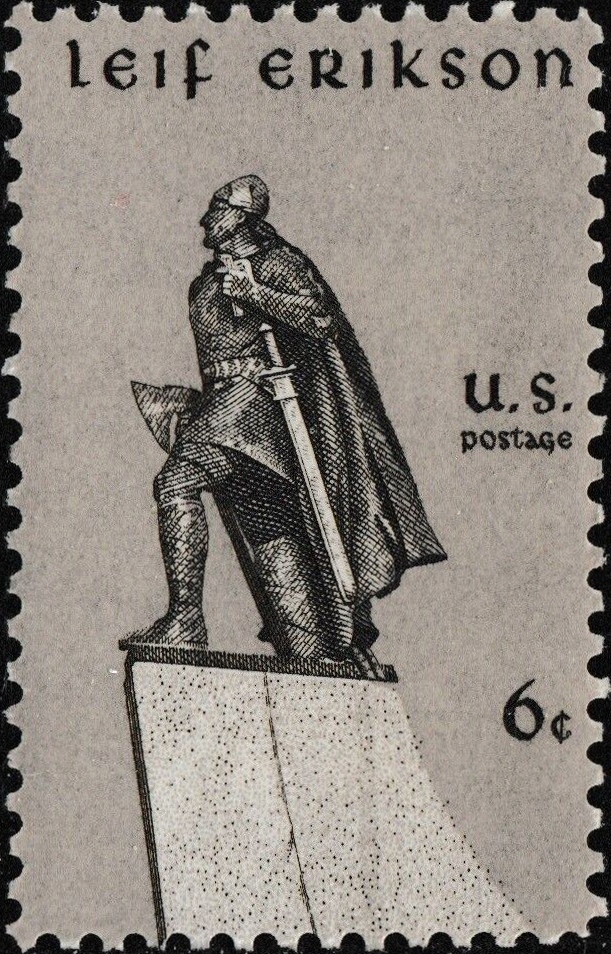
Leif Erikson, an all too forgiving brother


So, unfortunately, Freydis turned out to be a pretty horrible, greedy, merciless, thundering bitch, but either way, she is an interesting figure - a strong willed, courageous woman, but certainly not one to look up to or follow after - unless you fancy being secured in a psychiatric ward of a prison.

Thursday, 8 August 2013

Grendel, Grendel, Grendel's Mother


This has to be one of the coolest book covers around


Another Grendel's Mother post, yaaaay! Today I'm going to write about John Gardner's novel Grendel, and the animated film adaptation, Grendel, Grendel, Grendel. That's a lot of 'Grendel's in one sentence.

Grendel was one of the first (and most popular) adaptations of Beowulf, being written in 1971, and is known for its sympathetic treatment of Grendel. The story is told from Grendel's point of view, with very little focus on Beowulf (he isn't ever named, and we only meet him at the very end). As Alexander Stitt's film narrates, "it is told "through twentieth century eyes, where one is more likely to see the humanity in a monster" - yeah, well, not for Grendel's Mother.


This retelling of the Beowulf story, features one of the most monstrous and animal-like Grendel's Mother around, and although the story is seen through Grendel's eyes, even less of his mother is seen than in the original poem. And although it is a different view of her, it's not necessarily anyway less monstrous than any translations of the poem. She is described as a "life-bloated, baffled, long-suffering hag", a "horrible, humpbacked, carp-toothed creature", with "strange eyes" and "bristly fur". Can you feel the love that he feels for his mum? She is obviously not human-like at all...well, I guess you could find some people who fit those descriptions, but anyway...


Even more notable than appearance, is Grendel and his Mother's intelligence - where Grendel is portrayed as intelligent, rational, and quite philosophical (along with the dragon), ad even has an upper class British accent in the film, while his mother has no voice at all - "she'd forgotten language long ago, or maybe had never known it" - she cannot even comprehend what Grendel says.

Despite all this, there is a small amount of sympathy for Grendel's Mother - perhaps she is not all that monstrous - "I was, in her eyes some meaning I could never know and might not care to know", "she would have given her life to end my suffering". And although we know how it pans out in the original poem, we can only presume that she avenges her son after the novel ends. This love for her son of course, isn't necessarily a human trait, but could rather be an animal's maternal instinct - I mean, shit, the Moorwen in Outlander was almost more human-like than this Grendel's Mother!


Brian Froud's depiction of Grendel


So, despite being a book that was great for Grendel, it's not exactly great for his mother. It is a good book however, and worth a read if you're into Beowulf. Sure fuckit, aren't we all. And this is where I realise I'm turning into one of those people...those people who write blogs on academic stuff. Goodbye childhood.


Grendel, Grendel, Grendel can be found here! It's worth watching especially for the part at the start.

And now I'm off to London. Goodbye, suckers!

Sunday, 28 July 2013

Rape and abduction in Anglo-Saxon England


Source: progressivepatriots.com


I'm sure most people will remember that pretty controversial and outrageous statement that Republican (aren't they always!) Todd Akin said about rape victims being able to avoid pregnancy -
"If it's a legitimate rape, the female body has ways to try to shut that whole thing down". 
Yes, Todd, I'm sure you got an A in Biology. Funnily enough, with the pro-life folk always talking about abortion being something from the Dark Ages, this view that raped women can somehow prevent pregnancy is in fact from the Dark Ages! Maybe that's why many are considered to be White Anglo-Saxon Protestants.

According to Julia Coleman, in her chapter "Rape in Anglo-Saxon England", the earliest definition of rape in the Anglo-Saxon period can be found in the ninth century laws of King Alfred (remember, the guy who let the cakes burn). Here are some facts:
  • The rape of a non-virgin wasn't treated to be as serious as the rape of a virgin
  • Because marital sex was seen as a dutiful act to a spouse, it is likely that non-consnsual sex in a marriage wasn't seen as rape - unfortuantely many people still think this way
  • Abduction, elopement and adultery are also lumped in with rape
And what was the punishment for what was then considered rape? Well, mostly just a fine to the victim or her husband or father, but it could be as serious as castration in the case of a rape by a slave.


From another source, there is the likelihood that compensation was offered to the victims (or their "owners"), "ranging from 5s for seizing her by the breast to 60s for rape [...] The fine for removing a nun from a nunnery is also 120s, divided between the king and the ecclesiastical authorities [...] Compensation for rape is reduced by half if the victim was not a virgin " (Early English Laws). All this is presumably in shillings (20 shillings to a pound). Some other sources give different amounts for compensation. 


A screen shot from Corine Saunders' Rape and Ravishment in the Literature of Medieval England


In post-conquest England, after the Norman invasion, it is notable that there appears to be no mention of the victim's or the rapist's social class - whether you were a slave or a Lord, your genitals were getting the chop!


"Sausies for din-dins!"
    

As Coleman states, it wasn't only the woman's dignity that was affected - it also affected the men in her life's pride, as they feel lessened by the fact that they were unable to protect her. This can also be seen on a larger scale, with reports from Ancient Greece up until present day - rape is a pretty common consequence of warfare. "War rape" is more than just about the physical act, and goes beyond the terrorising of the woman (or man) who is being victimised. As Susan Brownmiller says:

(R)ape by a conqueror is compelling evidence of the conquered's status of masculine impotence. Defense of women has long been a hallmark of masculine pride, as possession of women has been a hallmark of masculine success. Rape by a conquering soldier destroys all remaining illusions of power and property for men of the defeated side.

Anglo-Saxon England, being a realm which was involved in regular conflict with the Danes and later the Normans, is no exception to this, and unfortunately women were often used as a tool to demonstrate the taking of the country to the men.


Sources:
http://www.law-lib.utoronto.ca/Diana/fulltext/tomp.htm
Rape in Anglo-Saxon England
Rape and Ravishment in the Literature of Medieval England
The Semiotics of Rape in Renaissance English Literature

Monday, 22 July 2013

Brynhildr - a Norse rom-com (minus the comedy... and much of the romance)

Brynhildr, depicted by Robert Engels in 1919


We've already talked about one (official) shieldmaiden, Lagertha, so I think it's time we talk about some more kickass Norse wimmins.

Interestingly enough (maybe? Is it? I dunno), there is a connection between Lagertha and the more famous shieldmaiden we are going to talk about today - Brynhildr. You may recall that Ragnar Lodbrok took Brynhildr's daughter, Aslaug, as his third wife, after divorcing Lagertha (I'm still a bit butt hurt over this). Brynhildr also has a connection to another figure, Gudrun/Kriemhild, who I want to discuss more in the future (she does pop up here quite a bit). Shit, she even has a connection to Grendel's Mother in Xena: Warrior Princess (Grinhilda)! Basically, Brynhildr gets around!

DISCLAIMER: There will be a whole lot of name repetitions - you will never want to hear the name Brynhildr again! Brynhildr Brynhildr Brynhildr!

The character of Brynhildr may be famous from Wagner's Ring Cycle, Der Ring des Nibelungen, but she started out as a figure in Norse mythology (and possibly even before this as Brunhilda of Austrasia, a real life Visigothic princess). Although, to be completely honest, most people will have heard the name Brynhildr/Brunhilde/blablabla etc, from things like Xena, various video games, World of Warcraft, Django Unchained, and by the looks of it, some softcore manga...what the...

Eh, anyway. Brynhildr appears in the Völsunga saga, a 13th century Icelandic text and some Eddic poems. In the Völsunga saga, she is condemned by Odin to live life as a mortal woman and imprisoned in a ring of fire until a man rescues and marries her. The lucky man to come and rescue Brynhildr was Sigurðr Sigmundson, hero of the Volsung saga, and needless to say, the two of them fall madly in love, ending with Sigurðr's offer of the ring Andvaranaut (which is likely to be an influence for the one ring in LOTR) as a proposal. Sigurðr, who needs to run off on important business, promises to return to make Brynhildr his bride. In the meantime, Gudrun comes over for a cup of tea and to ask for some help in interpreting a dream, which coincidentally enough foretells Sigurðr's betrayal of Brynhildr and his marriage to Gudrun - forget Freud, these guys really knew their dreams!


The man himself . Killing Fafnir.


So, at this stage, Sigurðr is off with Gjuki, the King of Burgundy. Gjuki's wife, Grimhild, who happens to be Gudrun's mother dearest AND a sorceress (how unlucky), prepares a magic potion so that Sigurðr will forget about Brynhildr. And alas, the potion does its job, and he marries Gudrun instead. In some strange series of events, Gjuki's wife then decides to marry her son Gunnar to Brynhildr (what a terrible mother-in-law she would have been). However, Gunnar finds that he can't get through this ring of flames, and so, Sigurðr offers to exchange shapes with him, and enters to claim her hand. So Sigurðr, disguised as Gunnar, stays with Brynhildr for three nights, putting a sword in between them so she will retain her virginity (imagine if they couldn't find a sword - close one!) and then takes the One Ring to Rule Them All from her finger to later give to Gudrun (oh no he didn't!). Sigurðr and Gunnar return to their true forms and Gunnar is married to Brynhildr.

And this is where shit gets real. Gudrun and Brynhildr start arguing about who has the better husband, where Brynhildr starts bragging about how brave her Gunnar was to ride through the flames to get her, causing Gudrun to drop the bombshell that it was actually Sigurðr. As you can imagine, Brynhildr goes ape, and Sigurðr starts to remember the truth, but fails to console her. So, Brunhildr tries to urge Gunnar to kill him, telling him that Sigurðr slept with her - Gunnar, being too scared to kill Sigurðr himself, gives his little brother a potion that enrages him, causing him to kill Sigurðr. Brynhildr then kills Sigurðr's son, and during Sigurðr's funeral, throws herself on his funeral pyre, thus entering into Hel with him - a somewhat romantic ending...in a rather messed up way.


Brünnhilde throws herself on the flames. By Arthur Rackham for Wagner's Ring Cycle


Have you died of boredom yet? There are differences in other versions of the story found in a few Eddic poems (eg Aslaug is Brynhildr's and Sigurðr's daughter), but honestly, ain't nobody got time fo' that.


The story of Brynhildr can then be found in the Nibelungenlied, a Middle High German epic poem about Siegfried (Sigurðr). There are quite a few differences regarding her tale in this version - Brunhild is the queen of Iceland, and with Siegfried's help (who is hidden under an invisibility claok that he got off Albus Dumbledore), Gunther (Gunnar) wins Brunhild in a series of rather warlike games. There doesn't appear to be any suggestion that Siegfried had proposed (or even known) Brunhild before this.

Brunhild, who is suspicious of Siegfried (as Gunther introduced him as a vassal, although he was actually royalty), denies Gunther her virginity until he tells her the truth. Gunther tries to take her by force, but Brunhild merely pushes away his advances as if he were a tiny kitten and ties him to the ceiling. 


Gunther's Wedding Night by Johann Heinrich Füssli


The next day, Gunther, being a little bit put out at not getting the ride, tells Siegfried what happened, so Siegfried enters their bed chamber that night under cover of the invisibility cloak, and holds Brunhild down until she submits to Gunther's will - a bit rapey if you ask me. In this version of the story, this is when Siegfried takes "a ring" from her finger (along with a girdle), which is later shown to her  y Kriemhild (Gudrun) during their "my husband is better than yours" argument - thus giving away the game. Hagen, Brunhild's vassal, promising to take revenge on the wrongdoer then kills Siegfried. So, as you can see, this version has a lot less romance, and a lot less sympathy for Siegfried/Sigurðr. 


Some other time I will discuss Wagner's Der Ring des Nibelungen, because this post is about forty-two times longer than I'd intended it to be. It's time for me to go watch Wrath of the Titans and see if it's as class....I mean....crap.... as Clash of the Titans (whose tagline was "Titans will Clash" - I never tire of telling people this).


Thursday, 18 July 2013

Space Grendels


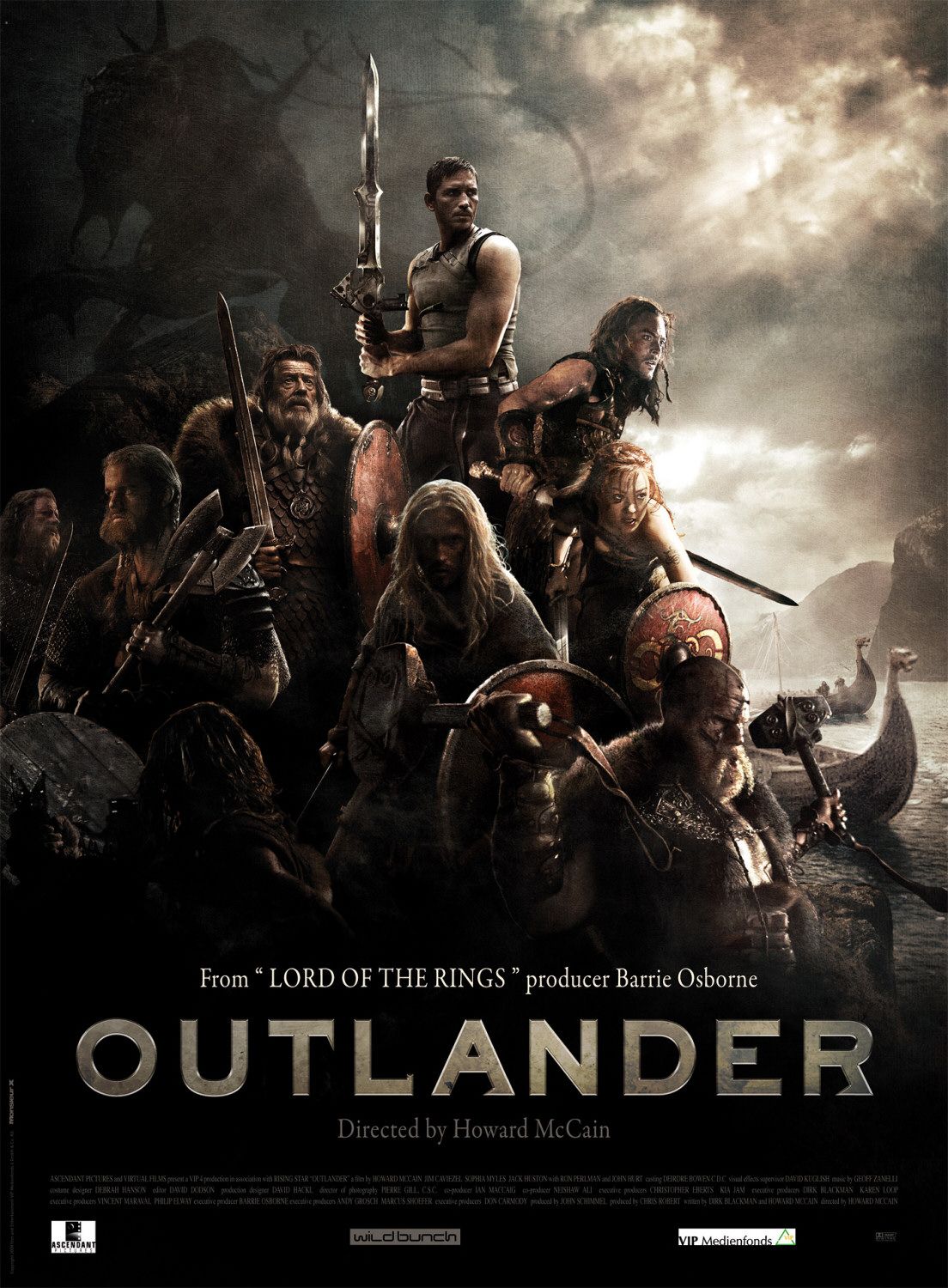
In the very few cases that people have asked me what my favourite Beowulf film is (most likely it's me telling them against their will when I'm shitfaced), I have to answer with Outlander. Funnily enough, it's only very vaguely got anything to do with Beowulf, and Grendel's Mother is the most monstrous that you'll probably ever see her. But all that aside, I think it's a pretty good film (but then again, I'm into all that kinda crap). And as well as its similarities to things like Clash of the Titans (I had to start calling this a guilty pleasure when I found out that it's not cool to like it) and 300, which I just can't get enough of, I think another reason I like this film is because of a certain viking....


So, I'm really gonna sell this movie to you now - basically, a man from another planet crashlands in 8th century Norway, unfortunately bringing along a 'Moorwen' which seems to have hitchhiked in his spaceship without consent. So, this fella, Kainan (played by Jim Caviezel, whoever the hell he is), then comes across King Hrothgar (John Hurt - a nod to Alien? minus chest-bursters) and his people, and the Moorwen starts attacking everybody, and the rest can be guessed from there. SOUNDS GREAT RIGHT? Yes, yes, I know, thank me later.

Outlander was made in 2008 by Howard McCain, and unsurprisingly nobody I know has ever heard of it, and it's one of those films that seems to get played on the Syfy channel sometimes (no way as good as such cinematic masterpieces like Mega Shark vs Giant Octopus and The Human Centipede of course). Anyway, as the story goes, McCain always wanted to make a Beowulf adaptation, but his agent told him that "everybody hates Beowulf" (how wrong could he be?!...actually, he was probably right...), so he decided to title it Outlander and made a few character changes....a few drastic ones. 

I'm going to concentrate on the Moorwen from here on in, because this monster beor appears to be some sort of re-imagining of Grendel's Mother. It's kind of hard to discern this Moorwen's gender, because as you'll see....


....yes, what the fuck is that?! It looks like some sort of warg-tyrannosaurus-komodo dragon-angler fish. So, according to Google Search, not many people seem to agree with my view that this is Grendel's Mother (in fact, only two results show up, neither of which actually says that the Moorwen is Grendel's Mother), but rather that the Moorwen is Grendel. But, if any of these people had paid attention, the Moorwen GIVES BIRTH to another one and then goes ape when her offspring is killed....sounds kind of like....yes, you got it, Grendel's Mother! 

Of course, like most films these days, Outlander makes us feel sympathy for the monster, and Kainan tells the Vikings about how his race of people thoughtlessly wiped out the Moorwen population in order to expand their own civilisation, and this last survivor of the species is just trying to exact revenge (and later on revenge for her dead offspring) - there seems to be a warning of urban expansion in there somewhere, but this is kind of undermined when they then proceed to "go kill this thing", seemingly losing their sympathy in a rush of adrenaline and human nature. At the very end, this vague sense of sympathy returns, just as the monster is about the die, but at the end of the day, she is just seen as a beast, and everybody can go back to drinking mead and running about on top of shields in peace, and Kainan gets the girl. Durrr.

But....saying all that, because I know it sounded very critical...I do like this film. It definitely beat watching a bleach-headed Beowulf do multiple back-flips to a soundtrack of techno, and it also beat watching Ray Winstone and Brendan Gleeson with their CGI'd abs looking like they're about to jump aboard the Polar Express. And I'll take an out-and-out monster over a porn star who turns into a praying mantis any day too! And it's worth watching it just for Wulfric. 


Sweet dreams


And, also, here is an amazing (and completely off topic) song that I feel I must spread to everyone and anyone who will listen.